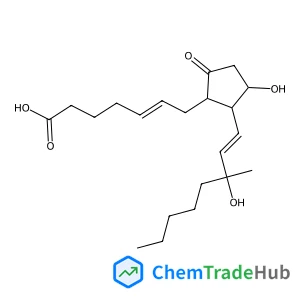
(5Z,11alpha,13E,15R)-11,15-Dihydroxy-15-methyl-9-oxoprosta-5,13-dien-1-oic acid
CAS Number:
55028-70-1
Molecular Formula:
C21H34O5
Miguel A. Salvadó, Pilar Pertierra, J. Manuel Recio
To advance in the understanding of the Earth's carbon cycle, it is necessary to determine thermodynamic boundaries and kinetic barriers associated with the pressure-induced polymorphic sequence of alkaline-earth carbonates. Following a symmetry-based strategy within the martensitic approximation, we propose a two-step mechanism mediated by a hexagonal P63/mmc structure for the aragonite to post-aragonite transformation in the MCO3 (M = Ca, Sr, Ba) crystal family. The calculated transition pressures and activation energies, from ∼7 to 42 GPa and ∼0.3 to 0.6 eV, respectively, are low enough to allow this transformation to occur under mantle conditions. Our analysis reveals that the intermediate hexagonal structure is the early one proposed by Holl et al., Phys. Chem. Miner., 2000, 27, 467–473 for high pressure BaCO3, and later considered as metastable. Phonon calculations inform that this P63/mmc structure is in fact unstable at zero pressure. Remarkably, our molecular dynamics calculations showed that this instability smoothly leads to a dynamically stable P63mc structure, which we confirm is actually the phase observed by Holl et al. This finding allows us to reconcile previous controversial data and contributes to clarifying the role of carbonates in the Earth's interior.
J. Karel, F. Bernardi, C. Wang, R. Stinshoff, N.-O. Born, S. Ouardi, U. Burkhardt, G. H. Fecher, C. Felser
DOI: 10.1039/C5CP04944J
Helgi Rafn Hróðmarsson, Ágúst Kvaran
DOI: 10.1039/C5CP06185G
Robert Pendrill, Olof Engström, Andrea Volpato, Mirco Zerbetto, Antonino Polimeno, Göran Widmalm
DOI: 10.1039/C5CP06288H
Hèctor Prats, Pablo Gamallo, Ramón Sayós, Francesc Illas
DOI: 10.1039/C5CP06863K
Dorian S. N. Parker, Ralf I. Kaiser, Oleg Kostko, Tyler P. Troy, Musahid Ahmed, Bing-Jian Sun, Shih-Hua Chen, A. H. H. Chang
DOI: 10.1039/C5CP02960K
Harald Ceymann, Moritz Balkenhohl, Alexander Schmiedel, Marco Holzapfel, Christoph Lambert
DOI: 10.1039/C5CP06917C
Keitel Cervantes-Salguero, Waka Nakanishi, Ibuki Kawamata, Kosuke Minami, Hirokazu Komatsu, Satoshi Murata
DOI: 10.1039/C5CP05765E
Szilvia Nagy, János Pipek
DOI: 10.1039/C5CP01214G
Stefan Ralser, Alexander Kaiser, Michael Probst, Johannes Postler, Michael Renzler, Diethard K. Bohme, Paul Scheier
DOI: 10.1039/C5CP06587A
Zheng-Hua Tan, Rui Yang, Kazuya Terabe, Xue-Bing Yin, Xin Guo
DOI: 10.1039/C5CP06484H
When handling 2-Methyl-2-propanyl 5-amino-2-thiophenecarboxylate (CAS: 1498311-5...
5-Bromo-1,2-dichloro-3-fluorobenzene (CAS: 1000572-93-9) is a crystalline solid ...
(2R)-2-Amino-2-(4-bromophenyl)ethanol (CAS: 354153-64-3) should be stored in a c...
Methyl 4-(aminomethyl)tetrahydro-2H-pyran-4-carboxylate hydrochloride (CAS: 3627...
1,4-Dimethyl-1H-pyrazole-5-sulfonyl chloride is primarily used as an intermediat...
Dinaphtho[1,2-b:2',1'-d]furan is generally safe when handled with appropriate pe...
The market for 7-Methyl-7,9-dihydro-1H-purine-2,6,8(3H)-trione (CAS: 612-37-3) i...
2-(4-Chlorophenyl)malonaldehyde (CAS: 205676-17-1) is a colorless or light yello...
2-Methylchrysene (CAS: 3351-32-4) is typically synthesized via the reaction of c...
N-(6-aminopyrimidin-4-yl)acetamide (CAS: 89533-23-3) is generally considered saf...

Physical Chemistry Chemical Physics (PCCP) is an international journal co-owned by 19 physical chemistry and physics societies from around the world. This journal publishes original, cutting-edge research in physical chemistry, chemical physics and biophysical chemistry. To be suitable for publication in PCCP, articles must include significant innovation and/or insight into physical chemistry; this is the most important criterion that reviewers and Editors will judge against when evaluating submissions. The journal has a broad scope and welcomes contributions spanning experiment, theory, computation and data science. Topical coverage includes spectroscopy, dynamics, kinetics, statistical mechanics, thermodynamics, electrochemistry, catalysis, surface science, quantum mechanics, quantum computing and machine learning. Interdisciplinary research areas such as polymers and soft matter, materials, nanoscience, energy, surfaces/interfaces, and biophysical chemistry are welcomed if they demonstrate significant innovation and/or insight into physical chemistry. Joined experimental/theoretical studies are particularly appreciated when complementary and based on up-to-date approaches.
![methyl 6-amino-1H-pyrrolo[2,3-b]pyridine-4-carboxylate structure](https://static.chemtradehub.com/structs/119/1190315-60-6-9d9a.webp "methyl 6-amino-1H-pyrrolo[2,3-b]pyridine-4-carboxylate structure")
![1-{[5-(4,4,5,5-Tetramethyl-1,3,2-dioxaborolan-2-yl)-2-thienyl]methyl}piperidine structure](https://static.chemtradehub.com/structs/121/1218790-44-3-baef.webp "1-{[5-(4,4,5,5-Tetramethyl-1,3,2-dioxaborolan-2-yl)-2-thienyl]methyl}piperidine structure")