


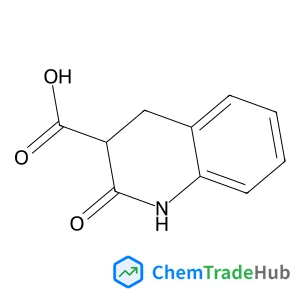
2-Oxo-1,2,3,4-tetrahydro-3-quinolinecarboxylic acid
CAS Number:
246867-17-4
Molecular Formula:
C10H9NO3
Aurelia A. Moses, Christopher Arntsen
Development of efficient anhydrous proton-conducting materials would expand the operational temperature ranges of hydrogen fuels cells (HFCs) and eliminate their dependence on maintaining sufficient hydration levels to function efficiently. Protic ionic liquids (PILs), which have high ionic densities and low vapor pressures, have emerged as a potential material for proton conducting layers in HFCs. In this work, we investigate proton transport via the Grotthuss mechanism in 1-ethylimidazolium bis-(trifluoromethanesulfonyl)imide ([C2HIm][TFSI]) protic ionic liquids with added imidazole (Im0) using ab initio molecular dynamics. In particular, we vary the composition of the systems studied from pure [C2HIm][TFSI] to those where the mole fraction of Im0 is 0.67. Given the large difference in pKa between C2HIm+ and HTFSI, TFSI− does not accept acidic protons from C2HIm+; conversely, imidazolium (HIm+) and C2HIm+ have very similar pKa values, and thus Im0 can readily accept protons. We find that the unprotonated nitrogen on Im0 dominates solvation of the labile protons on C2HIm+ and other Im0 species, resulting in formation of robust imidazole wires. Given the amphoteric nature of Im0, i.e. its ability to accept and donate protons, these wires provide conduits along which protons can rapidly traverse via the Grotthuss mechanism, thereby greatly increasing the proton coefficient of self-diffusion. We find that the average length of the wires increases with added Im0, and thus as the mole fraction of Im0 increases so too does the proton diffusion constant. Lastly, we analyze our trajectories to determine the energy and time scales associated with proton transfer.

Physical Chemistry Chemical Physics

Journal of Medical Biochemistry

Angewandte Chemie International Edition

Foundations of Chemistry

Mini-Reviews in Medicinal Chemistry

Photochemical & Photobiological Sciences

Advanced Engineering Materials

European Journal of Organic Chemistry

Faraday Discussions

CrystEngComm
Chunying Rong, Tian Lu, Paul Geerlings, Frank De Proft, Mercedes Alonso, Shubin Liu
DOI: 10.1039/C9CP06120G
J. T. A. Gilmour, N. Gaston
DOI: 10.1039/C9CP05933D
Andrés F. Marmolejo-Valencia, Zaahel Mata-Pinzón, Laura Dominguez, Carlos Amador-Bedolla
DOI: 10.1039/C9CP04041B
Mengyang Li, Zhibin Gao, Yanbo Han, Yaoxiao Zhao, Kun Yuan, Shigeru Nagase, Masahiro Ehara, Xiang Zhao
DOI: 10.1039/D0CP00167H
Ranajit Mondal, Madivala G. Basavaraj
DOI: 10.1039/C9CP03008E
Nickolas D. Charistos, Alvaro Muñoz-Castro
DOI: 10.1039/C9CP04223G
Hong-Ge Tan, Gang Xia, Li-Xiang Liu, Bing Miao
DOI: 10.1039/C9CP03819A
When handling 2-Methyl-2-propanyl 5-amino-2-thiophenecarboxylate (CAS: 1498311-5...
5-Bromo-1,2-dichloro-3-fluorobenzene (CAS: 1000572-93-9) is a crystalline solid ...
(2R)-2-Amino-2-(4-bromophenyl)ethanol (CAS: 354153-64-3) should be stored in a c...
Methyl 4-(aminomethyl)tetrahydro-2H-pyran-4-carboxylate hydrochloride (CAS: 3627...
1,4-Dimethyl-1H-pyrazole-5-sulfonyl chloride is primarily used as an intermediat...
Dinaphtho[1,2-b:2',1'-d]furan is generally safe when handled with appropriate pe...
The market for 7-Methyl-7,9-dihydro-1H-purine-2,6,8(3H)-trione (CAS: 612-37-3) i...
2-(4-Chlorophenyl)malonaldehyde (CAS: 205676-17-1) is a colorless or light yello...
2-Methylchrysene (CAS: 3351-32-4) is typically synthesized via the reaction of c...
N-(6-aminopyrimidin-4-yl)acetamide (CAS: 89533-23-3) is generally considered saf...
Physical Chemistry Chemical Physics (PCCP) is an international journal co-owned by 19 physical chemistry and physics societies from around the world. This journal publishes original, cutting-edge research in physical chemistry, chemical physics and biophysical chemistry. To be suitable for publication in PCCP, articles must include significant innovation and/or insight into physical chemistry; this is the most important criterion that reviewers and Editors will judge against when evaluating submissions. The journal has a broad scope and welcomes contributions spanning experiment, theory, computation and data science. Topical coverage includes spectroscopy, dynamics, kinetics, statistical mechanics, thermodynamics, electrochemistry, catalysis, surface science, quantum mechanics, quantum computing and machine learning. Interdisciplinary research areas such as polymers and soft matter, materials, nanoscience, energy, surfaces/interfaces, and biophysical chemistry are welcomed if they demonstrate significant innovation and/or insight into physical chemistry. Joined experimental/theoretical studies are particularly appreciated when complementary and based on up-to-date approaches.
![4-Chloro-N-{[4-(dimethylamino)phenyl]carbamoyl}benzenesulfonamide structure](https://static.chemtradehub.com/structs/558/5581-42-0-7dcb.webp "4-Chloro-N-{[4-(dimethylamino)phenyl]carbamoyl}benzenesulfonamide structure")
![2,5-Dichloro-1H-pyrrolo[3,2-b]pyridine structure](https://static.chemtradehub.com/structs/100/1000342-87-9-f632.webp "2,5-Dichloro-1H-pyrrolo[3,2-b]pyridine structure")





