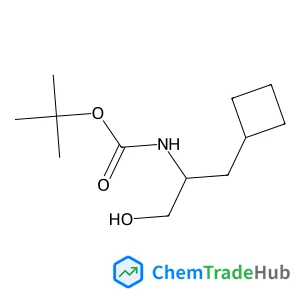
2-Methyl-2-propanyl (1-cyclobutyl-3-hydroxy-2-propanyl)carbamate
CAS Number:
816429-99-9
Molecular Formula:
C12H23NO3
Daniël B. Rap, Sandra Brünken, Anouk M. Rijs
Infrared signatures of polycyclic aromatic hydrocarbons (PAHs) are detected towards many phases of stellar evolution. PAHs are major players in the carbon chemistry of the interstellar medium, forming the connection between small hydrocarbons and large fullerenes. However, as details on the formation of PAHs in these environments are still unclear, modeling their abundance and chemistry has remained far from trivial. By combining molecular beam mass-selective IR spectroscopy and calculated IR spectra, we analyze the discharge of benzene and identify resulting products including larger PAHs, radicals and intermediates that serve as promising candidates for radio astronomical searches. The identification of various reaction products indicates that different gas-phase reaction mechanisms leading to PAH growth must occur under the same conditions to account for all observed PAH-related species, thereby revealing the complex and interconnected network of PAH formation pathways. The results of this study highlight key (exothermic) reactions that need to be included in astrochemical models describing the carbon chemistry in our universe.
Mamoru Fujitsuka, Sachiko Tojo, Teruo Shinmyozu, Tetsuro Majima
DOI: 10.1039/B810122A
Yan-Song Zheng, Shu-Yun Ran, Yu-Jian Hu, Xian-Xian Liu
DOI: 10.1039/B817974C
Serena Silvi, Edwin C. Constable, Catherine E. Housecroft, Jonathon E. Beves, Emma L. Dunphy, Massimiliano Tomasulo, Françisco M. Raymo, Alberto Credi
DOI: 10.1039/B900712A
A. Prasanna de Silva, Catherine M. Dobbin, Thomas P. Vance
DOI: 10.1039/B822181B
Ritu Kataky, Paula Lopes
DOI: 10.1039/B822685G
Cong Yu, Vivian Wing-Wah Yam
DOI: 10.1039/B820397K
Xianbing Ke, Hao Hu, Keda Zhang, Wenjin Xu, Qifeng Zhu, Lamei Wu, Xianming Hu
DOI: 10.1039/B817910G
Na Tian, Zhi-You Zhou, Shi-Gang Sun
DOI: 10.1039/B819751B
Hideyuki Otsuka, Takatoshi Muta, Masahide Sakada, Takeshi Maeda, Atsushi Takahara
DOI: 10.1039/B818014H
When handling 2-Methyl-2-propanyl 5-amino-2-thiophenecarboxylate (CAS: 1498311-5...
5-Bromo-1,2-dichloro-3-fluorobenzene (CAS: 1000572-93-9) is a crystalline solid ...
(2R)-2-Amino-2-(4-bromophenyl)ethanol (CAS: 354153-64-3) should be stored in a c...
Methyl 4-(aminomethyl)tetrahydro-2H-pyran-4-carboxylate hydrochloride (CAS: 3627...
1,4-Dimethyl-1H-pyrazole-5-sulfonyl chloride is primarily used as an intermediat...
Dinaphtho[1,2-b:2',1'-d]furan is generally safe when handled with appropriate pe...
The market for 7-Methyl-7,9-dihydro-1H-purine-2,6,8(3H)-trione (CAS: 612-37-3) i...
2-(4-Chlorophenyl)malonaldehyde (CAS: 205676-17-1) is a colorless or light yello...
2-Methylchrysene (CAS: 3351-32-4) is typically synthesized via the reaction of c...
N-(6-aminopyrimidin-4-yl)acetamide (CAS: 89533-23-3) is generally considered saf...

Physical Chemistry Chemical Physics (PCCP) is an international journal co-owned by 19 physical chemistry and physics societies from around the world. This journal publishes original, cutting-edge research in physical chemistry, chemical physics and biophysical chemistry. To be suitable for publication in PCCP, articles must include significant innovation and/or insight into physical chemistry; this is the most important criterion that reviewers and Editors will judge against when evaluating submissions. The journal has a broad scope and welcomes contributions spanning experiment, theory, computation and data science. Topical coverage includes spectroscopy, dynamics, kinetics, statistical mechanics, thermodynamics, electrochemistry, catalysis, surface science, quantum mechanics, quantum computing and machine learning. Interdisciplinary research areas such as polymers and soft matter, materials, nanoscience, energy, surfaces/interfaces, and biophysical chemistry are welcomed if they demonstrate significant innovation and/or insight into physical chemistry. Joined experimental/theoretical studies are particularly appreciated when complementary and based on up-to-date approaches.
![methyl 6-amino-1H-pyrrolo[2,3-b]pyridine-4-carboxylate structure](https://static.chemtradehub.com/structs/119/1190315-60-6-9d9a.webp "methyl 6-amino-1H-pyrrolo[2,3-b]pyridine-4-carboxylate structure")