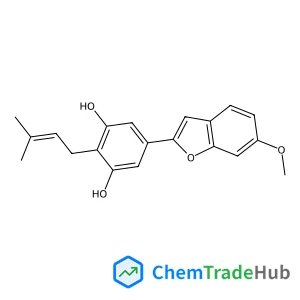
5-(6-Methoxy-1-benzofuran-2-yl)-2-(3-methyl-2-buten-1-yl)-1,3-benzenediol
CAS Number:
1017277-40-5
Molecular Formula:
C20H20O4
Xi-Yang Yu
Isotope substitution, a fascinating tool of physical chemistry, has been broadly applied in the research field of heterogeneous catalysis. In general, due to the differences in the mass-related atomic vibrational frequencies and zero-point energy of isotopic molecules, the apparent isotope effect (AIE) or observed kinetic isotope effect (observed KIE) from isotope substitution examination could provide unique knowledge regarding the reaction rate and mechanism of a catalytic reaction, such as the rate-determining step, key reaction intermediate, or catalyst design and synthesis. However, the treatment of the AIE is not as straightforward as the isotopic switch experiment, and needs sufficient care and comprehensive identification to deal with the influences from the equilibrium isotope effects (EIEs) of quasi-equilibrium elementary steps, kinetic isotope effect (KIE) of the pseudo rate-determining step, transition states, intrinsic reaction barriers, etc. Fundamentally, the key factors affecting the AIE could be the partition function part and the zero-point energy part of each single elementary step. Theoretically, the classification of the KIE could be based on the quantity of KIE (including normal KIE and inverse KIE) or the molecular transformation (including primary KIE, secondary KIE, tunneling KIE, and solvent KIE) involved. This article presents a recap of the fundamental concepts and relations of KIE, EIE and AIE, and a concise review on the selected applications of isotope effects throughout heterogeneous catalysis. Lastly, the meaningful perspectives regarding the critical factors that impact the AIE and the appropriate treatment of the AIE are discussed meticulously.
Neil M. Boag, K. Mohan Rao
DOI: 10.1039/B818537A
Andrew Mills, Kate McDiarmid, Michael McFarlane, Pauline Grosshans
DOI: 10.1039/B900569B
Suzanne E. Howson, Laura E. N. Allan, Nikola P. Chmel, Guy J. Clarkson, Remy van Gorkum, Peter Scott
DOI: 10.1039/B821573A
Piotr Michal Diakowski, Heinz-Bernhard Kraatz
DOI: 10.1039/B819876D
Kristopher A. Kilian, Till Böcking, J. Justin Gooding
DOI: 10.1039/B815449J
Karolina Kasperkiewicz, Jan-Willem G. Bos, Andrew N. Fitch, Kosmas Prassides, Serena Margadonna
DOI: 10.1039/B815830D
A. Prasanna de Silva, Catherine M. Dobbin, Thomas P. Vance
DOI: 10.1039/B822181B
Xin-Long Wang, Chao Qin, Ya-Qian Lan, Kui-Zhan Shao, Zhong-Min Su, En-Bo Wang
DOI: 10.1039/B815629H
Kyung-Chang Seo, Young-Geol Kwon, Dae-Hee Kim, In-Sook Jang, Jin-Won Cho, Sung-Kee Chung
DOI: 10.1039/B821058F
When handling 2-Methyl-2-propanyl 5-amino-2-thiophenecarboxylate (CAS: 1498311-5...
5-Bromo-1,2-dichloro-3-fluorobenzene (CAS: 1000572-93-9) is a crystalline solid ...
(2R)-2-Amino-2-(4-bromophenyl)ethanol (CAS: 354153-64-3) should be stored in a c...
Methyl 4-(aminomethyl)tetrahydro-2H-pyran-4-carboxylate hydrochloride (CAS: 3627...
1,4-Dimethyl-1H-pyrazole-5-sulfonyl chloride is primarily used as an intermediat...
Dinaphtho[1,2-b:2',1'-d]furan is generally safe when handled with appropriate pe...
The market for 7-Methyl-7,9-dihydro-1H-purine-2,6,8(3H)-trione (CAS: 612-37-3) i...
2-(4-Chlorophenyl)malonaldehyde (CAS: 205676-17-1) is a colorless or light yello...
2-Methylchrysene (CAS: 3351-32-4) is typically synthesized via the reaction of c...
N-(6-aminopyrimidin-4-yl)acetamide (CAS: 89533-23-3) is generally considered saf...

Physical Chemistry Chemical Physics (PCCP) is an international journal co-owned by 19 physical chemistry and physics societies from around the world. This journal publishes original, cutting-edge research in physical chemistry, chemical physics and biophysical chemistry. To be suitable for publication in PCCP, articles must include significant innovation and/or insight into physical chemistry; this is the most important criterion that reviewers and Editors will judge against when evaluating submissions. The journal has a broad scope and welcomes contributions spanning experiment, theory, computation and data science. Topical coverage includes spectroscopy, dynamics, kinetics, statistical mechanics, thermodynamics, electrochemistry, catalysis, surface science, quantum mechanics, quantum computing and machine learning. Interdisciplinary research areas such as polymers and soft matter, materials, nanoscience, energy, surfaces/interfaces, and biophysical chemistry are welcomed if they demonstrate significant innovation and/or insight into physical chemistry. Joined experimental/theoretical studies are particularly appreciated when complementary and based on up-to-date approaches.