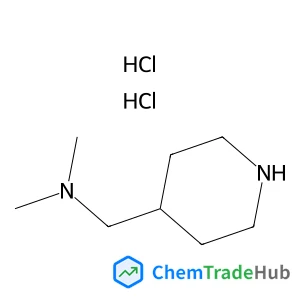
N,N-dimethyl(piperidin-4-yl)methanamine hydrochloride
CAS Number:
172281-72-0
Molecular Formula:
C8H20Cl2N2
Weiqiao Huang, Changgeng Wei
The Ni–Mo catalyst has attracted significant attention due to its excellent coke-resistance in dry reforming of methane (DRM) reaction, but its detailed mechanism is still vague. Herein, Mo-doped Ni (Ni–Mox) and MoOx adsorbed Ni surfaces (MoOx@Ni) are employed to explore the DRM reaction mechanism and the effect of coke-resistance. Due to the electron donor effect of Mo, the antibonding states below the Fermi level between Ni and C increase and the adsorption of C decrease, thereby inhibiting the carbonization of Ni. On account of the strong Mo and O interaction, more O atoms gather around Mo, which inhibits the oxidation of Ni and may promote the formation of MoOx species on the Ni–Mo catalyst. The presence of Mo–O species promotes the carbon oxidation, forming a unique redox cycle (MoOx ↔ MoOx−1) similar to the Mars–van Krevelen (MvK) mechanism, explaining the excellent anti-carbon deposition effect on the Ni–Mo catalyst.

Science

Pure and Applied Chemistry

Russian Chemical Reviews

Journal of Medicinal Chemistry

Organic Preparations and Procedures International

European Journal of Wood and Wood Products

Planta Medica

Israel Journal of Chemistry

Journal of Catalysis

Proceedings of the National Academy of Sciences of the United States of America
Edison Salazar, Suzanne Reinink, Shirin Faraji
DOI: 10.1039/D2CP00550F
Stuart W. Crane, Michael N. R. Ashfold
DOI: 10.1039/D2CP90143A
Ritam Mansour, Saikat Mukherjee, Max Pinheiro, Jr., Jennifer A. Noble, Christophe Jouvet
DOI: 10.1039/D2CP01056A
Jingwen Jiang, Yiguo Xu, Xiuwen Zhang
DOI: 10.1039/D2CP02054H
Oihana Galparsoro, Pascal Larrégaray
DOI: 10.1039/D2CP01850K
Xialei Guo, Yuhua Hou, Xuan Chen, Ruyan Zhang, Wei Li, Xiaoma Tao, Youlin Huang
DOI: 10.1039/D2CP02730E
Louis Minion, Jason W. L. Lee, Michael Burt
DOI: 10.1039/D2CP01114J
Aleksandra Leszczyk, Paweł Tecmer, Dariusz Kedziera, Katharina Boguslawski
DOI: 10.1039/D2CP03377A
Yawei Gao, Ana Paula Clares, Adri. C. T. van Duin
DOI: 10.1039/D2CP00630H
Ethyl 4-chlorothieno[2,3-b]pyridine-5-carboxylate (CAS: 59713-58-5) can be synth...
5-Methyl-1H-indole-3-carbaldehyde (CAS: 52562-50-2) is subject to various regula...
(1,3-Dimethyl-2,4-dioxo-1,2,3,4-tetrahydro-5-pyrimidinyl)boronic acid is a white...
Waste containing Sulfocostunolide A (CAS: 1016983-51-9) should be handled with c...
When handling Murraxocin (CAS: 88478-44-8), ensure proper personal protective eq...
Formvar (CAS: 63148-64-1) is an alkyd resin characterized by a high molecular we...
(S)-4-benzyl-2-((benzyloxy)methyl)morpholine is generally safe when handled with...
Methyl 1-(5-bromo-2-pyrimidinyl)cyclopropanecarboxylate (CAS: 1447607-69-3) is p...
2-Methyl-1-phenyl-1-propanamine hydrochloride (CAS: 24290-47-9) is generally con...
3-(4-Bromophenyl)-2-methylpropanoic acid is synthesized through a multi-step pro...

Physical Chemistry Chemical Physics (PCCP) is an international journal co-owned by 19 physical chemistry and physics societies from around the world. This journal publishes original, cutting-edge research in physical chemistry, chemical physics and biophysical chemistry. To be suitable for publication in PCCP, articles must include significant innovation and/or insight into physical chemistry; this is the most important criterion that reviewers and Editors will judge against when evaluating submissions. The journal has a broad scope and welcomes contributions spanning experiment, theory, computation and data science. Topical coverage includes spectroscopy, dynamics, kinetics, statistical mechanics, thermodynamics, electrochemistry, catalysis, surface science, quantum mechanics, quantum computing and machine learning. Interdisciplinary research areas such as polymers and soft matter, materials, nanoscience, energy, surfaces/interfaces, and biophysical chemistry are welcomed if they demonstrate significant innovation and/or insight into physical chemistry. Joined experimental/theoretical studies are particularly appreciated when complementary and based on up-to-date approaches.