












Surface plasmon resonance detection of UV irradiation-induced DNA damage and photoenzymatic repair processes through specific interaction between consensus double-stranded DNA and p53 protein
Literature Information
Publication Date
2022-12-26
DOI
10.1039/D2AN01847K
Impact Factor
4.616
Authors
Yuhan He, Sijia Chen, Guoyang Xie, Xinyao Yi, Jianxiu Wang
View Original
Abstract
DNA damage, such as DNA lesions and strand breaks, impairs normal cell functions and failure in the DNA repair process could lead to gene mutation, cell apoptosis and disease occurrence. p53 is a tumor suppressor and DNA-binding protein, and DNA damage might affect their interaction and the subsequent p53 function. Herein, real-time monitoring of DNA damage and repair processes through DNA–p53 protein interaction was performed by surface plasmon resonance (SPR). The target DNA with consecutive pyrimidine nucleobases was first damaged upon UVC (254 nm) irradiation and then photoenzymatically repaired under UVA (365 nm) irradiation. The as-formed double-stranded (ds) DNA between probe DNA and normal, damaged or repaired target DNA was immobilized on the sensor chips, followed by the injection of p53 protein. By measuring the SPR signals under different cases, the DNA damage and repair processes could be conveniently monitored. The SPR signals were inversely proportional to the UVC doses ranging from 0.021 to 1.26 kJ m−2, providing a viable means for the quantification of the DNA damage level. The binding affinity between p53 and the dsDNA formed upon the hybridization of probe DNA and normal, damaged, or photoenzymatically repaired target DNA was estimated. This is the first report on measuring the equilibrium dissociation constant (KD) between the p53 protein and the dsDNA with photodamaged or repaired target sequences. The sensing strategy by SPR thus opens a new avenue for real-time measurement of the DNA damage and the repair processes.
Recommended Journals
Related Literature
Using differential mobility spectrometry to measure ion solvation: an examination of the roles of solvents and ionic structures in separating quinoline-based drugs
Chang Liu, J. C. Yves Le Blanc, Jefry Shields, John S. Janiszewski, Christian Ieritano, Gene F. Ye, Gillian F. Hawes, W. Scott Hopkins, J. Larry Campbell
2015-07-03
Paper
DOI: 10.1039/C5AN00842E
A peroxidase-active aptazyme as an isothermally amplifiable label in an aptazyme-linked oligonucleotide assay for low-picomolar IgE detection
Jeroen Pollet, Ulrich Strych
2012-10-23
Communication
DOI: 10.1039/C2AN36201E
Methylation-blocked enzymatic recycling amplification for highly sensitive fluorescence sensing of DNA methyltransferase activity
Feng Chen, Yongxi Zhao
2012-10-19
Paper
DOI: 10.1039/C2AN36329A
Terbium(iii)/gold nanocluster conjugates: the development of a novel ratiometric fluorescent probe for mercury(ii) and a paper-based visual sensor
Yan-Xia Qi, Min Zhang, Anwei Zhu, Guoyue Shi
2015-06-12
Paper
DOI: 10.1039/C5AN00802F
Controlled growth of polyhedral and plate-like Ag nanocrystals on a nanofiber mat as a SERS substrate
2015-05-15
Paper
DOI: 10.1039/C5AN00305A
Determination of metal ion concentrations by SERS using 2,2′-bipyridyl complexes
Julie Docherty, Samuel Mabbott, W. Ewen Smith, John Reglinski, Karen Faulds, Christine Davidson, Duncan Graham
2015-08-21
Paper
DOI: 10.1039/C5AN01525A
Illustration of SID-IM-SID (surface-induced dissociation-ion mobility-SID) mass spectrometry: homo and hetero model protein complexes
Royston S. Quintyn, Vicki H. Wysocki
2015-08-27
Paper
DOI: 10.1039/C5AN01095K
You might also like
Compound Q&A
What are the main uses of 4-Nitrophenyl phosphate disodium salt hexahydrate (CAS: 333338-18-4)?
4-Nitrophenyl phosphate disodium salt hexahydrate is primarily used as a substra...
333338-18-44-Nitrophenyl phosph...
Compound Q&A
What are the main uses of 2-(Trifluoromethyl)-1,3-oxazole-4-carboxylic Acid (CAS: 1060816-01-4)?
2-(Trifluoromethyl)-1,3-oxazole-4-carboxylic Acid (CAS: 1060816-01-4) is widely ...
1060816-01-42-(Trifluoromethyl)-...
Compound Q&A
How should 2-Fluoro-4-biphenylcarboxylic acid (CAS: 137045-30-8) be stored?
2-Fluoro-4-biphenylcarboxylic acid should be stored in a cool, dry place at room...
137045-30-82-Fluoro-4-biphenylc...
Compound Q&A
What industries use Prednisolone-21-Carboxylic Acid (CAS: 61549-70-0)?
Prednisolone-21-Carboxylic Acid is primarily used in the pharmaceutical industry...
61549-70-0Prednisolone-21-Carb...
Compound Q&A
How should 4-(Hydrazinomethyl)-1,2,3-benzenetriol (CAS: 3614-72-0) be stored?
4-(Hydrazinomethyl)-1,2,3-benzenetriol (CAS: 3614-72-0) should be stored in a co...
3614-72-04-(Hydrazinomethyl)-...
Compound Q&A
What industries use 4-Amino-1-methyl-1H-pyrazole-5-carboxylic acid hydrochloride (CAS: 92534-70-8)?
4-Amino-1-methyl-1H-pyrazole-5-carboxylic acid hydrochloride (CAS: 92534-70-8) i...
92534-70-84-Amino-1-methyl-1H-...
Compound Q&A
What regulatory guidelines apply to dehydropachymic acid (CAS: 77012-31-8)?
Dehydropachymic acid (CAS: 77012-31-8) is regulated by various agencies. It fall...
77012-31-8Dehydropachymic acid
Compound Q&A
What is the market or research trend for 6-[(2,2-Dimethylpropanoyl)amino]nicotinic acid (CAS: 898561-66-5)?
The market and research trends for 6-[(2,2-Dimethylpropanoyl)amino]nicotinic aci...
898561-66-56-[(2,2-Dimethylprop...
Compound Q&A
How should 1,10-Phenanthroline-2,9-dicarbaldehyde (CAS: 57709-62-3) be stored?
1,10-Phenanthroline-2,9-dicarbaldehyde should be stored in a cool, dry place awa...
57709-62-31,10-Phenanthroline-...
Compound Q&A
How is 5-Carbamoyl-11-oxo-10,11-dihydro-5H-dibenzo[b,f]azepin-10-yl acetate (CAS: 113952-21-9) typically synthesized?
5-Carbamoyl-11-oxo-10,11-dihydro-5H-dibenzo[b,f]azepin-10-yl acetate can be synt...
113952-21-95-Carbamoyl-11-oxo-1...
Source Journal
Analyst

CiteScore:
7.8
Self-citation Rate:
5.6%
Articles per Year:
653
Analyst publishes analytical and bioanalytical research that reports premier fundamental discoveries and inventions, and the applications of those discoveries, unconfined by traditional discipline barriers.
Recommended Compounds
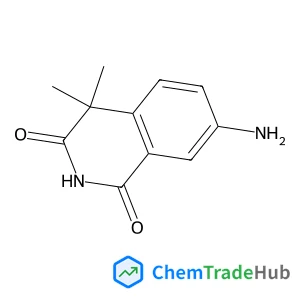
1,3(2H,4H)-Isoquinolinedione, 7-amino-4,4-dimethyl-
CAS Number:
14576-22-8
Molecular Formula:
C11H12N2O2
Recommended Suppliers






Disclaimer
This page provides academic journal information for reference and research purposes only. We are not affiliated with any journal publishers and do not handle publication submissions. For publication-related inquiries, please contact the respective journal publishers directly.
If you notice any inaccuracies in the information displayed, please contact us at support@chemtradehub.com. We will promptly review and address your concerns.