













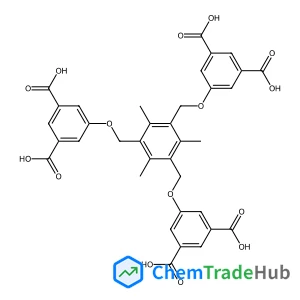
5,5',5''-(((2,4,6-Trimethylbenzene-1,3,5-triyl)tris(methylene))tris(oxy))triisophthalic acid
CAS Number:
1159974-70-5
Molecular Formula:
C36H30O15
Yang Ding, Kai Feng, Panpan He, Ning Liu, Liang Hao, Jiang Gong, Ran Niu
Solar evaporation is considered as a promising approach for harvesting freshwater from non-potable water utilizing sustainable solar energy. Integrating the photocatalytic effect into solar vapor generation is beneficial for the substantial augmentation of solar energy utilization for freshwater production and dealing with polluted water when it is used as source water. In this work, a synergistic photothermal–photochemical hybrid membrane is prepared by facilely dip-coating three-dimensional porous carbon nitride (CN) and a two-dimensional MXene on non-woven cotton cloth. The obtained hybrid membrane possesses high light absorption in the whole solar spectrum, a decreased band gap, excellent photothermal conversion accompanied by a reduced non-radiative reflection loss, and enlarged photocurrent by forming a Schottky junction between the MXene and CN under simulated solar light. With the combined merits above, the hybrid membrane shows excellent photocatalytic performance and solar steam generation. Typically, the hybrid membrane degrades 95% Rhodamine B, 92% crystal violet and 72% methyl orange at 3 mg L−1 under 1 kW m−2 irradiation within 60 min. The water evaporation rate is up to 2.30 kg m−2 h−1 with a solar-to-vapor conversion efficiency of 98.9% under one-sun irradiation. Significantly, a large-scale solar conversion device is constructed for outdoor experiments to simultaneously harvest freshwater from contaminated water and degrade organic dyes in source water. The daily freshwater production rate is 5.7 kg m−2, meeting the requirement of two adults. This work demonstrates the promising potential of the hybrid membrane for potable water production and contaminated water treatment within one device and opens an avenue for application in energy conversion and storage.
Mårten Ahlquist, Giancarlo Fabrizi, Sandro Cacchi, Per-Ola Norrby
DOI: 10.1039/B507784B
Chunling Fu, Jing Li
DOI: 10.1039/B508069J
Charng-Sheng Tsai, Ting-Bin Yu, Chao-Tsen Chen
DOI: 10.1039/B507237A
Gaku Fukuhara, Tadashi Mori
DOI: 10.1039/B504948B
Christian J. Baylies, John C. Jeffery, Tom A. Miller, Ryan Moon, Craig R. Rice, T. Riis-Johannessen
DOI: 10.1039/B506199G
Liangru Yang, Alex von Zelewsky, Helen Stoeckli-Evans
DOI: 10.1039/B507769A
Andrea Deák, Gábor Tárkányi
DOI: 10.1039/B506728F
Kazunori Nakashima, Tatsuo Maruyama, Noriho Kamiya, Masahiro Goto
DOI: 10.1039/B505479F
Waste containing N-Methoxy-N-methyl-1,3-thiazole-5-carboxamide (CAS: 898825-89-3...
N-(4-Biphenylyl)dibenzo[b,d]furan-4-amine should be stored in a tightly sealed c...
The market for 3-Acetamido-5-amino-2,4,6-triiodobenzoic acid (CAS: 1713-07-1) is...
Benzyl 2-O-acetyl-3,4,6-tri-O-benzyl-beta-D-galactopyranoside (CAS: 61820-03-9) ...
2-Ethylpiperazine dihydrochloride (CAS: 438050-52-3) is regulated under the Glob...
1,1'-[1,3-Phenylenebis(methylene)]bis(3-methyl-1H-pyrrole-2,5-dione) (CAS: 11946...
Several alternatives can be used in the synthesis of 5-Fluoro-2-(1-pyrrolidinyl)...
Proper personal protective equipment (PPE) must be worn when handling this compo...
When handling 6-Bromoimidazo[1,2-a]pyridin-8-amine, it is important to wear appr...
Alternatives to (2S,4R)-4-(4-Nitrobenzyl)pyrrolidine-2-carboxylic acid hydrochlo...
![4-[(2-{2-[2-(2-Aminoethoxy)ethoxy]ethoxy}ethyl)amino]-2-(2,6-dioxo-3-piperidinyl)-1H-isoindole-1,3(2H)-dione structure](https://static.chemtradehub.com/structs/209/2093416-31-8-3162.webp "4-[(2-{2-[2-(2-Aminoethoxy)ethoxy]ethoxy}ethyl)amino]-2-(2,6-dioxo-3-piperidinyl)-1H-isoindole-1,3(2H)-dione structure")
![[5-fluoro-2-(morpholine-4-carbonyl)phenyl]boronic acid structure](https://static.chemtradehub.com/structs/121/1217501-26-2-505c.webp "[5-fluoro-2-(morpholine-4-carbonyl)phenyl]boronic acid structure")
![2-Methylbenzo[h]quinoline structure](https://static.chemtradehub.com/structs/605/605-88-9-ac43.webp "2-Methylbenzo[h]quinoline structure")


