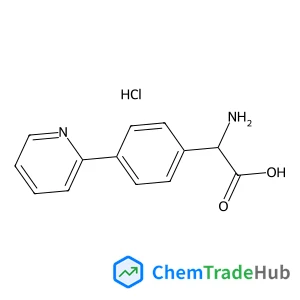
2-Amino-2-(4-(pyridin-2-YL)phenyl)acetic acid hydrochloride
CAS Number:
1135818-89-1
Molecular Formula:
C13H13ClN2O2
Sachin R. Rondiya, Shyamal Shegokar, Lakshmana Kumar Bommineedi, Russell W. Cross, Nelson Y. Dzade, Babasaheb R. Sankapal
Enhancing energy storing capability with the aid of unique nanostructured morphologies is beneficial for the development of high performance supercapacitors. Developing earth abundant and low-cost transition metal selenides (TMSs) with enhanced charge transfer capabilities and good stability is still a challenge. Herein, state of the art for iron selenide with a nanoflake surface architecture, synthesized with the aid of a simple, industry-scalable and ionic layer controlled chemical approach, namely the successive ionic layer adsorption and reaction (SILAR) method, is presented. The iron selenide electrode yields a capacitance of 671.7 F g−1 at 2 mV s−1 scan rate and 434.6 F g−1 at 2 mA cm−2 current density through cyclic voltammetry (CV) and galvanostatic charge–discharge (GCD) studies, respectively, with 91.9% cyclic retention at 4000 cycles. The developed bendable solid-state supercapacitor reveals a remarkable power density of 5.1 kW kg−1 with outstanding deformation tolerance, including its use in a practical demo to run a small fan, demonstrating its capability for advanced energy storage applications. A complementary first-principles density functional theory (DFT) approach is used in combination with the experimental supercapacitive performance to achieve an understanding of the electronic structure.
A. C. Legon, J. M. A. Thumwood
DOI: 10.1039/B100414J
Junnan He, Nan Zheng, Ming Li, YuBin Zheng, Wangze Song
DOI: 10.1039/D1PY00650A
László Biczók, Pierre Valat, Véronique Wintgens
DOI: 10.1039/B100692O
A. Bradford, P. L. Drake, O. Worsfold, I. R. Peterson, D. J. Walton, G. J. Price
DOI: 10.1039/B008894N
Mauricia Schettino, Rosana M. Romano, Alexander Yu. Makarov, Andrey V. Zibarev
DOI: 10.1039/B009433L
Jaroslaw Sadlo, Marek Danilczuk, Jacek Michalik
DOI: 10.1039/B008246P
DOI: 10.1039/A905655F
Andriy E. Yaroshchuk
DOI: 10.1039/B009186N
Uwe Langer, Christof Hoelger, Gerd Buntkowsky, Hans-Martin Vieth, Hans-Heinrich Limbach
DOI: 10.1039/B007564G
(3.beta.)-3-Hydroxy-N,N-dimethyl-chol-5-en-24-amide (CAS: 79066-03-8) is primari...
5-(Aminomethyl)-2-methoxyphenol (CAS: 89702-89-6) is classified under GHS as a s...
Thieno[2,3-c]pyridin-7(6H)-one (CAS: 28981-13-7) is a heterocyclic organic compo...
1-[(6-Methoxy-3-pyridinyl)methyl]-4-piperidinamine dihydrochloride is generally ...
[(2E)-3-Phenyl-2-propen-1-yl]phosphonic acid (CAS: 146404-58-2) is regulated und...
6-Bromo-7-methoxyquinoline (CAS: 1620515-86-7) falls under the scope of the Glob...
This compound is primarily used in the pharmaceutical industry for the developme...
1-Ethyl-7-[2-methyl-6-(4H-1,2,4-triazol-3-yl)-3-pyridinyl]-3,5-dihydropyrazino[2...
Alternative reagents such as 2-[(dimethylamino)methyl]phenylboronic acid or rela...
3-(Piperidin-4-yloxy)pyridine (CAS: 310881-48-2) is an organic compound with the...