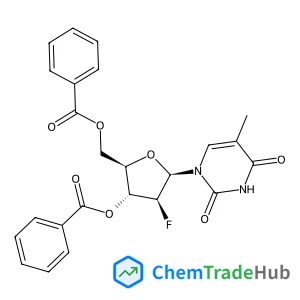
1-(3',5'-Di-O-benzoyl-2'-deoxy-2'-fluoro-b-D-arabinofuranosyl)thymine
CAS Number:
97614-47-6
Molecular Formula:
C24H21FN2O7
Picosecond infrared–visible sum-frequency generation (SFG) surface vibrational spectroscopy was applied for insitu monitoring of chemisorbed CO on a polycrystalline platinum foil at room temperature. The dependence of the SFG spectra on the CO gas-phase pressure was investigated in the range pCO=10-8–1000 mbar. From the measured SFG spectra, frequencies of the CO vibrationally resonant contribution were determined as a function of CO pressure. At low CO pressures (10-8–10 mbar) a single vibrational band with center frequency in the range 2091–2099 cm-1 was obtained which is characteristic of stretching vibrations of CO terminally adsorbed on Pt atoms of low-index (100)-, (110)- and (111)-type planes. At higher pressure (pCO50 mbar) the appearance of new “low-frequency’' CO surface species was observed which dominate the SFG spectra at CO pressures above 300 mbar. The low-frequency spectral feature was found to be completely reversible and reproducible with variation of the CO pressure. The pressure-dependent change in the SFG spectra suggests formation of Pt–(CO)2 platinum carbonyl binary complexes at surface structures resulting from a reversible CO adsorbate-induced displacive reconstruction of the Pt substrate at high CO pressures.
(3.beta.)-3-Hydroxy-N,N-dimethyl-chol-5-en-24-amide (CAS: 79066-03-8) is primari...
5-(Aminomethyl)-2-methoxyphenol (CAS: 89702-89-6) is classified under GHS as a s...
Thieno[2,3-c]pyridin-7(6H)-one (CAS: 28981-13-7) is a heterocyclic organic compo...
1-[(6-Methoxy-3-pyridinyl)methyl]-4-piperidinamine dihydrochloride is generally ...
[(2E)-3-Phenyl-2-propen-1-yl]phosphonic acid (CAS: 146404-58-2) is regulated und...
6-Bromo-7-methoxyquinoline (CAS: 1620515-86-7) falls under the scope of the Glob...
This compound is primarily used in the pharmaceutical industry for the developme...
1-Ethyl-7-[2-methyl-6-(4H-1,2,4-triazol-3-yl)-3-pyridinyl]-3,5-dihydropyrazino[2...
Alternative reagents such as 2-[(dimethylamino)methyl]phenylboronic acid or rela...
3-(Piperidin-4-yloxy)pyridine (CAS: 310881-48-2) is an organic compound with the...

Physical Chemistry Chemical Physics (PCCP) is an international journal co-owned by 19 physical chemistry and physics societies from around the world. This journal publishes original, cutting-edge research in physical chemistry, chemical physics and biophysical chemistry. To be suitable for publication in PCCP, articles must include significant innovation and/or insight into physical chemistry; this is the most important criterion that reviewers and Editors will judge against when evaluating submissions. The journal has a broad scope and welcomes contributions spanning experiment, theory, computation and data science. Topical coverage includes spectroscopy, dynamics, kinetics, statistical mechanics, thermodynamics, electrochemistry, catalysis, surface science, quantum mechanics, quantum computing and machine learning. Interdisciplinary research areas such as polymers and soft matter, materials, nanoscience, energy, surfaces/interfaces, and biophysical chemistry are welcomed if they demonstrate significant innovation and/or insight into physical chemistry. Joined experimental/theoretical studies are particularly appreciated when complementary and based on up-to-date approaches.