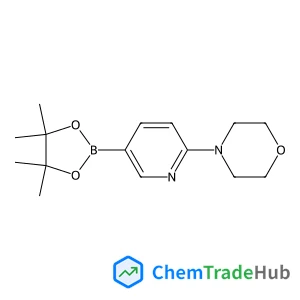
4-(5-(4,4,5,5-tetramethyl-1,3,2-dioxaborolan-2-yl)pyridin-2-yl)morpholine
CAS Number:
485799-04-0
Molecular Formula:
C15H23BN2O3
Kelsey N. Stewart, Dylan W. Domaille
Biocatalysis provides facile access to selective chemical transformations and helps satisfy sustainable chemical production criteria. However, the reaction scope of biocatalysts is significantly narrower compared to synthetic chemical transformations. Hybrid biocatalytic–chemocatalytic cascades expand the scope of products while maintaining many of the benefits associated with biocatalysis. Here, we report that single-pot systems with whole cell K. pastoris (ATCC® 28485™) or isolated enzyme alcohol oxidase (E.C. 1.1.3.13) as oxidative biocatalysts with a lysine organocatalyst yield the commercial target, 2-ethyl-2-hexenal (2-EH) from n-butanol in a two-step hybrid cascade. Peak yields for both biocatalysts were achieved with 100 mM n-butanol at pH 8 and 30 °C. The isolated enzyme slightly outperformed whole cell K. pastoris, reaching 73% conversion (4.7 g L−1 titers) compared to 61% (3.9 g L−1 titers) in whole cell systems. Titers could be improved for both biocatalysts (5.7–6.7 g L−1) at increased butanol loading; however, this came at the expense of decreased yields. Compared to our initial results with a Gluconobacter oxidans whole cell biocatalyst, the reported system improves upon 2-EH titers by 2.8–3.3-fold at maximal yields.
Chongshan Yin, Chunqing He, Qicheng Liu, Bangyun Xiong, Xiaowei Zhang, Libing Qian, Jingjing Li, Yawei Zhou
DOI: 10.1039/C9CP04832D
Wenhui Hu, Fan Yang, Nick Pietraszak, Jing Gu, Jier Huang
DOI: 10.1039/D0CP03995K
Alexander A. Kolganov, Ivan Yu. Chernyshov
DOI: 10.1039/D0CP04439C
João R. Robalo, Denilson Mendes de Oliveira, Petra Imhof, Dor Ben-Amotz, Ana Vila Verde
DOI: 10.1039/D0CP04205F
DOI: 10.1039/D0CP02470H
QHwan Kim, Joon-Hyuk Ko, Sunghoon Kim, Wonho Jhe
DOI: 10.1039/D0CP03456H
Amin Bakhshandeh, Derek Frydel, Yan Levin
DOI: 10.1039/D0CP03633A
Eduardo Martín Rico-Sotomayor, José Enrique Barquera-Lozada
DOI: 10.1039/D0CP03305G
Waste containing 2-Ethyl-4-Methyl-1H-Imidazole-5-Carbaldehyde (CAS: 88634-80-4) ...
Triethoxy(octyl)silane (CAS: 1385031-14-0) is widely used in the pharmaceuticals...
Several alternatives to 3-iodo-7-nitro-1H-indazole (CAS: 864724-64-1) exist in t...
Yes, there are alternatives to Benzene, bis[(trimethoxysilyl)ethyl] (CAS: 266317...
Isothiazole-3-carbonitrile (CAS: 1452-17-1) is generally considered safe when us...
(3-Chlorophenyl)methanol (CAS: 873-63-2) is considered low to moderately toxic. ...
(2S,3S)-2-Hydroxy-3-({[(2-methyl-2-propanyl)oxy]carbonyl}amino)-3-(2-naphthyl)pr...
Proper handling of methyl 2-(bromomethyl)-5-methoxybenzoate requires the use of ...
6,8-Dibromoimidazo[1,2-a]pyridine-2-carboxylic acid (CAS: 904805-36-3) is an aro...
3-Amino-5-bromo-2-pyridinecarbonitrile is considered safe when handled under pro...

Reaction Chemistry & Engineering is an interdisciplinary journal reporting cutting-edge research focused on enhancing the understanding and efficiency of reactions. Reaction engineering leverages the interface where fundamental molecular chemistry meets chemical engineering and technology. Challenges in chemistry can be overcome by the application of new technologies, while engineers may find improved solutions for process development from the latest developments in reaction chemistry. Reaction Chemistry & Engineering is a unique forum for researchers whose interests span the broad areas of chemical engineering and chemical sciences to come together in solving problems of importance to wider society. All papers should be written to be approachable by readers across the engineering and chemical sciences. Papers that consider multiple scales, from the laboratory up to and including plant scale, are particularly encouraged.