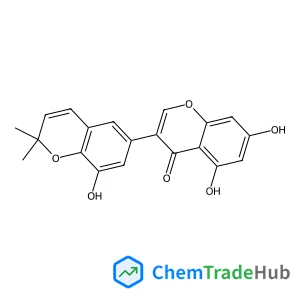
5,7,8'-Trihydroxy-2',2'-dimethyl-2'H,4H-3,6'-bichromen-4-one
CAS Number:
129280-33-7
Molecular Formula:
C20H16O6
Zhenzhou Ma, Bochong Chen, Liu Zhao, Enxian Yuan, Tingting Cui
In order to reveal the effects of molecular structure, the catalytic cracking of n-hexane, 1-hexene, cyclohexane and cyclohexene over HZSM-5 zeolites was carried out at 260–550 °C under an atmosphere. Particular attention was paid to the variation in the trends of the conversion and product distribution with the reaction temperature and time on stream (TOS). The fresh and spent HZSM-5 zeolites were studied by XRD, SEM, Py-IR, TPO, NH3-TPD and N2 physisorption. It was found that the catalytic activity was in descending order of 1-hexene > cyclohexene > n-hexane > cyclohexane, and the catalytic stability was in descending order of 1-hexene > n-hexane > cyclohexene > cyclohexane. n-Hexane benefited alkane formation, 1-hexene benefited alkene formation, while cyclohexane and cyclohexene benefited aromatic formation. Coke formation blocked the porous channels and reduced the acid sites of HZSM-5 zeolites, and C6 catalytic cracking exhibited a distinct response to increases in coke and TOS. Compared with n-hexane, the increase in coke formation significantly inhibited cyclohexane catalytic cracking. Although 1-hexene catalytic cracking achieved a similar amount of coke to cyclohexane, the conversion of 1-hexene remained unchanged with an increase in TOS, which was attributed to the high activity of the CC bond. Analogously, cyclohexene with high activity exhibited stable conversion with an increase in TOS. Interestingly, the coke was almost all generated at the beginning in cyclohexene catalytic cracking at 550 °C and selectivity for everything except benzene was close to zero after 3 h on stream. Considering the stable conversion and fluctuating product distribution with an increase in TOS, it was deduced that alkene was crucial to coke formation in cyclohexene catalytic cracking. The typical reaction pathways were summarized from the literature and mechanism indices were defined to reveal the role of molecular structure in C6 catalytic cracking. It was found that the CC bond and cyclic structure inhibited protolytic cracking, hydride transfer and isomerization, while they enhanced oligomerization and aromatization compared to a C–C bond and a linear structure, respectively.
Tae-Hyeon Park, Dong-Won Jeong, Du-Jeon Jang
DOI: 10.1039/D0CP03734F
D. K. Andrea Phan Huu, Cristina Sissa, Francesca Terenziani, Anna Painelli
DOI: 10.1039/D0CP04496B
Li-Juan Zhang, Bin Yang, Da-Zhi Li
DOI: 10.1039/D0CP04101G
Sven Grätz, Torsten Gutmann, Lars Borchardt
DOI: 10.1039/D0CP04010J
V. H. Shafeeq, G. Unnikrishnan
DOI: 10.1039/D0CP04275G
A. Bellili, M. C. Gazeau, Y. Bénilan, N. Fray, J. C. Guillemin, M. Hochlaf, M. Schwell
DOI: 10.1039/C9CP04310A
Odile R. Smits
DOI: 10.1039/D0CP02884C
Prasanta Bandyopadhyay, Soumyadip Ray, Md. Motin Seikh
DOI: 10.1039/C9CP05374C
Waste containing 2-Ethyl-4-Methyl-1H-Imidazole-5-Carbaldehyde (CAS: 88634-80-4) ...
Triethoxy(octyl)silane (CAS: 1385031-14-0) is widely used in the pharmaceuticals...
Several alternatives to 3-iodo-7-nitro-1H-indazole (CAS: 864724-64-1) exist in t...
Yes, there are alternatives to Benzene, bis[(trimethoxysilyl)ethyl] (CAS: 266317...
Isothiazole-3-carbonitrile (CAS: 1452-17-1) is generally considered safe when us...
(3-Chlorophenyl)methanol (CAS: 873-63-2) is considered low to moderately toxic. ...
(2S,3S)-2-Hydroxy-3-({[(2-methyl-2-propanyl)oxy]carbonyl}amino)-3-(2-naphthyl)pr...
Proper handling of methyl 2-(bromomethyl)-5-methoxybenzoate requires the use of ...
6,8-Dibromoimidazo[1,2-a]pyridine-2-carboxylic acid (CAS: 904805-36-3) is an aro...
3-Amino-5-bromo-2-pyridinecarbonitrile is considered safe when handled under pro...

Reaction Chemistry & Engineering is an interdisciplinary journal reporting cutting-edge research focused on enhancing the understanding and efficiency of reactions. Reaction engineering leverages the interface where fundamental molecular chemistry meets chemical engineering and technology. Challenges in chemistry can be overcome by the application of new technologies, while engineers may find improved solutions for process development from the latest developments in reaction chemistry. Reaction Chemistry & Engineering is a unique forum for researchers whose interests span the broad areas of chemical engineering and chemical sciences to come together in solving problems of importance to wider society. All papers should be written to be approachable by readers across the engineering and chemical sciences. Papers that consider multiple scales, from the laboratory up to and including plant scale, are particularly encouraged.
![N-[(9H-Fluoren-9-ylmethoxy)carbonyl]-beta-phenyl-L-phenylalanine structure](https://static.chemtradehub.com/structs/201/201484-50-6-c2fc.webp "N-[(9H-Fluoren-9-ylmethoxy)carbonyl]-beta-phenyl-L-phenylalanine structure")