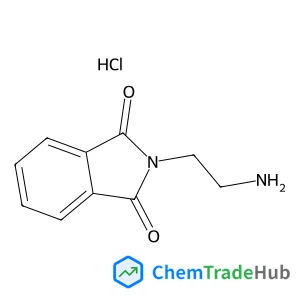
2-(2-Aminoethyl)-1H-isoindole-1,3(2H)-dione hydrochloride (1:1)
CAS Number:
30250-67-0
Molecular Formula:
C10H11ClN2O2
Gui-Min Xue, Chen-Guang Zhao, Jin-Feng Xue, Hui Chen, Zhen-Zhu Zhao, Ying-Ying Si, Kun Du, Yan-Le Zhi, Wei-Sheng Feng
Two pairs of meroterpenoid enantiomers, (±)-fissisternoids A (1) and B (2), along with their putative biogenetic precursor 3 were isolated from the branches and leaves of Fissistigma bracteolatum. Compound 1 represents an unprecedented meroterpenoid featuring a unique tricyclo [3,3,1,01′,5′] decane central framework, and compound 2 possesses a rare 6/6/5/4 tetracyclic carbon skeleton, both of which were derived from quinodihydrochalcone and monoterpenoid via a key [4 + 2] Diels–Alder cyclization and Prins reaction. Their structures and absolute configurations were established using spectroscopic data, X-ray diffraction, and electronic circular dichroism calculations. Compounds 1 and 2 exhibit anti-inflammatory activity (IC50: 13.2 μM, 1; 9.8 μM, 2) via suppression of inflammatory cytokines IL-1β, IL-6, and iNOS.
Rakesh Ranjan, Benny Kattikanal George
DOI: 10.1039/D3SU00304C
Filipa Macedo, Telma Guiu, Chris H. J. Franco, Vânia André, Alexander M. Kirillov
DOI: 10.1039/D3LF00123G
Dhanya R., Abhirami Panoth, N. Venkatachalapathy
DOI: 10.1039/D3FB00146F
Gouri Sankar Das, Manish Srivastava, Kumud Malika Tripathi
DOI: 10.1039/D3SU00328K
Aniket Balapure, Jayati Ray Dutta, Ramakrishnan Ganesan
DOI: 10.1039/D3LF00126A
Zhuolun Jiang, Ka Man Cheung, To Ngai
DOI: 10.1039/D3SU00219E
(1R,3S)-1,3-Cyclopentanediol finds applications in various industries. In the ph...
When handling N'-[4-(Dimethylamino)phenyl]-N,N-dimethyl-1,4-benzenediamine, it i...
There are several alternatives to 5-(2,4-Difluorophenyl)-2-methoxypyrimidine in ...
1-(3-Methoxyphenoxy)propan-2-ol (CAS: 382141-68-6) must comply with the Globally...
Tetrodotoxin Citrate is extremely dangerous and should be handled with extreme c...
2-Methyl-2-propanyl [(1R,3S)-3-hydroxycyclopentyl]carbamate (CAS: 225641-84-9) i...
Waste containing 4-(2-Hydroxyhexafluoroisopropyl)Benzoic Acid (CAS: 16261-80-6) ...
2-Methyl-2-proanyl {(2S)-1-[(benzyloxy)amino]-3-hydroxy-3-methyl-1-oxo-2-butanyl...
Benzeneethanamine, α-ethyl-, hydrochloride (1:1) is an organic compound with the...
In the synthesis of compounds similar to 3-{(E)-[4-(Dimethylamino)phenyl]diazeny...

Organic Chemistry Frontiers publishes high-quality research from across organic chemistry. Emphases are placed on studies that make significant contributions to the field of organic chemistry by reporting either new or significantly improved protocols or methodologies. Topics include, but are not limited to the following: Organic synthesis Development of synthetic methodologies Catalysis Natural products Functional organic materials Supramolecular and macromolecular chemistry Physical and computational organic chemistry