












Visible-light photocatalytic preparation of alkenyl thioethers from 1,2,3-thiadiazoles and Hantzsch esters: synthetic and mechanistic investigations
Literature Information
Publication Date
2021-10-05
DOI
10.1039/D1QO01076J
Impact Factor
5.281
Authors
Zhanqun Liang, Shaofang Zhou, Changlei Zhu, Xiaoguang Bao
View Original
Abstract
Herein, we disclose a protocol to synthesize trisubstituted alkenyl thioethers through a direct S-alkylation of 1,2,3-thiadiazoles with C-radical precursors, 4-alkyl-1,4-dihydropyridines (DHPs), driven by visible-light photocatalysis. A broad range of primary, secondary, and tertiary C-radical precursors, DHPs, are suitable for this reaction and the desired products can be obtained in good to excellent yields under mild conditions. Remarkably, high stereoselectivity with Z-alkenyl thioethers was achieved in the presence of a Cu(OAc)2 catalyst. Synergistic experimental and computational studies were carried out to shed light on the mechanisms of this reaction, in which the quenching pathway of an excited photocatalyst (*RuII) could be altered in the presence of the Cu(OAc)2 catalyst. A reductive quenching pathway (RuII/*RuII/RuI/RuII) is proposed in the absence of the Cu(OAc)2 catalyst while an oxidative quenching pathway (RuII/*RuII/RuIII/RuII) is suggested with the assistance of the Cu(OAc)2 catalyst. In addition, the origin of the Z-selectivity of the product is discussed.
Related Literature
Density-functional theory models of Fe(iv)O reactivity in metal–organic frameworks: self-interaction error, spin delocalisation and the role of hybrid exchange
Fernan Saiz, Leonardo Bernasconi
2020-05-26
Paper
DOI: 10.1039/D0CP01285H
Solvent similarity index
Mark D. Driver, Christopher A. Hunter
2020-05-15
Paper
DOI: 10.1039/D0CP01570A
Exciton transfer free energy from Car–Parrinello molecular dynamics
Christian Schwermann, Nikos L. Doltsinis
2020-01-16
Paper
DOI: 10.1039/C9CP06419B
Computational insight into the halogen bonded self-assembly of hexa-coordinated metalloporphyrins
Jyoti Rani, Vratta Grover, Swati Dhamija, Hatem M. Titi
2020-04-20
Paper
DOI: 10.1039/D0CP00351D
Highly branched triple-chain surfactant-mediated electrochemical exfoliation of graphite to obtain graphene oxide: colloidal behaviour and application in water treatment
Nur Amirah Jamaluddin, Suriani Abu Bakar, Tretya Ardyani, Masanobu Sagisaka, Shota Suhara, Mohamad Hafiz Mamat, Mohd Khairul Ahmad, Stephen M. King, Sarah E. Rogers, Julian Eastoe
2020-05-19
Paper
DOI: 10.1039/D0CP01243B
You might also like
Compound Q&A
What are the main uses of 4-Nitrophenyl phosphate disodium salt hexahydrate (CAS: 333338-18-4)?
4-Nitrophenyl phosphate disodium salt hexahydrate is primarily used as a substra...
333338-18-44-Nitrophenyl phosph...
Compound Q&A
What are the main uses of 2-(Trifluoromethyl)-1,3-oxazole-4-carboxylic Acid (CAS: 1060816-01-4)?
2-(Trifluoromethyl)-1,3-oxazole-4-carboxylic Acid (CAS: 1060816-01-4) is widely ...
1060816-01-42-(Trifluoromethyl)-...
Compound Q&A
How should 2-Fluoro-4-biphenylcarboxylic acid (CAS: 137045-30-8) be stored?
2-Fluoro-4-biphenylcarboxylic acid should be stored in a cool, dry place at room...
137045-30-82-Fluoro-4-biphenylc...
Compound Q&A
What industries use Prednisolone-21-Carboxylic Acid (CAS: 61549-70-0)?
Prednisolone-21-Carboxylic Acid is primarily used in the pharmaceutical industry...
61549-70-0Prednisolone-21-Carb...
Compound Q&A
How should 4-(Hydrazinomethyl)-1,2,3-benzenetriol (CAS: 3614-72-0) be stored?
4-(Hydrazinomethyl)-1,2,3-benzenetriol (CAS: 3614-72-0) should be stored in a co...
3614-72-04-(Hydrazinomethyl)-...
Compound Q&A
What industries use 4-Amino-1-methyl-1H-pyrazole-5-carboxylic acid hydrochloride (CAS: 92534-70-8)?
4-Amino-1-methyl-1H-pyrazole-5-carboxylic acid hydrochloride (CAS: 92534-70-8) i...
92534-70-84-Amino-1-methyl-1H-...
Compound Q&A
What regulatory guidelines apply to dehydropachymic acid (CAS: 77012-31-8)?
Dehydropachymic acid (CAS: 77012-31-8) is regulated by various agencies. It fall...
77012-31-8Dehydropachymic acid
Compound Q&A
What is the market or research trend for 6-[(2,2-Dimethylpropanoyl)amino]nicotinic acid (CAS: 898561-66-5)?
The market and research trends for 6-[(2,2-Dimethylpropanoyl)amino]nicotinic aci...
898561-66-56-[(2,2-Dimethylprop...
Compound Q&A
How should 1,10-Phenanthroline-2,9-dicarbaldehyde (CAS: 57709-62-3) be stored?
1,10-Phenanthroline-2,9-dicarbaldehyde should be stored in a cool, dry place awa...
57709-62-31,10-Phenanthroline-...
Compound Q&A
How is 5-Carbamoyl-11-oxo-10,11-dihydro-5H-dibenzo[b,f]azepin-10-yl acetate (CAS: 113952-21-9) typically synthesized?
5-Carbamoyl-11-oxo-10,11-dihydro-5H-dibenzo[b,f]azepin-10-yl acetate can be synt...
113952-21-95-Carbamoyl-11-oxo-1...
Source Journal
Organic Chemistry Frontiers

CiteScore:
7.8
Self-citation Rate:
8.7%
Articles per Year:
724
Organic Chemistry Frontiers publishes high-quality research from across organic chemistry. Emphases are placed on studies that make significant contributions to the field of organic chemistry by reporting either new or significantly improved protocols or methodologies. Topics include, but are not limited to the following: Organic synthesis Development of synthetic methodologies Catalysis Natural products Functional organic materials Supramolecular and macromolecular chemistry Physical and computational organic chemistry
Recommended Compounds
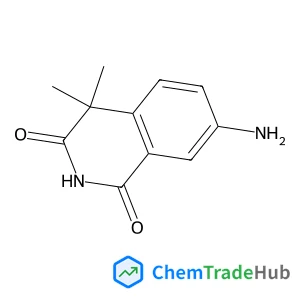
1,3(2H,4H)-Isoquinolinedione, 7-amino-4,4-dimethyl-
CAS Number:
14576-22-8
Molecular Formula:
C11H12N2O2
Recommended Suppliers





Disclaimer
This page provides academic journal information for reference and research purposes only. We are not affiliated with any journal publishers and do not handle publication submissions. For publication-related inquiries, please contact the respective journal publishers directly.
If you notice any inaccuracies in the information displayed, please contact us at support@chemtradehub.com. We will promptly review and address your concerns.