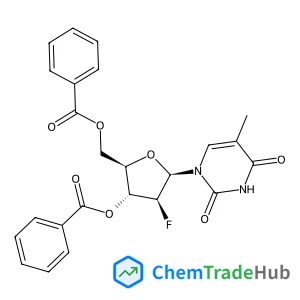
1-(3',5'-Di-O-benzoyl-2'-deoxy-2'-fluoro-b-D-arabinofuranosyl)thymine
CAS Number:
97614-47-6
Molecular Formula:
C24H21FN2O7
Gemma Aragay, Guillem Peñuelas-Haro
The current library of synthetic molecular sensors for small polar molecules is limited. In this work, we describe the synthesis of two diastereomeric mono-phosphonate calix[4]pyrrole cavitands, 1in and 1out, acting as fluorescent sensors for amino acids. The two isomeric cavitands differ in the relative orientation, in (1in) and out (1out), of their PO bridging group and the N-phenyl-naphthalamine fluorophore directly attached to it, with respect to their polar aromatic cavities. Using 1H and 31P NMR spectroscopy and non-fluorescent cavitand analogues (5in and 5out), we demonstrate the formation of 1 : 1 complexes with L-proline (L-Pro) and the relevance of the inwardly directed PO group in the binding of the amino acid. Only the L-Pro⊂5in complex establishes a charged hydrogen bonding interaction between the receptor PO group and the protonated amine of the bound zwitterionic amino acid. This interaction is responsible for an increase in the thermodynamic stability of the complex compared to the L-Pro⊂5out counterpart. We investigate the binding properties of the fluorescent cavitands, 1in and 1out, with L-Pro and L-pipecolic acid (L-Pip) at micromolar concentration using emission spectroscopy (direct binding-based sensing, BBS). The observed emission changes in the BBS experiments were small but evidenced the role of the cavitands as fluorescent sensors. In agreement with the millimolar concentration results (1H NMR experiments), the fluorescent 1in sensor displays a larger binding affinity for L-Pro than the 1out isomer. Conversely, the 1out isomer experienced larger emission changes upon amino acid binding. We developed FRET-based indicator displacement assays (IDA) owing to the small emission changes observed in the direct BBS experiments. At micromolar concentration, the competitive displacement of the quencher N-oxide 6 from the cavity of the 1 : 1 supramolecular ensemble (6⊂1in and 6⊂1out), by L-Pro, L-Pip, and L-phenylalanine (L-Phe) produced fluorescence “turn-on”. The results of the BBS and IDA experiments assigned a binding selectivity to the 1in isomer for L-Pro.
C. Scherzinger, O. Holderer, D. Richter, W. Richtering
DOI: 10.1039/C2CP23328B
Chad M. Huelsman, Phillip E. Savage
DOI: 10.1039/C2CP23910H
Richard J. Wheatley, Angelica A. Gopal
DOI: 10.1039/C2CP23504H
Iker Leon, Emilio J. Cocinero, Judith Millán, Sander Jaeqx, Alberto Lesarri, Fernando Castaño, José A. Fernández
DOI: 10.1039/C2CP23583H
Guofa Dong, Meihua Huang, Lunhui Guan
DOI: 10.1039/C2CP23718K
Eugenii Ya. Misochko, Alexander V. Akimov, Denis V. Korchagin, Artem A. Masitov, Konstantin N. Shavrin
DOI: 10.1039/C2CP22853J
Sebastian Weibels, Adrian Syguda, Christian Herrmann, Hermann Weingärtner
DOI: 10.1039/C2CP24041F
Yavuz Dede, Ilker Ozkan
DOI: 10.1039/C2CP23127A
Julien Scalbert, Frederic C. Meunier, Cecile Daniel, Yves Schuurman
DOI: 10.1039/C1CP22620G
Thomas Steinbrecher, Mario S. Mommer, Yuki Nagata, Marcus Elstner
DOI: 10.1039/C2CP23489K
(3.beta.)-3-Hydroxy-N,N-dimethyl-chol-5-en-24-amide (CAS: 79066-03-8) is primari...
5-(Aminomethyl)-2-methoxyphenol (CAS: 89702-89-6) is classified under GHS as a s...
Thieno[2,3-c]pyridin-7(6H)-one (CAS: 28981-13-7) is a heterocyclic organic compo...
1-[(6-Methoxy-3-pyridinyl)methyl]-4-piperidinamine dihydrochloride is generally ...
[(2E)-3-Phenyl-2-propen-1-yl]phosphonic acid (CAS: 146404-58-2) is regulated und...
6-Bromo-7-methoxyquinoline (CAS: 1620515-86-7) falls under the scope of the Glob...
This compound is primarily used in the pharmaceutical industry for the developme...
1-Ethyl-7-[2-methyl-6-(4H-1,2,4-triazol-3-yl)-3-pyridinyl]-3,5-dihydropyrazino[2...
Alternative reagents such as 2-[(dimethylamino)methyl]phenylboronic acid or rela...
3-(Piperidin-4-yloxy)pyridine (CAS: 310881-48-2) is an organic compound with the...

Organic Chemistry Frontiers publishes high-quality research from across organic chemistry. Emphases are placed on studies that make significant contributions to the field of organic chemistry by reporting either new or significantly improved protocols or methodologies. Topics include, but are not limited to the following: Organic synthesis Development of synthetic methodologies Catalysis Natural products Functional organic materials Supramolecular and macromolecular chemistry Physical and computational organic chemistry
![4,4-Difluoro-2-methyl-1-{[(2-methyl-2-propanyl)oxy]carbonyl}-L-proline structure](https://static.chemtradehub.com/structs/119/1194032-23-9-f426.webp "4,4-Difluoro-2-methyl-1-{[(2-methyl-2-propanyl)oxy]carbonyl}-L-proline structure")