












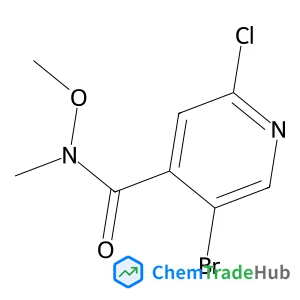
5-Bromo-2-chloro-N-methoxy-N-methylisonicotinamide
CAS Number:
1256790-08-5
Molecular Formula:
C8H8BrClN2O2
Chad M. Huelsman, Phillip E. Savage
We processed phenol with supercritical water in a series of experiments, which systematically varied the temperature, water density, reactant concentration, and reaction time. Both the gas and liquid phases were analyzed post-reaction using gas chromatographic techniques, which identified and quantified the reaction intermediates and products, including H2, CO, CH4, and CO2 in the gas phase and twenty different compounds—mainly polycyclic aromatic hydrocarbons—in the liquid phase. Many of these liquid phase compounds were identified for the first time and could pose environmental risks. Higher temperatures promoted gasification and resulted in a product gas rich in H2 and CH4 (33% and 29%, respectively, at 700 °C), but char yields increased as well. We implicated dibenzofuran and other identified phenolic dimers as precursor molecules for char formation pathways, which can be driven by free radical polymerization at high temperatures. Examination of the trends in conversion as a function of initial water and phenol concentrations revealed competing effects, and these informed the kinetic modeling of phenol disappearance. Two different reaction pathways emerged from the kinetic modeling: one in which rate ∝ [phenol]1.73[water]−16.60 and the other in which rate ∝ [phenol]0.92[water]1.39. These pathways may correspond to pyrolysis, which dominates when there is abundant phenol and little water, and hydrothermal reactions, which dominate in excess water. This result confirms that supercritical water gasification of phenol does not simply follow first-order kinetics, as previous efforts to model phenol disappearance had assumed.
Ryo Tanaka, Naoki Tonoko, Shin-ichi Kihara, Yuushou Nakayama, Takeshi Shiono
DOI: 10.1039/C8PY00519B
Stefan Brits, William J. Neary, Goutam Palui, Justin G. Kennemur
DOI: 10.1039/C7PY01922J
Pierre Furtwengler, Luc Avérous
DOI: 10.1039/C8PY00827B
Prasanta Kumar Behera, Prantik Mondal, Nikhil K. Singha
DOI: 10.1039/C8PY00549D
Gilles B. Desmet, Yoshi W. Marien, Paul H. M. Van Steenberge, Marie-Françoise Reyniers, Guy B. Marin
DOI: 10.1039/C7PY01008G
Rashin Namivandi-Zangeneh, Rebecca J. Kwan, Thuy-Khanh Nguyen, Jonathan Yeow, Frances L. Byrne, Edgar H. H. Wong, Cyrille Boyer
DOI: 10.1039/C7PY01069A
Li Yu, Mei Zhang, Fu-Sheng Du, Zi-Chen Li
DOI: 10.1039/C8PY00620B
(3.beta.)-3-Hydroxy-N,N-dimethyl-chol-5-en-24-amide (CAS: 79066-03-8) is primari...
5-(Aminomethyl)-2-methoxyphenol (CAS: 89702-89-6) is classified under GHS as a s...
Thieno[2,3-c]pyridin-7(6H)-one (CAS: 28981-13-7) is a heterocyclic organic compo...
1-[(6-Methoxy-3-pyridinyl)methyl]-4-piperidinamine dihydrochloride is generally ...
[(2E)-3-Phenyl-2-propen-1-yl]phosphonic acid (CAS: 146404-58-2) is regulated und...
6-Bromo-7-methoxyquinoline (CAS: 1620515-86-7) falls under the scope of the Glob...
This compound is primarily used in the pharmaceutical industry for the developme...
1-Ethyl-7-[2-methyl-6-(4H-1,2,4-triazol-3-yl)-3-pyridinyl]-3,5-dihydropyrazino[2...
Alternative reagents such as 2-[(dimethylamino)methyl]phenylboronic acid or rela...
3-(Piperidin-4-yloxy)pyridine (CAS: 310881-48-2) is an organic compound with the...

Physical Chemistry Chemical Physics (PCCP) is an international journal co-owned by 19 physical chemistry and physics societies from around the world. This journal publishes original, cutting-edge research in physical chemistry, chemical physics and biophysical chemistry. To be suitable for publication in PCCP, articles must include significant innovation and/or insight into physical chemistry; this is the most important criterion that reviewers and Editors will judge against when evaluating submissions. The journal has a broad scope and welcomes contributions spanning experiment, theory, computation and data science. Topical coverage includes spectroscopy, dynamics, kinetics, statistical mechanics, thermodynamics, electrochemistry, catalysis, surface science, quantum mechanics, quantum computing and machine learning. Interdisciplinary research areas such as polymers and soft matter, materials, nanoscience, energy, surfaces/interfaces, and biophysical chemistry are welcomed if they demonstrate significant innovation and/or insight into physical chemistry. Joined experimental/theoretical studies are particularly appreciated when complementary and based on up-to-date approaches.
amine structure](https://static.chemtradehub.com/structs/629/62924-61-2-0728.webp "[(2-chlorophenyl)methyl](ethyl)amine structure")
![Ethanone, 1-[4-chloro-2-(methylthio)-5-pyrimidinyl]- structure](https://static.chemtradehub.com/structs/661/66116-82-3-863e.webp "Ethanone, 1-[4-chloro-2-(methylthio)-5-pyrimidinyl]- structure")





