


Visible light-induced aerobic dioxygenation of α,β-unsaturated amides/alkenes toward selective synthesis of β-oxy alcohols using rose bengal as a photosensitizer
Literature Information
Publication Date
2021-03-02
DOI
10.1039/D1QO00149C
Impact Factor
5.281
Authors
Ming-Zhong Zhang, Jing Tian, Min Yuan, Wan-Qi Peng, Yu-Zhu Wang, Peng Wang, Long Liu, Quan Gou, Huisheng Huang, Tieqiao Chen
View Original
Abstract
The first visible light-induced dioxygenation of α,β-unsaturated amides with N-hydroxy compounds under air was developed with the use of the non-toxic organic dye rose bengal as the photoredox catalyst. This metal-free reaction is highly chemoselective, producing the corresponding β-oxy alcohols rather than the competitive cyclized products through aminooxyarylation. Other aromatic alkenes, dihydrofurans and dienes, were also applicable to this reaction. Compared with the established radical dioxygenation methods to construct β-oxy alcohols, the present photochemical protocol avoids the use of (over)stoichiometric amounts of hazardous/poisonous oxidants, transition metals and additional reducing reagents, yielding the desired dioxygenated products in a safe and eco-friendly fashion. Moreover, the practical application of this methodology is highlighted by a concise two-step synthesis of 1,4-dioxane-2-carboxamides, a framework for building Mcl-1 inhibitors.
Recommended Journals

Journal of Saudi Chemical Society

Russian Journal of Organic Chemistry

Current Opinion in Solid State & Materials Science

Chemistry Education Research and Practice

Russian Chemical Bulletin

Drug Discovery Today

Journal of Natural Medicines

Organic Process Research & Development

Russian Journal of General Chemistry

Nature Medicine
Related Literature
On the analyses of fluorescence depolarisation data in the presence of electronic energy migration. Part II: Applying and evaluating two-photon excited fluorescence
Oleg Opanasyuk, Therese Mikaelsson, Linus Ryderfors, Emad Mukhtar, Lennart B.-Å. Johansson
2011-11-30
Paper
DOI: 10.1039/C2CP23177H
Hydration and interactions in protein solutions containing concentrated electrolytes studied by small-angle scattering
F. Zhang, F. Roosen-Runge, M. W. A. Skoda, R. M. J. Jacobs, M. Wolf, Ph. Callow, H. Frielinghaus, V. Pipich, S. Prévost, F. Schreiber
2011-12-14
Paper
DOI: 10.1039/C2CP23460B
Mechanism of photocatalytic activities in Cr-doped SrTiO3 under visible-light irradiation: an insight from hybrid density-functional calculations
Pakpoom Reunchan, Shuxin Ouyang
2011-12-01
Paper
DOI: 10.1039/C2CP23348G
Investigation of band offsets of interface BiOCl:Bi2WO6: a first-principles study
2011-12-07
Paper
DOI: 10.1039/C2CP23186G
Molecular dynamics calculation of molecular volumes and volumes of activation
J. Spooner, N. Boon, E. Deglint, E. Edwards, B. Yanciw, B. Patton, L. Thiele, P. Dance
2012-01-12
Paper
DOI: 10.1039/C2CP22949H
High current density electrodeposition from silver complex ionic liquids
Stijn Schaltin, Neil R. Brooks, Linda Stappers, Kristof Van Hecke, Luc Van Meervelt, Koen Binnemans, Jan Fransaer
2011-12-21
Paper
DOI: 10.1039/C2CP22987K
The role of tropospheric ice surfaces in the elimination of the CFC substitute, trifluoroethanol
Elena Moreno, Alfonso Aranda, Yolanda Díaz-de-Mera, Ernesto Martínez, Iván Bravo, Ana Rodríguez
2012-02-07
Paper
DOI: 10.1039/C2CP23553F
23Na double-rotation NMR of sodium nucleotides leads to the discovery of a new dCMP hendecahydrate
Frédéric A. Perras, Ilia Korobkov, David L. Bryce
2012-02-01
Communication
DOI: 10.1039/C2CP40273D
Semiconductor quantum dot–inorganic nanotube hybrids
Ronen Kreizman, Osip Schwartz, Zvicka Deutsch, Stella Itzhakov, Alla Zak, Sidney R. Cohen, Reshef Tenne, Dan Oron
2012-01-31
Paper
DOI: 10.1039/C2CP24043B
Al2O3(110) surface as a template for the ordered growth of Ni and Co nanoclusters
Krithika Venkataramani, Thomas N. Jensen, Stig Helveg, Michael Reichling, Flemming Besenbacher, Jeppe V. Lauritsen
2012-01-09
Paper
DOI: 10.1039/C2CP22712F
You might also like
Compound Q&A
What are the main uses of (3.beta.)-3-Hydroxy-N,N-dimethyl-chol-5-en-24-amide (CAS: 79066-03-8)?
(3.beta.)-3-Hydroxy-N,N-dimethyl-chol-5-en-24-amide (CAS: 79066-03-8) is primari...
79066-03-8(3.beta.)-3-Hydroxy-...
Compound Q&A
What regulatory guidelines apply to 5-(aminomethyl)-2-methoxyphenol (CAS: 89702-89-6)?
5-(Aminomethyl)-2-methoxyphenol (CAS: 89702-89-6) is classified under GHS as a s...
89702-89-65-(aminomethyl)-2-me...
Compound Q&A
What is Thieno[2,3-c]pyridin-7(6H)-one (CAS: 28981-13-7)?
Thieno[2,3-c]pyridin-7(6H)-one (CAS: 28981-13-7) is a heterocyclic organic compo...
28981-13-7Thieno[2,3-c]pyridin...
Compound Q&A
Is 1-[(6-Methoxy-3-pyridinyl)methyl]-4-piperidinamine dihydrochloride (CAS: 1185311-28-7) safe?
1-[(6-Methoxy-3-pyridinyl)methyl]-4-piperidinamine dihydrochloride is generally ...
1185311-28-71-[(6-Methoxy-3-pyri...
Compound Q&A
What regulatory guidelines apply to [(2E)-3-Phenyl-2-propen-1-yl]phosphonic acid (CAS: 146404-58-2)?
[(2E)-3-Phenyl-2-propen-1-yl]phosphonic acid (CAS: 146404-58-2) is regulated und...
146404-58-2[(2E)-3-Phenyl-2-pro...
Compound Q&A
What regulatory guidelines apply to 6-Bromo-7-methoxyquinoline (CAS: 1620515-86-7)?
6-Bromo-7-methoxyquinoline (CAS: 1620515-86-7) falls under the scope of the Glob...
1620515-86-76-Bromo-7-methoxyqui...
Compound Q&A
What industries use (2R)-1-(1-Benzofuran-2-yl)-N-propyl-2-pentanamine (CAS: 260550-89-8)?
This compound is primarily used in the pharmaceutical industry for the developme...
260550-89-8(2R)-1-(1-Benzofuran...
Compound Q&A
What are the main uses of 1-Ethyl-7-[2-methyl-6-(4H-1,2,4-triazol-3-yl)-3-pyridinyl]-3,5-dihydropyrazino[2,3-b]pyrazin-2(1H)-one (CAS: 1228013-15-7)?
1-Ethyl-7-[2-methyl-6-(4H-1,2,4-triazol-3-yl)-3-pyridinyl]-3,5-dihydropyrazino[2...
1228013-15-71-Ethyl-7-[2-methyl-...
Compound Q&A
Are there alternatives to {5-(Acryloylamino)-2-[(dimethylamino)methyl]phenyl}boronic acid (CAS: 1217500-78-1) in synthesis?
Alternative reagents such as 2-[(dimethylamino)methyl]phenylboronic acid or rela...
1217500-78-1{5-(Acryloylamino)-2...
Compound Q&A
What is 3-(Piperidin-4-yloxy)pyridine (CAS: 310881-48-2)?
3-(Piperidin-4-yloxy)pyridine (CAS: 310881-48-2) is an organic compound with the...
310881-48-23-(Piperidin-4-yloxy...
Source Journal
Organic Chemistry Frontiers

CiteScore:
7.8
Self-citation Rate:
8.7%
Articles per Year:
724
Organic Chemistry Frontiers publishes high-quality research from across organic chemistry. Emphases are placed on studies that make significant contributions to the field of organic chemistry by reporting either new or significantly improved protocols or methodologies. Topics include, but are not limited to the following: Organic synthesis Development of synthetic methodologies Catalysis Natural products Functional organic materials Supramolecular and macromolecular chemistry Physical and computational organic chemistry
Recommended Compounds
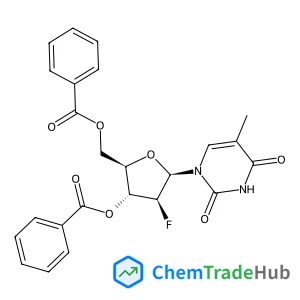
1-(3',5'-Di-O-benzoyl-2'-deoxy-2'-fluoro-b-D-arabinofuranosyl)thymine
CAS Number:
97614-47-6
Molecular Formula:
C24H21FN2O7
![4,4-Difluoro-2-methyl-1-{[(2-methyl-2-propanyl)oxy]carbonyl}-L-proline structure](https://static.chemtradehub.com/structs/119/1194032-23-9-f426.webp "4,4-Difluoro-2-methyl-1-{[(2-methyl-2-propanyl)oxy]carbonyl}-L-proline structure")
4,4-Difluoro-2-methyl-1-{[(2-methyl-2-propanyl)oxy]carbonyl}-L-proline
CAS Number:
1194032-23-9
Molecular Formula:
C11H17F2NO4
Recommended Suppliers





Disclaimer
This page provides academic journal information for reference and research purposes only. We are not affiliated with any journal publishers and do not handle publication submissions. For publication-related inquiries, please contact the respective journal publishers directly.
If you notice any inaccuracies in the information displayed, please contact us at support@chemtradehub.com. We will promptly review and address your concerns.