












Molecular dynamics calculation of molecular volumes and volumes of activation
Literature Information
Publication Date
2012-01-12
DOI
10.1039/C2CP22949H
Impact Factor
3.676
Authors
J. Spooner, N. Boon, E. Deglint, E. Edwards, B. Yanciw, B. Patton, L. Thiele, P. Dance
View Original
Abstract
Experimentally, the effects of pressure on reaction rates are described by their pressure derivatives, known as volumes of activation. Transition state theory directly links activation volumes to partial molar volumes of reactants and transition states. We discuss a molecular dynamics method for the accurate calculation of molecular volumes, within which the volumes of molecular species are obtained as a difference between the volumes of pure solvent and solvent with a single molecule inserted. The volumes thus obtained depend on the molecular geometry, the strength and type of the solute–solvent interactions, as well as temperature and pressure. The partial molar volumes calculated using this approach agree well with experimental data. Since this method can also be applied to transition state species, it allows for quantitative analysis of experimental volumes of activation in terms of structural parameters of the corresponding transition states. The efficiency of the approach is illustrated by calculation of volumes of activation for three nonpolar reactions in nonpolar solvents. The results agree well with the experimental data.
Related Literature
Polyallene-based amphiphilic triblock copolymer via successive free radical polymerization and ATRP
Hao Guo, Xiaoyu Huang
2017-11-27
Paper
DOI: 10.1039/C7PY01407D
Fabrication of color changeable CO2 sensitive nanofibers
Jiaojiao Shang, Shaojian Lin, Patrick Theato
2017-11-16
Communication
DOI: 10.1039/C7PY01628J
Highly efficient access to well-defined linear polymers with substantial vinyl pendants via ATRP of divinyl monomers
Xiao-Yan Wang, Xiu-Li Sun, Zhi-Hao Chen, Feng Wang, Sunewang R. Wang, Yong Tang
2018-07-26
Paper
DOI: 10.1039/C8PY00797G
Facile fabrication of positively-charged helical poly(phenyl isocyanide) modified multi-stimuli-responsive nanoassembly capable of high efficiency cell-penetrating, ratiometric fluorescence imaging, and rapid intracellular drug release
Wen-Ming Zhang, Jian Zhang, Zhu Qiao, Huan-Ying Liu, Zong-Quan Wu, Jun Yin
2018-07-17
Paper
DOI: 10.1039/C8PY00865E
New electroactive macromonomers and multi-responsive PEDOT graft copolymers
Sara Marina, Daniele Mantione, Kasina ManojKumar, Vijayakrishna Kari, Agnieszka Tercjak, Ana Sanchez-Sanchez
2018-06-15
Paper
DOI: 10.1039/C8PY00680F
Swelling properties of thermoresponsive/hydrophilic co-networks with functional crosslinked domain structures
Shohei Ida, Hironobu Kitanaka, Tatsuya Ishikawa, Shokyoku Kanaoka, Yoshitsugu Hirokawa
2018-01-03
Paper
DOI: 10.1039/C7PY01793F
You might also like
Compound Q&A
What are the main uses of (3.beta.)-3-Hydroxy-N,N-dimethyl-chol-5-en-24-amide (CAS: 79066-03-8)?
(3.beta.)-3-Hydroxy-N,N-dimethyl-chol-5-en-24-amide (CAS: 79066-03-8) is primari...
79066-03-8(3.beta.)-3-Hydroxy-...
Compound Q&A
What regulatory guidelines apply to 5-(aminomethyl)-2-methoxyphenol (CAS: 89702-89-6)?
5-(Aminomethyl)-2-methoxyphenol (CAS: 89702-89-6) is classified under GHS as a s...
89702-89-65-(aminomethyl)-2-me...
Compound Q&A
What is Thieno[2,3-c]pyridin-7(6H)-one (CAS: 28981-13-7)?
Thieno[2,3-c]pyridin-7(6H)-one (CAS: 28981-13-7) is a heterocyclic organic compo...
28981-13-7Thieno[2,3-c]pyridin...
Compound Q&A
Is 1-[(6-Methoxy-3-pyridinyl)methyl]-4-piperidinamine dihydrochloride (CAS: 1185311-28-7) safe?
1-[(6-Methoxy-3-pyridinyl)methyl]-4-piperidinamine dihydrochloride is generally ...
1185311-28-71-[(6-Methoxy-3-pyri...
Compound Q&A
What regulatory guidelines apply to [(2E)-3-Phenyl-2-propen-1-yl]phosphonic acid (CAS: 146404-58-2)?
[(2E)-3-Phenyl-2-propen-1-yl]phosphonic acid (CAS: 146404-58-2) is regulated und...
146404-58-2[(2E)-3-Phenyl-2-pro...
Compound Q&A
What regulatory guidelines apply to 6-Bromo-7-methoxyquinoline (CAS: 1620515-86-7)?
6-Bromo-7-methoxyquinoline (CAS: 1620515-86-7) falls under the scope of the Glob...
1620515-86-76-Bromo-7-methoxyqui...
Compound Q&A
What industries use (2R)-1-(1-Benzofuran-2-yl)-N-propyl-2-pentanamine (CAS: 260550-89-8)?
This compound is primarily used in the pharmaceutical industry for the developme...
260550-89-8(2R)-1-(1-Benzofuran...
Compound Q&A
What are the main uses of 1-Ethyl-7-[2-methyl-6-(4H-1,2,4-triazol-3-yl)-3-pyridinyl]-3,5-dihydropyrazino[2,3-b]pyrazin-2(1H)-one (CAS: 1228013-15-7)?
1-Ethyl-7-[2-methyl-6-(4H-1,2,4-triazol-3-yl)-3-pyridinyl]-3,5-dihydropyrazino[2...
1228013-15-71-Ethyl-7-[2-methyl-...
Compound Q&A
Are there alternatives to {5-(Acryloylamino)-2-[(dimethylamino)methyl]phenyl}boronic acid (CAS: 1217500-78-1) in synthesis?
Alternative reagents such as 2-[(dimethylamino)methyl]phenylboronic acid or rela...
1217500-78-1{5-(Acryloylamino)-2...
Compound Q&A
What is 3-(Piperidin-4-yloxy)pyridine (CAS: 310881-48-2)?
3-(Piperidin-4-yloxy)pyridine (CAS: 310881-48-2) is an organic compound with the...
310881-48-23-(Piperidin-4-yloxy...
Source Journal
Physical Chemistry Chemical Physics

CiteScore:
5.5
Self-citation Rate:
10.3%
Articles per Year:
3036
Physical Chemistry Chemical Physics (PCCP) is an international journal co-owned by 19 physical chemistry and physics societies from around the world. This journal publishes original, cutting-edge research in physical chemistry, chemical physics and biophysical chemistry. To be suitable for publication in PCCP, articles must include significant innovation and/or insight into physical chemistry; this is the most important criterion that reviewers and Editors will judge against when evaluating submissions. The journal has a broad scope and welcomes contributions spanning experiment, theory, computation and data science. Topical coverage includes spectroscopy, dynamics, kinetics, statistical mechanics, thermodynamics, electrochemistry, catalysis, surface science, quantum mechanics, quantum computing and machine learning. Interdisciplinary research areas such as polymers and soft matter, materials, nanoscience, energy, surfaces/interfaces, and biophysical chemistry are welcomed if they demonstrate significant innovation and/or insight into physical chemistry. Joined experimental/theoretical studies are particularly appreciated when complementary and based on up-to-date approaches.
Recommended Compounds
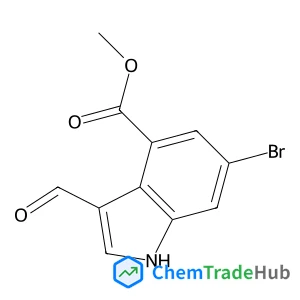
methyl 6-bromo-3-formyl-1H-indole-4-carboxylate
CAS Number:
1353636-63-1
Molecular Formula:
C11H8BrNO3
Recommended Suppliers




Disclaimer
This page provides academic journal information for reference and research purposes only. We are not affiliated with any journal publishers and do not handle publication submissions. For publication-related inquiries, please contact the respective journal publishers directly.
If you notice any inaccuracies in the information displayed, please contact us at support@chemtradehub.com. We will promptly review and address your concerns.