













A design strategy for D–A conjugated polymers for NIR-II fluorescence imaging
Literature Information
Publication Date
2021-07-23
DOI
10.1039/D1PY00470K
Impact Factor
5.582
Authors
Yingbin Su, Yawei Miao, Yaowei Zhu, Wentao Zou
View Original
Abstract
The development of bioimaging technology in recent years has shown that second near-infrared (NIR-II) fluorescence imaging (FI) is gradually replacing the traditional visible light and first near-infrared (NIR-I) FI. In the NIR-II window, the light absorption, autofluorescence and scattering of biological tissues are significantly reduced, which strongly promotes the design, development and application of contrast agents with NIR-II emission capabilities. However, the NIR-II bioimaging technology is still incomplete, in the initial stage, and has high research value. In order to increase the quantum yield (QY) of D–A polymers, we used thiophene, 3-methoxythiophene, 3,4-ethylenedioxythiophene (EDOT), 3-hexylthiophene and 3-(2-ethylhexyl)thiophene as strong electron donors and designed and synthesized NIR-II organic polymers P1, P2, P3, P4 and P5, which are of great significance to the molecular design of D–A conjugated polymers. Finally, we explored the FI of the polymers in vivo and in vitro, and verified our idea of increasing the QY.
Related Literature
Enantioselective synthesis of cyclopropylcarboxamides using s-BuLi–sparteine-mediated metallation
Stephanie Lauru, Nigel S. Simpkins, David Gethin, Claire Wilson
2008-09-16
Communication
DOI: 10.1039/B810441G
Axial chirality control of troposBIPHEP–Rh complexes by chiral dienes: synergy effect in catalytic asymmetric hydrogenation‡
Kohsuke Aikawa, Yūki Takabayashi, Susumu Kawauchi, Koichi Mikami
2008-09-30
Communication
DOI: 10.1039/B809683J
Sonication treatment of CdTe/CdS semiconductor nanocrystals and their bio-application
Kyung Nam Kim, Pan Kee Bae, Hyun Ju Chang, Yong-Rok Kim, Joung Kyu Park
2008-09-24
Communication
DOI: 10.1039/B812317A
Facile preparation of low cytotoxicity fluorescent carbon nanocrystals by electrooxidation of graphite
Qiao-Ling Zhao, Zhi-Ling Zhang, Bi-Hai Huang, Jun Peng, Min Zhang, Dai-Wen Pang
2008-09-24
Communication
DOI: 10.1039/B812420E
New functional materials for heavy metal sorption: “Supramolecular” attachment of thiols to mesoporous silica substrates
Timothy G. Carter, Wassana Yantasee, Thanapon Sangvanich, Glen E. Fryxell, Darren W. Johnson, R. Shane Addleman
2008-09-26
Communication
DOI: 10.1039/B810576F
A metallopolymer case-history: polymer, ring or ligand reaction?
Edwin C. Constable, Kate Harris, Catherine E. Housecroft, Markus Neuburger, Silvia Schaffner
2008-09-17
Communication
DOI: 10.1039/B811204E
You might also like
Compound Q&A
What are the main uses of 1H-Indazole-6-carbonitrile (CAS: 141290-59-7)?
1H-Indazole-6-carbonitrile finds applications in pharmaceuticals, where it serve...
141290-59-71H-Indazole-6-carbon...
Compound Q&A
How should waste containing Dioctyl (2E)-2-butenedioate (CAS: 2997-85-5) be handled?
Waste containing Dioctyl (2E)-2-butenedioate (CAS: 2997-85-5) should be collecte...
2997-85-5Dioctyl (2E)-2-buten...
Compound Q&A
What industries use Sodium [(1,2-benzoxazol-3-ylmethyl)sulfonyl]azanide (CAS: 68291-98-5)?
Sodium [(1,2-benzoxazol-3-ylmethyl)sulfonyl]azanide is primarily used in pharmac...
68291-98-5Sodium [(1,2-benzoxa...
Compound Q&A
Are there alternatives to Dimethyl 4-(4,4,5,5-tetramethyl-1,3,2-dioxaborolan-2-yl)-2,6-pyridinedicarboxylate (CAS: 741709-66-0) in synthesis?
Dimethyl 4-(4,4,5,5-tetramethyl-1,3,2-dioxaborolan-2-yl)-2,6-pyridinedicarboxyla...
741709-66-0Dimethyl 4-(4,4,5,5-...
Compound Q&A
How should waste containing 2-Fluoro-6-hydrazinopyridine (CAS: 80714-39-2) be handled?
Waste containing 2-Fluoro-6-hydrazinopyridine (CAS: 80714-39-2) should be manage...
80714-39-22-Fluoro-6-hydrazino...
Compound Q&A
What is 6-Formyl-2-pyridinecarboxylic acid (CAS: 499214-11-8)?
6-Formyl-2-pyridinecarboxylic acid is an organic compound with the molecular for...
499214-11-86-Formyl-2-pyridinec...
Compound Q&A
What is the market or research trend for 3-(3,4-dimethoxyphenyl)-2,5-dimethyl-N-(2-morpholin-4-ylethyl)pyrazolo[1,5-a]pyrimidin-7-amine (CAS: 900874-91-1)?
Research trends for this compound indicate a focus on its potential applications...
900874-91-13-(3,4-dimethoxyphen...
Compound Q&A
How is 9H-Tribenzo[b,d,f]azepine (CAS: 29875-73-8) typically synthesized?
9H-Tribenzo[b,d,f]azepine is typically synthesized via a multi-step process invo...
29875-73-89H-Tribenzo[b,d,f]az...
Compound Q&A
How is 1-Cyclopropyl-7-ethoxy-6-fluoro-8-methoxy-4-oxo-1,4-dihydro-3-quinolinecarboxylic acid (CAS: 1797982-51-4) typically synthesized?
1-Cyclopropyl-7-ethoxy-6-fluoro-8-methoxy-4-oxo-1,4-dihydro-3-quinolinecarboxyli...
1797982-51-41-Cyclopropyl-7-etho...
Compound Q&A
How should waste containing Methyl 3-oxo-1,2,3,4-tetrahydro-6-quinoxalinecarboxylate (CAS: 671820-52-3) be handled?
Waste containing Methyl 3-oxo-1,2,3,4-tetrahydro-6-quinoxalinecarboxylate (CAS: ...
671820-52-3Methyl 3-oxo-1,2,3,4...
Source Journal
Polymer Chemistry

CiteScore:
8.6
Self-citation Rate:
7.3%
Articles per Year:
457
Polymer Chemistry welcomes submissions in all areas of polymer science that have a strong focus on macromolecular chemistry. Manuscripts may cover a broad range of fields, yet no direct application focus is required.
Recommended Compounds
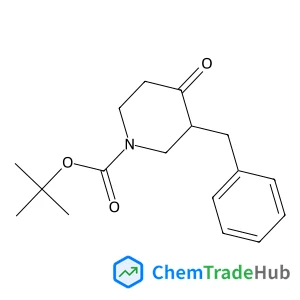
2-Methyl-2-propanyl 3-benzyl-4-oxo-1-piperidinecarboxylate
CAS Number:
193274-82-7
Molecular Formula:
C17H23NO3
![2-Methyl-2-propanyl 4-{2-fluoro-5-[(4-oxo-3,4-dihydro-1-phthalazinyl)methyl]benzoyl}-1-piperazinecarboxylate structure](https://static.chemtradehub.com/structs/763/763114-04-1-65a9.webp "2-Methyl-2-propanyl 4-{2-fluoro-5-[(4-oxo-3,4-dihydro-1-phthalazinyl)methyl]benzoyl}-1-piperazinecarboxylate structure")
2-Methyl-2-propanyl 4-{2-fluoro-5-[(4-oxo-3,4-dihydro-1-phthalazinyl)methyl]benzoyl}-1-piperazinecarboxylate
CAS Number:
763114-04-1
Molecular Formula:
C25H27FN4O4
Recommended Suppliers





Disclaimer
This page provides academic journal information for reference and research purposes only. We are not affiliated with any journal publishers and do not handle publication submissions. For publication-related inquiries, please contact the respective journal publishers directly.
If you notice any inaccuracies in the information displayed, please contact us at support@chemtradehub.com. We will promptly review and address your concerns.