













The effects of cononsolvents on the synthesis of responsive particles via polymerisation-induced thermal self-assembly
Literature Information
Publication Date
2021-07-20
DOI
10.1039/D1PY00396H
Impact Factor
5.582
Authors
Marissa D. Morales-Moctezuma, Sebastian G. Spain
View Original
Abstract
Nanogels have emerged as innovative platforms for numerous biomedical applications including gene and drug delivery, biosensors, imaging, and tissue engineering. Polymerisation-induced thermal self-assembly (PITSA) has been shown to be a suitable route for the synthesis of temperature-responsive nanogels, and cononsolvents have been used to improve the solubility of comonomers. Here, we show that use of cononsolvents during synthesis also has significant effects on the properties of the final nanogels. Responsive nanogels consisting of a poly(acrylic acid) corona and a crosslinked poly(N-isopropylacrylamide) core were synthesised via RAFT-mediated PITSA in water and water/EtOH mixtures. Nanogels synthesised in water were found to increase in size as the degree of polymerisation (DPn) of the pNIPAM block was increased. For a fixed pNIPAM DPn, particle sizes were seen to decrease with increasing EtOH content in the synthesis solvent. This is rationalised by the decreasing solubility of the growing pNIPAM in the reaction medium resulting in earlier particle nucleation. The temperature response of the particles was also found to be dependent on the synthesis conditions with increasing EtOH content in the synthesis solvent increasing the volume phase transition temperature. Model poly(acrylic acid)-block-poly(N-isopropylacrylamide) copolymers synthesised under similar conditions were seen to have differing tacticities dependent on the synthesis solvent with increasing EtOH content resulting in increased syndiotacticity and increased cloud point temperatures. We propose that the tacticity changes are due to the PITSA process, with the constrained environment of the particle resulting in increased syndiotacticity.
Related Literature
Effect of Li concentration-dependent material properties on diffusion induced stresses of a Sn anode
Chung Su Hong, Nadeem Qaiser, Hyeon Gyun Nam
2019-04-12
Paper
DOI: 10.1039/C9CP00559E
Theoretical study on the regioselective photoisomerization of asymmetric N,C-chelate organoboron compounds
Fang-Ping Li, Hong-Yang Zhu, Quan-Song Li, Ze-Sheng Li
2019-03-20
Paper
DOI: 10.1039/C9CP00569B
Molecular QCA embedding in microporous materials
Alberto M. Pintus, Andrea Gabrieli, Federico G. Pazzona, Giovanni Pireddu, Pierfranco Demontis
2019-03-25
Paper
DOI: 10.1039/C9CP00832B
N2+(2Σg) and Rb(2S) in a hybrid trap: modeling ion losses from radiative association paths
F. A. Gianturco, A. D. Dörfler, S. Willitsch, E. Yurtsever, T. González-Lezana, P. Villarreal
2019-03-28
Paper
DOI: 10.1039/C8CP06761A
Phenylacetylene as a gas phase sliding balance for solvating alcohols
Ginny Karir, Nils O. B. Lüttschwager, Martin A. Suhm
2019-03-26
Paper
DOI: 10.1039/C9CP00435A
Calculations of NO reduction with CO over a Cu1/PMA single-atom catalyst: a study of surface oxygen species, active sites, and the reaction mechanism
Cong Sun, Meng-Xu Jiang, Li-Long Zhang, Mo-Jie Sun
2019-04-16
Paper
DOI: 10.1039/C9CP01092K
Two solvent-induced variable host–guest two-dimensional binary frameworks mediated by hydrogen bonding
Wei Li, Shenyu Qiu, Chengyong Xu, Junping Hu, Xiaoling Chen
2019-04-08
Paper
DOI: 10.1039/C9CP01395D
Notable effect of water on excess electron attachment to aqueous DNA deoxyribonucleosides
Yan Zhang, Jiayue Wang, Songqiu Yang
2019-04-08
Paper
DOI: 10.1039/C9CP00536F
You might also like
Compound Q&A
What are the main uses of 1H-Indazole-6-carbonitrile (CAS: 141290-59-7)?
1H-Indazole-6-carbonitrile finds applications in pharmaceuticals, where it serve...
141290-59-71H-Indazole-6-carbon...
Compound Q&A
How should waste containing Dioctyl (2E)-2-butenedioate (CAS: 2997-85-5) be handled?
Waste containing Dioctyl (2E)-2-butenedioate (CAS: 2997-85-5) should be collecte...
2997-85-5Dioctyl (2E)-2-buten...
Compound Q&A
What industries use Sodium [(1,2-benzoxazol-3-ylmethyl)sulfonyl]azanide (CAS: 68291-98-5)?
Sodium [(1,2-benzoxazol-3-ylmethyl)sulfonyl]azanide is primarily used in pharmac...
68291-98-5Sodium [(1,2-benzoxa...
Compound Q&A
Are there alternatives to Dimethyl 4-(4,4,5,5-tetramethyl-1,3,2-dioxaborolan-2-yl)-2,6-pyridinedicarboxylate (CAS: 741709-66-0) in synthesis?
Dimethyl 4-(4,4,5,5-tetramethyl-1,3,2-dioxaborolan-2-yl)-2,6-pyridinedicarboxyla...
741709-66-0Dimethyl 4-(4,4,5,5-...
Compound Q&A
How should waste containing 2-Fluoro-6-hydrazinopyridine (CAS: 80714-39-2) be handled?
Waste containing 2-Fluoro-6-hydrazinopyridine (CAS: 80714-39-2) should be manage...
80714-39-22-Fluoro-6-hydrazino...
Compound Q&A
What is 6-Formyl-2-pyridinecarboxylic acid (CAS: 499214-11-8)?
6-Formyl-2-pyridinecarboxylic acid is an organic compound with the molecular for...
499214-11-86-Formyl-2-pyridinec...
Compound Q&A
What is the market or research trend for 3-(3,4-dimethoxyphenyl)-2,5-dimethyl-N-(2-morpholin-4-ylethyl)pyrazolo[1,5-a]pyrimidin-7-amine (CAS: 900874-91-1)?
Research trends for this compound indicate a focus on its potential applications...
900874-91-13-(3,4-dimethoxyphen...
Compound Q&A
How is 9H-Tribenzo[b,d,f]azepine (CAS: 29875-73-8) typically synthesized?
9H-Tribenzo[b,d,f]azepine is typically synthesized via a multi-step process invo...
29875-73-89H-Tribenzo[b,d,f]az...
Compound Q&A
How is 1-Cyclopropyl-7-ethoxy-6-fluoro-8-methoxy-4-oxo-1,4-dihydro-3-quinolinecarboxylic acid (CAS: 1797982-51-4) typically synthesized?
1-Cyclopropyl-7-ethoxy-6-fluoro-8-methoxy-4-oxo-1,4-dihydro-3-quinolinecarboxyli...
1797982-51-41-Cyclopropyl-7-etho...
Compound Q&A
How should waste containing Methyl 3-oxo-1,2,3,4-tetrahydro-6-quinoxalinecarboxylate (CAS: 671820-52-3) be handled?
Waste containing Methyl 3-oxo-1,2,3,4-tetrahydro-6-quinoxalinecarboxylate (CAS: ...
671820-52-3Methyl 3-oxo-1,2,3,4...
Source Journal
Polymer Chemistry

CiteScore:
8.6
Self-citation Rate:
7.3%
Articles per Year:
457
Polymer Chemistry welcomes submissions in all areas of polymer science that have a strong focus on macromolecular chemistry. Manuscripts may cover a broad range of fields, yet no direct application focus is required.
Recommended Compounds
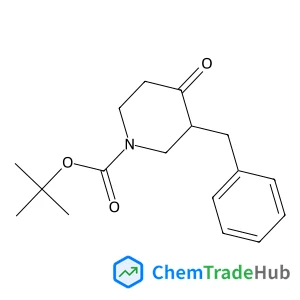
2-Methyl-2-propanyl 3-benzyl-4-oxo-1-piperidinecarboxylate
CAS Number:
193274-82-7
Molecular Formula:
C17H23NO3
Recommended Suppliers






Disclaimer
This page provides academic journal information for reference and research purposes only. We are not affiliated with any journal publishers and do not handle publication submissions. For publication-related inquiries, please contact the respective journal publishers directly.
If you notice any inaccuracies in the information displayed, please contact us at support@chemtradehub.com. We will promptly review and address your concerns.