












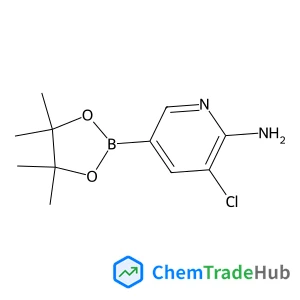
3-Chloro-5-(4,4,5,5-tetramethyl-1,3,2-dioxaborolan-2-yl)-2-pyridinamine
CAS Number:
1032758-99-8
Molecular Formula:
C11H16BClN2O2
Shuai Tan, Mark N. Prichard, Raj Kalkeri, Roger Ptak, Piet Herdewijn
The substantial impact of acyclic nucleoside phosphonates (ANPs) on human medicine encourages the synthesis of new ANP analogues with a potentially differentiated antiviral spectrum. Herein, we demonstrate the functionalization of the 2-position of the (R,S)-3-hydroxy-2-(phosphonomethoxy)propyl side-chain of an inactive ANP with a polar cyano group to generate a thymine analogue with selective inhibition of hepatitis B virus (HBV) replication (SI > 302; EC50 = 0.33 μM), without significant antiretroviral activity. These findings suggest new strategies to synthesize unique ANPs with a targeted antiviral profile.
Marina Rumyantseva, Abulkosim Nasriddinov, Alexander Gaskov, Anna Moiseeva, Yuri Fedorov, Gediminas Jonusauskas
DOI: 10.1039/C9CP07016H
Xiao-Ming Cao, Zheng-Jiang Shao
DOI: 10.1039/D0CP00554A
Sergey N. Shkerin, Ekaterina S. Ulyanova, Sergey V. Naumov
DOI: 10.1039/D0CP05107A
Mariagrazia Fortino, Elisabetta Collini, Alfonso Pedone, Julien Bloino
DOI: 10.1039/D0CP00034E
Peng Cen, Mikhail S. Tyumentsev, Mark R. St. J. Foreman
DOI: 10.1039/C9CP05982B
Florian R. Rehak, GiovanniMaria Piccini, Maristella Alessio, Joachim Sauer
DOI: 10.1039/D0CP00394H
Rupert Michiels, Aaron C. LaForge, Matthias Bohlen, Carlo Callegari, Andrew Clark, Aaron von Conta, Marcello Coreno, Michele Di Fraia, Marcel Drabbels, Paola Finetti, Martin Huppert, Veronica Oliver, Oksana Plekan, Kevin C. Prince, Stefano Stranges, Vít Svoboda, Hans Jakob Wörner, Frank Stienkemeier
DOI: 10.1039/D0CP00669F
Ana Santidrián, Magdalena Kierkowicz, Elzbieta Pach, Denisa Darvasiová, Belén Ballesteros, Gerard Tobias, Martin Kalbáč
DOI: 10.1039/D0CP01408G
Michael Gradzielski
DOI: 10.1039/D0CP01076F
Elisabeth Levrau, Matthias M. Minjauw, Michiel Van Daele, Rita Vos, Jolien Dendooven, Christophe Detavernier
DOI: 10.1039/D0CP00395F
This compound is mainly used as an intermediate in the synthesis of antipsychoti...
Waste containing 1-(D-Ribofuranosyl)-1,4-dihydro-3-pyridinecarboxamide (CAS: 191...
2-Methyl-2-propanyl 3-bromo-3-(hydroxymethyl)-1-azetidinecarboxylate (CAS: 20079...
N-(4-Chloro-2-pyridinyl)acetamide (CAS: 245056-66-0) is a chemical compound with...
5-Chloro-2-hydroxybenzoic acid, also known as 5-chlorosalicylic acid, is an arom...
When handling 1,1-Dichloro-1-fluoroethane (CAS: 1717-00-6), it is important to u...
Fmoc-(2S,3R)-3-phenylpyrrolidine-2-carboxylic acid is a white crystalline solid ...
4-Amino-5-bromo-2-pyridinecarboxylic acid is primarily used as a precursor in th...
Handling this compound should be done with personal protective equipment (PPE) i...
When handling 8-bromo-2,2-dimethyl-3,4-dihydro-2H-1,4-benzoxazin-3-one, use prop...
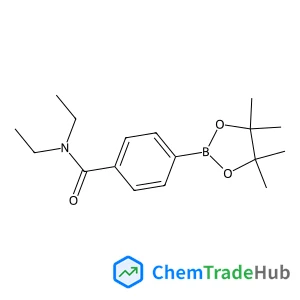
![tert-Butyl N-[(2-chloropyridin-4-yl)methyl]carbamate structure](https://static.chemtradehub.com/structs/916/916210-27-0-9f95.webp "tert-Butyl N-[(2-chloropyridin-4-yl)methyl]carbamate structure")
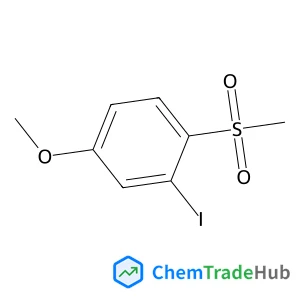
![2,6-Di(thiophen-2-yl)dithieno[3,2-b:2',3'-d]thiophene structure](https://static.chemtradehub.com/structs/910/910788-24-8-5b70.webp "2,6-Di(thiophen-2-yl)dithieno[3,2-b:2',3'-d]thiophene structure")





