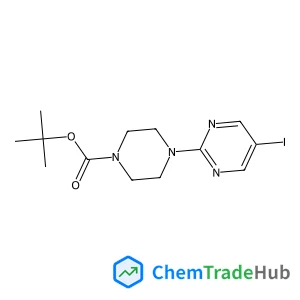
2-Methyl-2-propanyl 4-(5-iodo-2-pyrimidinyl)-1-piperazinecarboxylate
CAS Number:
1027616-32-5
Molecular Formula:
C13H19IN4O2
Patrick Kubryk, Reinhard Niessner, Natalia P. Ivleva
Raman microspectroscopy is an emerging tool to analyze the molecular and isotopic composition of single microbial cells. It can be used to achieve an in situ understanding of metabolic processes. Due to the low sensitivity of the Raman effect, surface-enhanced Raman scattering (SERS) is utilized to enhance the Raman signal. The SERS spectra of bacteria are usually characterized by a pronounced band at around 730 cm−1, which is assigned to glycosidic ring vibrations or to adenine or even to CH2 deformation in different studies. In order to clarify the origin of this band, we employed a stable isotope approach and performed a SERS analysis of Escherichia coli bacteria using in situ prepared Ag nanoparticles. The cells were grown on unlabeled (12C, 14N) and labeled (13C, 15N) carbon and nitrogen sources in different combinations. The SERS band of the stable isotope labeled microorganisms showed a characteristic red-shift in the SERS spectra, which solely depends on the isotopic composition. It was therefore possible to confidently assign this band to adenine-related compounds. Furthermore, by utilizing the fingerprint area of single-cell SERS spectra as the input for the principal component analysis, one can clearly differentiate between E. coli bacteria incorporating different stable isotopes.

Journal of Saudi Chemical Society

Chemistry Education Research and Practice

Journal of Peptide Science

New Journal of Chemistry

Journal of Natural Medicines

Russian Journal of Coordination Chemistry

Saudi Pharmaceutical Journal

Current Opinion in Solid State & Materials Science

Current Opinion in Colloid & Interface Science

Russian Journal of Bioorganic Chemistry
RaviRanjan Kumar, Gunaseelan Dhanarajan, Moumita Bhaumik, Ramkrishna Sen
DOI: 10.1039/C7SE00010C
David Lackner, Jens Ohlmann, Frank Dimroth, Roel van de Krol, Thomas Hannappel, Klaus Schwarzburg
DOI: 10.1039/C6SE00083E
Alan Le Goff, Michael Holzinger
DOI: 10.1039/C8SE00374B
Junxian Pei, Jun Huang, Zhi Huang, Kang Liu
DOI: 10.1039/C8SE00604K
Chong-Yong Lee, Yong Zhao, Caiyun Wang, David R. G. Mitchell, Gordon G. Wallace
DOI: 10.1039/C7SE00069C
Shinjita Acharya, Luciano M. Santino, Yang Lu, Hari Anandarajah, Aly Wayne
DOI: 10.1039/C7SE00057J
Xuhui Zhang, Liangzheng Zhu, Haiying Zheng, Hongxia Wang, Tasawar Hayat, Xu Pan
DOI: 10.1039/C7SE00036G
Yubing Li, Jingjing He, Yulin Wang, Xiai Zhang, Yameng Zhang, Xuexin Liu, Kunjie Wang, Yi Wang
DOI: 10.1039/C8SE00449H
Waste containing 6-Chloro-5-(2'-hydroxy-3'-methoxy-4-biphenylyl)-3-(3-methoxyphe...
(3alpha,5alpha)-3-Hydroxypregnane-11,20-dione is primarily used in the pharmaceu...
The market for 4-Amino-6-chloro-2-pyridinecarboxylic acid (CAS: 546141-56-4) is ...
Alternatives to (2-Benzoylethyl)trimethylammonium chloride (CAS: 24472-88-6) in ...
N-[4-Nitro-3-(trifluoromethyl)phenyl]acetamide (CAS: 393-12-4) is generally safe...
Alternative reagents such as other phosphates or similar functional groups can b...
There are alternatives to N,N'-Bis(3-aminopropyl)-1,3-propanediamine (CAS: 4605-...
When handling Aluminium trihexadecanoate, it is important to use appropriate per...
(1,1-Dioxido-3-oxo-1,2-benzothiazol-2(3H)-yl)acetic acid is a chemical compound ...
Several alternatives to 5,5-dimethyloxolan-2-one (CAS: 3123-97-5) can be used in...

Analyst publishes analytical and bioanalytical research that reports premier fundamental discoveries and inventions, and the applications of those discoveries, unconfined by traditional discipline barriers.