












O-Acetylated sugars in the gas phase: stability, migration, positional isomers and conformation
Literature Information
Publication Date
2021-11-25
DOI
10.1039/D1CP04837F
Impact Factor
3.676
Authors
Oznur Yeni, Amira Gharbi, Stéphane Chambert, Jean Rouillon, Abdul-Rahman Allouche, Baptiste Schindler, Isabelle Compagnon
View Original
Abstract
O-Acetylations are functional modifications which can be found on different hydroxyl groups of glycans and which contribute to the fine tuning of their biological activity. Localizing the acetyl modifications is notoriously challenging in glycoanalysis, in particular because of their mobility: loss or migration of the acetyl group may occur through the analytical workflow. Whereas migration conditions in the condensed phase have been rationalized, little is known about the suitability of Mass Spectrometry to retain and resolve the structure of O-acetylated glycan isomers. Here we used the resolving power of infrared ion spectroscopy in combination with ab initio calculations to assess the structure of O-acetylated monosaccharide ions in the gaseous environment of a mass analyzer. N-Acetyl glucosamines were synthetized with an O-acetyl group in positions 3 or 6, respectively. The protonated ions produced by electrospray ionization were observed by mass spectrometry and their vibrational fingerprints were recorded in the 3 μm range by IRMPD spectroscopy (InfraRed Multiple Photon Dissociation). Experimentally, the isomers show distinctive IR fingerprints. Additionally, ab initio calculations confirm the position of the O-acetylation and resolve their gas phase conformation. These findings demonstrate that the position of O-acetyl groups is retained through the transfer from solution to the gas phase, and can be identified by IRMPD spectroscopy.
Recommended Journals
Related Literature
Pulsed EPR characterization of HIV-1 protease conformational sampling and inhibitor-induced population shifts
Zhanglong Liu, Thomas M. Casey, Mandy E. Blackburn, Xi Huang, Linh Pham, Ian Mitchelle S. de Vera, Jeffrey D. Carter, Jamie L. Kear-Scott, Angelo M. Veloro, Luis Galiano, Gail E. Fanucci
2015-10-09
Paper
DOI: 10.1039/C5CP04556H
Mildly reduced less defective graphene oxide/sulfur/carbon nanotube composite films for high-performance lithium–sulfur batteries
Rui Li, Miao Zhang, Yingru Li, Ji Chen, Bowen Yao, Mingpeng Yu, Gaoquan Shi
2016-03-18
Paper
DOI: 10.1039/C6CP00512H
The structure–function relationship for alumina supported platinum during the formation of ammonia from nitrogen oxide and hydrogen in the presence of oxygen
Emma Catherine Adams, Lindsay Richard Merte, Anders Hellman, Magnus Skoglundh, Johan Gustafson, Eva Charlotte Bendixen, Pär Gabrielsson, Florian Bertram, Jonas Evertsson, Chu Zhang, Stefan Carlson, Per-Anders Carlsson
2016-03-30
Communication
DOI: 10.1039/C5CP07624B
Plutonium and transplutonium element trioxides: molecular structures, chemical bonding, and isomers
2015-08-21
Paper
DOI: 10.1039/C5CP02190A
Vibronic coupling in the excited-states of carotenoids
Takeshi Miki, Tiago Buckup, Marie S. Krause, June Southall, Richard J. Cogdell, Marcus Motzkus
2016-03-23
Paper
DOI: 10.1039/C5CP07542D
Rational design of hierarchical ZnO superstructures for efficient charge transfer: mechanistic and photovoltaic studies of hollow, mesoporous, cage-like nanostructures with compacted 1D building blocks
Tridip Ranjan Chetia, Mohammad Shaad Ansari, Mohammad Qureshi
2016-01-19
Paper
DOI: 10.1039/C5CP07687K
Self-assembled nanoparticle patterns on carbon nanowall surfaces
N. V. Suetin, S. A. Evlashin, A. V. Egorov, K. V. Mironovich, S. A. Dagesyan, L. V. Yashina, E. A. Goodilin, V. A. Krivchenko
2016-03-31
Paper
DOI: 10.1039/C6CP01638C
Designing graphene as a new frustrated Lewis pair catalyst for hydrogen activation by co-doping
Bo Li, TianFu Liu, Jian Song, Dang Sheng Su
2016-03-24
Paper
DOI: 10.1039/C5CP07969A
Insights into the allosteric regulation of Syk association with receptor ITAM, a multi-state equilibrium
Chao Feng, Carol Beth Post
2015-10-08
Paper
DOI: 10.1039/C5CP05417F
Theoretical predictions of structures in dispersions containing charged colloidal particles and non-adsorbing polymers
Fei Xie, Martin Turesson, Clifford E. Woodward, Kitty van Gruijthuijsen, Anna Stradner, Jan Forsman
2016-03-30
Paper
DOI: 10.1039/C5CP07814H
You might also like
Compound Q&A
What are the main uses of 1-(3-Aminophenyl)-3-[(3R)-1-(3,3-dimethyl-2-oxobutyl)-2-oxo-5-(2-pyridinyl)-2,3-dihydro-1H-1,4-benzodiazepin-3-yl]urea (CAS: 155412-88-7)?
This compound is mainly used as an intermediate in the synthesis of antipsychoti...
155412-88-71-(3-Aminophenyl)-3-...
Compound Q&A
How should waste containing 1-(D-Ribofuranosyl)-1,4-dihydro-3-pyridinecarboxamide (CAS: 19132-12-8) be handled?
Waste containing 1-(D-Ribofuranosyl)-1,4-dihydro-3-pyridinecarboxamide (CAS: 191...
19132-12-81-(D-Ribofuranosyl)-...
Compound Q&A
What regulatory guidelines apply to 2-Methyl-2-propanyl 3-bromo-3-(hydroxymethyl)-1-azetidinecarboxylate (CAS: 2007919-81-3)?
2-Methyl-2-propanyl 3-bromo-3-(hydroxymethyl)-1-azetidinecarboxylate (CAS: 20079...
2007919-81-32-Methyl-2-propanyl ...
Compound Q&A
What is N-(4-Chloro-2-pyridinyl)acetamide (CAS: 245056-66-0)?
N-(4-Chloro-2-pyridinyl)acetamide (CAS: 245056-66-0) is a chemical compound with...
245056-66-0N-(4-Chloro-2-pyridi...
Compound Q&A
What is 5-Chloro-2-hydroxybenzoic acid (CAS: 321-14-2)?
5-Chloro-2-hydroxybenzoic acid, also known as 5-chlorosalicylic acid, is an arom...
321-14-25-Chloro-2-hydroxybe...
Compound Q&A
What precautions should be taken when handling 1,1-Dichloro-1-fluoroethane (CAS: 1717-00-6)?
When handling 1,1-Dichloro-1-fluoroethane (CAS: 1717-00-6), it is important to u...
1717-00-61,1-Dichloro-1-fluor...
Compound Q&A
What are the physical and chemical properties of Fmoc-(2S,3R)-3-phenylpyrrolidine-2-carboxylic acid (CAS: 281655-32-1)?
Fmoc-(2S,3R)-3-phenylpyrrolidine-2-carboxylic acid is a white crystalline solid ...
281655-32-1Fmoc-(2S,3R)-3-pheny...
Compound Q&A
What are the main uses of 4-Amino-5-bromo-2-pyridinecarboxylic acid (CAS: 1363381-01-4)?
4-Amino-5-bromo-2-pyridinecarboxylic acid is primarily used as a precursor in th...
1363381-01-44-Amino-5-bromo-2-py...
Compound Q&A
What precautions should be taken when handling (S)-tert-butyl 2-((2-(4-bromophenyl)-2-oxoethyl)carbamoyl)pyrrolidine-1-carboxylate (CAS: 1007881-98-2)?
Handling this compound should be done with personal protective equipment (PPE) i...
1007881-98-2(S)-tert-butyl 2-((2...
Compound Q&A
What precautions should be taken when handling 8-bromo-2,2-dimethyl-3,4-dihydro-2H-1,4-benzoxazin-3-one (CAS: 688363-73-7)?
When handling 8-bromo-2,2-dimethyl-3,4-dihydro-2H-1,4-benzoxazin-3-one, use prop...
688363-73-78-bromo-2,2-dimethyl...
Source Journal
Physical Chemistry Chemical Physics

CiteScore:
5.5
Self-citation Rate:
10.3%
Articles per Year:
3036
Physical Chemistry Chemical Physics (PCCP) is an international journal co-owned by 19 physical chemistry and physics societies from around the world. This journal publishes original, cutting-edge research in physical chemistry, chemical physics and biophysical chemistry. To be suitable for publication in PCCP, articles must include significant innovation and/or insight into physical chemistry; this is the most important criterion that reviewers and Editors will judge against when evaluating submissions. The journal has a broad scope and welcomes contributions spanning experiment, theory, computation and data science. Topical coverage includes spectroscopy, dynamics, kinetics, statistical mechanics, thermodynamics, electrochemistry, catalysis, surface science, quantum mechanics, quantum computing and machine learning. Interdisciplinary research areas such as polymers and soft matter, materials, nanoscience, energy, surfaces/interfaces, and biophysical chemistry are welcomed if they demonstrate significant innovation and/or insight into physical chemistry. Joined experimental/theoretical studies are particularly appreciated when complementary and based on up-to-date approaches.
Recommended Compounds
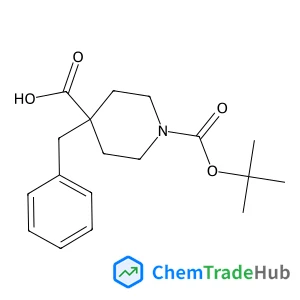
4-Benzyl-1-(tert-butoxycarbonyl)piperidine-4-carboxylic acid
CAS Number:
170838-87-6
Molecular Formula:
C18H25NO4
Recommended Suppliers






Disclaimer
This page provides academic journal information for reference and research purposes only. We are not affiliated with any journal publishers and do not handle publication submissions. For publication-related inquiries, please contact the respective journal publishers directly.
If you notice any inaccuracies in the information displayed, please contact us at support@chemtradehub.com. We will promptly review and address your concerns.