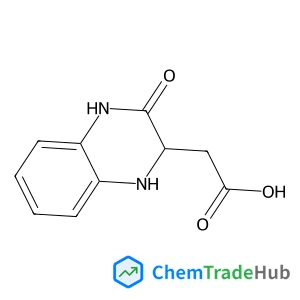
(3-Oxo-1,2,3,4-tetrahydro-2-quinoxalinyl)acetic acid
CAS Number:
136584-14-0
Molecular Formula:
C10H10N2O3
J. J. Pais Pereda
A large variety of recently predicted and synthesized 2D materials significantly broaden the capabilities of magnetic interface design for spintronic applications. Their diverse structural and electronic properties allow fine adjustment of interfacial interactions between the electrode and spacer materials providing robust and effective spin transport. Based on recent experimental results, here we present a theoretical study of novel interfaces formed by a half-metallic Co2FeGe1/2Ga1/2 (CFGG) substrate with h-BN or MoSe2 monolayer on its top. By means of the DFT approach, the structural, magnetic and electronic properties are studied for the Co- and FeGeGa termination of the CFGG surface. The observed large spin polarization in the vicinity of the interface and robust magnetization exhibit the potential of 2D materials/CFGG heterostructures for spintronic applications.
Chunwang Peng, Yun Xie, Jian Zhou
DOI: 10.1039/C6CP00170J
Jing-Jing Huang, Yong J. Yuan
DOI: 10.1039/C6CP00167J
Leining Zhang, Weikang Wu, Yi Zhou, Hongru Ren, Jichen Dong, Hui Li
DOI: 10.1039/C5CP07641B
Qin Wang, Shunyong Hou, Liang Xu, Jianping Yin
DOI: 10.1039/C5CP06392B
L. D. Antonov, W. Boomsma, T. Hamelryck
DOI: 10.1039/C5CP04886A
B. Eggers, M. Metzler, D. Künzel, A. Groß, T. Jacob, U. Ziener
DOI: 10.1039/C5CP07853A
Rania S. Seoudi, Annette Dowd, Brian J. Smith, Adam Mechler
DOI: 10.1039/C6CP01355D
Zhiqi Li, Shujun Li, Zhihui Zhang, Xinyuan Zhang, Jingfeng Li, Chunyu Liu, Wenbin Guo, Shengping Ruan
DOI: 10.1039/C6CP00989A
Aurélien Bornet, Sami Jannin
DOI: 10.1039/C5CP07884A
This compound is mainly used as an intermediate in the synthesis of antipsychoti...
Waste containing 1-(D-Ribofuranosyl)-1,4-dihydro-3-pyridinecarboxamide (CAS: 191...
2-Methyl-2-propanyl 3-bromo-3-(hydroxymethyl)-1-azetidinecarboxylate (CAS: 20079...
N-(4-Chloro-2-pyridinyl)acetamide (CAS: 245056-66-0) is a chemical compound with...
5-Chloro-2-hydroxybenzoic acid, also known as 5-chlorosalicylic acid, is an arom...
When handling 1,1-Dichloro-1-fluoroethane (CAS: 1717-00-6), it is important to u...
Fmoc-(2S,3R)-3-phenylpyrrolidine-2-carboxylic acid is a white crystalline solid ...
4-Amino-5-bromo-2-pyridinecarboxylic acid is primarily used as a precursor in th...
Handling this compound should be done with personal protective equipment (PPE) i...
When handling 8-bromo-2,2-dimethyl-3,4-dihydro-2H-1,4-benzoxazin-3-one, use prop...

Physical Chemistry Chemical Physics (PCCP) is an international journal co-owned by 19 physical chemistry and physics societies from around the world. This journal publishes original, cutting-edge research in physical chemistry, chemical physics and biophysical chemistry. To be suitable for publication in PCCP, articles must include significant innovation and/or insight into physical chemistry; this is the most important criterion that reviewers and Editors will judge against when evaluating submissions. The journal has a broad scope and welcomes contributions spanning experiment, theory, computation and data science. Topical coverage includes spectroscopy, dynamics, kinetics, statistical mechanics, thermodynamics, electrochemistry, catalysis, surface science, quantum mechanics, quantum computing and machine learning. Interdisciplinary research areas such as polymers and soft matter, materials, nanoscience, energy, surfaces/interfaces, and biophysical chemistry are welcomed if they demonstrate significant innovation and/or insight into physical chemistry. Joined experimental/theoretical studies are particularly appreciated when complementary and based on up-to-date approaches.