












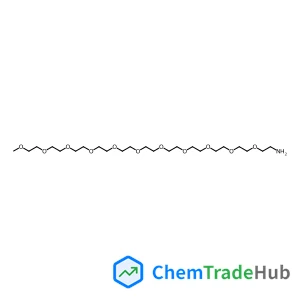
2,5,8,11,14,17,20,23,26,29,32-Undecaoxatetratriacontan-34-amine
CAS Number:
854601-60-8
Molecular Formula:
C23H49NO11
Meghna A. Manae, Lakshay Dheer, Sandhya Rai, Sharan Shetty, Umesh V. Waghmare
One of the most challenging topics in heterogeneous catalysis is conversion of CH4 to higher hydrocarbons. Direct conversion of CH4 to ethylene can be achieved via the oxidative coupling of methane (OCM) reaction. Despite studies which have shown MgO to activate CH4 and initiate the OCM reaction, its large-scale applications face a significant impediment due to formation of a byproduct, CO2, and poisoning of the catalyst due to carbonate formation. In the present work, we address two aspects of the OCM reaction on MgO surfaces: carbonate formation on the surface of the catalyst, and (dissociative) adsorption of CH4. We use first-principles density functional theoretical calculations to determine the energetics and underlying mechanisms of interaction of CO2 and CH4 with various surfaces of MgO: (100), (110), and (111) (both Mg- and O-terminations), and the seldom studied, hydroxylated (111) MgO surface with O-termination. We find that the strength of the interaction of CO2 with MgO surfaces depends on several factors: their surface energies, coordination number of surface O atoms, and ability to donate electrons. However, the O-terminated (111) surface of MgO bucks all aforementioned factors, with only oxygen richness affecting its reactivity towards CO2. The interaction of CH4 with MgO surfaces depends primarily on the coordination number of the surface O atoms and the orientation of the CH4 molecule with respect to the surface. Finally, we provide insights into (a) formation of surface carbonates, which is relevant to CO2 capture and conversion, and (b) C–H bond activation on MgO surfaces, which is crucial for direct conversion of CH4 to value-added chemicals.
Masao Morita, Shangze Wu, Yuichi Kobayashi
DOI: 10.1039/C8OB03128B
Xiaocong Pei, Guan Zhou, Xuejing Li, Yuchen Xu, Resmi C. Panicker, Rajavel Srinivasan
DOI: 10.1039/C9OB00995G
Tao Zhou, Tingjie You, Jianhui Chen, Chenliang Su, Yuanzhi Xia
DOI: 10.1039/C9OB00494G
Chang-Dong Xie, Yahu A. Liu, Xue-Shun Jia, Wei-Bo Hu
DOI: 10.1039/C9OB00665F
Elisabetta Brenna, Francesco Dalla Santa, Francesco G. Gatti, Giuseppe Gatti, Davide Tessaro
DOI: 10.1039/C8OB02715C
Shun Masuda, Shugo Tsuda, Taku Yoshiya
DOI: 10.1039/C8OB02778A
Jun-Ru Guo, Jun-Fang Gong, Mao-Ping Song
DOI: 10.1039/C9OB00449A
Thorsten Kinsinger, Uli Kazmaier
DOI: 10.1039/C9OB00966C
Andrey G. Lvov, Vadim V. Kachala, Konstantin A. Lyssenko, Valerii Z. Shirinian
DOI: 10.1039/C9OB00690G
Liwen Bai, Pian Chen, Jiangxia Xiang, Jiarui Sun, Xinxiang Lei
DOI: 10.1039/C8OB03012J
3-Fluoro-2-methylbenzylamine is an organic compound with the CAS number 771573-3...
Tert-butyl 2-(oxetan-3-ylidene)acetate is considered safe for its intended uses ...
Proper personal protective equipment (PPE) such as gloves, goggles, and a lab co...
2-Ethyl-4-methyl-1,3-thiazole is commonly synthesized via the reaction of thiour...
This compound should be stored in a cool, dry place away from direct sunlight an...
L-Lysine Acetate Salt (CAS: 52315-92-1) is subject to various regulatory guideli...
6-Fluoro-3-hydroxy-2-pyrazinecarboxamide (CAS: 259793-96-9) is generally conside...
1,1'-Sulfonylbis(1H-imidazole) is a crystalline solid with a molecular weight of...
4-Methyl-7-nitro-1H-indole-3-carbonitrile (CAS: 289483-82-5) is primarily used i...
Waste containing 5-Bromo-3-indolyl-beta-galactoside (CAS: 97753-82-7) should be ...

Physical Chemistry Chemical Physics (PCCP) is an international journal co-owned by 19 physical chemistry and physics societies from around the world. This journal publishes original, cutting-edge research in physical chemistry, chemical physics and biophysical chemistry. To be suitable for publication in PCCP, articles must include significant innovation and/or insight into physical chemistry; this is the most important criterion that reviewers and Editors will judge against when evaluating submissions. The journal has a broad scope and welcomes contributions spanning experiment, theory, computation and data science. Topical coverage includes spectroscopy, dynamics, kinetics, statistical mechanics, thermodynamics, electrochemistry, catalysis, surface science, quantum mechanics, quantum computing and machine learning. Interdisciplinary research areas such as polymers and soft matter, materials, nanoscience, energy, surfaces/interfaces, and biophysical chemistry are welcomed if they demonstrate significant innovation and/or insight into physical chemistry. Joined experimental/theoretical studies are particularly appreciated when complementary and based on up-to-date approaches.
![5-(2-Phenylpyrazolo[1,5-a]pyridin-3-yl)-2H-pyrazolo[3,4-c]pyridazin-3-amine structure](https://static.chemtradehub.com/structs/865/865362-74-9-0091.webp "5-(2-Phenylpyrazolo[1,5-a]pyridin-3-yl)-2H-pyrazolo[3,4-c]pyridazin-3-amine structure")



