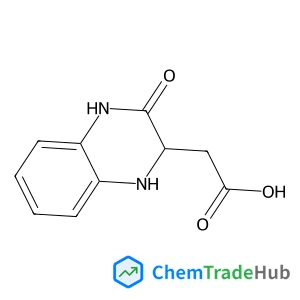
(3-Oxo-1,2,3,4-tetrahydro-2-quinoxalinyl)acetic acid
CAS Number:
136584-14-0
Molecular Formula:
C10H10N2O3
Noncentrosymmetric superconductors are strong candidates for exploring intrinsic topological superconductivity. Here, we predict two new noncentrosymmetric superconductors SnVSe2 and PbVSe2 by a systematic first-principles study. These two compounds show good thermal and dynamic stabilities. Moreover, the band topology of both compounds is predicted to be nontrivial via Z2 calculation and slab models. We also investigate the electron–phonon interactions in SnVSe2 and PbVSe2, indicating the Tc of SnVSe2 and PbVSe2 without external pressure are predicted to be ∼1.18 K and ∼0.22 K, respectively. Furthermore, the results on pressure engineering in PbVSe2 imply that the Tc of PbVSe2 can be tuned to 2.39 K for enhanced contributions from Pb layers under pressure up to 6.4 GPa. This work may provide new platforms for probing spin-triplet paring and may help with designing and developing new metal-intercalated transition metal dichalcogenides.
Arturo Moncho-Jordá
DOI: 10.1039/C5CP07794J
Shin-ichi Yamazaki, Yusuke Yamada, Sahori Takeda, Midori Goto, Tsutomu Ioroi, Zyun Siroma, Kazuaki Yasuda
DOI: 10.1039/C6CP90101H
Niklas Nilius, Hanna Fedderwitz, Boris Groß, Claudine Noguera, Jacek Goniakowski
DOI: 10.1039/C5CP06933E
Hong-Dan Peng, Jia-Mei Yang, Jing-Hui Yan, Ge-Bo Pan
DOI: 10.1039/C5CP05507E
B. Eggers, M. Metzler, D. Künzel, A. Groß, T. Jacob, U. Ziener
DOI: 10.1039/C5CP07853A
J. Hyodo, H. Schraknepper, K. Tominaga
DOI: 10.1039/C5CP07192E
Saugata Sahu, Minati Das, G. Krishnamoorthy
DOI: 10.1039/C5CP07949G
Li Jiang, Chunru Wang
DOI: 10.1039/C6CP00249H
This compound is mainly used as an intermediate in the synthesis of antipsychoti...
Waste containing 1-(D-Ribofuranosyl)-1,4-dihydro-3-pyridinecarboxamide (CAS: 191...
2-Methyl-2-propanyl 3-bromo-3-(hydroxymethyl)-1-azetidinecarboxylate (CAS: 20079...
N-(4-Chloro-2-pyridinyl)acetamide (CAS: 245056-66-0) is a chemical compound with...
5-Chloro-2-hydroxybenzoic acid, also known as 5-chlorosalicylic acid, is an arom...
When handling 1,1-Dichloro-1-fluoroethane (CAS: 1717-00-6), it is important to u...
Fmoc-(2S,3R)-3-phenylpyrrolidine-2-carboxylic acid is a white crystalline solid ...
4-Amino-5-bromo-2-pyridinecarboxylic acid is primarily used as a precursor in th...
Handling this compound should be done with personal protective equipment (PPE) i...
When handling 8-bromo-2,2-dimethyl-3,4-dihydro-2H-1,4-benzoxazin-3-one, use prop...

Physical Chemistry Chemical Physics (PCCP) is an international journal co-owned by 19 physical chemistry and physics societies from around the world. This journal publishes original, cutting-edge research in physical chemistry, chemical physics and biophysical chemistry. To be suitable for publication in PCCP, articles must include significant innovation and/or insight into physical chemistry; this is the most important criterion that reviewers and Editors will judge against when evaluating submissions. The journal has a broad scope and welcomes contributions spanning experiment, theory, computation and data science. Topical coverage includes spectroscopy, dynamics, kinetics, statistical mechanics, thermodynamics, electrochemistry, catalysis, surface science, quantum mechanics, quantum computing and machine learning. Interdisciplinary research areas such as polymers and soft matter, materials, nanoscience, energy, surfaces/interfaces, and biophysical chemistry are welcomed if they demonstrate significant innovation and/or insight into physical chemistry. Joined experimental/theoretical studies are particularly appreciated when complementary and based on up-to-date approaches.