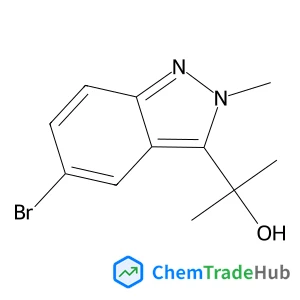
2-(5-Bromo-2-methyl-2H-indazol-3-yl)-2-propanol
CAS Number:
1823787-20-7
Molecular Formula:
C11H13BrN2O
Therese Eriksson, Amber Mace, Jonas Mindemark, Daniel Brandell
Both polyesters and polycarbonates have been proposed as alternatives to polyethers as host materials for future polymer electrolytes for solid-state lithium-ion batteries. While being comparatively similar functional groups, the electron density on the coordinating carbonyl oxygen is different, thereby rendering different coordinating strength towards lithium ions. In this study, the transport properties of poly(ε-caprolactone) and poly(trimethylene carbonate) as well as random copolymers of systematically varied composition of the two have been investigated, in order to better elucidate the role of the coordination strength. The cationic transference number, a property well-connected with the complexing ability of the polymer, was shown to depend almost linearly on the ester content of the copolymer, increasing from 0.49 for the pure poly(ε-caprolactone) to 0.83 for pure poly(trimethylene carbonate). Contradictory to the transference number measurements that suggest a stronger lithium-to-ester coordination, DFT calculations showed that the carbonyl oxygen in the carbonate coordinates more strongly to the lithium ion than that of the ester. FT-IR measurements showed the coordination number to be higher in the polyester system, resulting in a higher total coordination strength and thereby resolving the paradox. This likely originates in properties that are specific of polymeric solvent systems, e.g. steric properties and chain dynamics, which influence the coordination chemistry. These results highlight the complexity in polymeric systems and their ion transport properties in comparison to low-molecular-weight analogues, and how polymer structure and steric effects together affect the coordination strength and transport properties.
Yunhong Liu, Fenying Wang, Jianwei Zhao, Luyun Jiang, Manabu Kiguchi, Kei Murakoshi
DOI: 10.1039/B902795E
DOI: 10.1039/C0CP90058C
Valéria Moraes Longo, Maria das Graça Sampaio Costa, Alexandre Zirpole Simões, Ieda Lúcia Viana Rosa, Carlos Oliveira Paiva Santos, Juan Andrés, Elson Longo, José Arana Varela
DOI: 10.1039/B923281H
Yuhei Tanaka, Tamitake Itoh, Yukihiro Ozaki
DOI: 10.1039/C000824A
Jonas M. Hostettler, Luca Castiglioni, Andreas Bach, Peter Chen
DOI: 10.1039/B909830E
DOI: 10.1039/C003389H
Selvarengan Paranthaman, François-Xavier Coudert, Alain H. Fuchs
DOI: 10.1039/B925074C
When handling 2-Methyl-2-propanyl 5-amino-2-thiophenecarboxylate (CAS: 1498311-5...
5-Bromo-1,2-dichloro-3-fluorobenzene (CAS: 1000572-93-9) is a crystalline solid ...
(2R)-2-Amino-2-(4-bromophenyl)ethanol (CAS: 354153-64-3) should be stored in a c...
Methyl 4-(aminomethyl)tetrahydro-2H-pyran-4-carboxylate hydrochloride (CAS: 3627...
1,4-Dimethyl-1H-pyrazole-5-sulfonyl chloride is primarily used as an intermediat...
Dinaphtho[1,2-b:2',1'-d]furan is generally safe when handled with appropriate pe...
The market for 7-Methyl-7,9-dihydro-1H-purine-2,6,8(3H)-trione (CAS: 612-37-3) i...
2-(4-Chlorophenyl)malonaldehyde (CAS: 205676-17-1) is a colorless or light yello...
2-Methylchrysene (CAS: 3351-32-4) is typically synthesized via the reaction of c...
N-(6-aminopyrimidin-4-yl)acetamide (CAS: 89533-23-3) is generally considered saf...

Physical Chemistry Chemical Physics (PCCP) is an international journal co-owned by 19 physical chemistry and physics societies from around the world. This journal publishes original, cutting-edge research in physical chemistry, chemical physics and biophysical chemistry. To be suitable for publication in PCCP, articles must include significant innovation and/or insight into physical chemistry; this is the most important criterion that reviewers and Editors will judge against when evaluating submissions. The journal has a broad scope and welcomes contributions spanning experiment, theory, computation and data science. Topical coverage includes spectroscopy, dynamics, kinetics, statistical mechanics, thermodynamics, electrochemistry, catalysis, surface science, quantum mechanics, quantum computing and machine learning. Interdisciplinary research areas such as polymers and soft matter, materials, nanoscience, energy, surfaces/interfaces, and biophysical chemistry are welcomed if they demonstrate significant innovation and/or insight into physical chemistry. Joined experimental/theoretical studies are particularly appreciated when complementary and based on up-to-date approaches.
![1-Oxa-8-azaspiro[4.5]decan-3-ol structure](https://static.chemtradehub.com/structs/757/757239-76-2-a0ec.webp "1-Oxa-8-azaspiro[4.5]decan-3-ol structure")