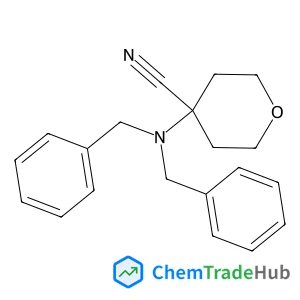
4-(Dibenzylamino)tetrahydro-2H-pyran-4-carbonitrile
CAS Number:
1630906-81-8
Molecular Formula:
C20H22N2O
Valéria Moraes Longo, Maria das Graça Sampaio Costa, Alexandre Zirpole Simões, Ieda Lúcia Viana Rosa, Carlos Oliveira Paiva Santos, Juan Andrés, Elson Longo, José Arana Varela
A combined experimental and theoretical investigation on the photoluminescence properties of SrTiO3 (ST) and SrSm0.01Ti0.99O3 (ST_Sm) nanostructures is presented in this work. The nanocrystalline powders were prepared by the polymeric precursor method, and the order–disorder behavior of this material was investigated by means of X-ray diffraction (XRD), spectral absorbance (UV-vis), transmission electron microscopy (TEM) images, electron paramagnetic resonance (EPR) and photoluminescence (PL) experimental techniques. The decrease in the broad PL emission band of ST and ST_Sm powders measured at room temperature indicates an increase in the structural order as the annealing temperature increases, i.e. characteristic samarium peaks intensify as the structural order increases in ST_Sm samples. The interactions of the network clusters that form the ST and ST_Sm structures were evaluated by means of the ab initio periodic method at the density functional theory (DFT) level with the hybrid nonlocal B3LYP approximation. The symmetry-breaking process that leads to the presence of non-ideal [TiO6] and [SrO12] clusters, as well as the relationship between these clusters, provides favorable structural and electronic conditions for the appearance of PL phenomena.
Ganesh Sambasivam, Karthikeyan Sivashanmugam
DOI: 10.1039/D3OB90144K
Irene Sánchez-Sordo, Sergio Barbeira-Arán, Martín Fañanás-Mastral
DOI: 10.1039/D3QO01631E
Kanak Kanti Das, Somenath Mahato, Debraj Ghorai, Sutapa Dey, Santanu Panda
DOI: 10.1039/D3QO01838E
DOI: 10.1039/D3QO01735D
Baihui Liang, Xiangya Cai, JingYu Liu, Jie Huang, Youzhi Chen, Haiyin Deng, Quanquan Zhou, Tianxiang Chen, Xiuwen Chen, Zhongzhi Zhu
DOI: 10.1039/D3QO01565C
Zhengqiang Liu, Wenbo H. Liu
DOI: 10.1039/D3QO01805A
Hong-Yan Shen, Xu-Dong Mao
DOI: 10.1039/D3QO01841E
Wang Chen, Xin-yu Liu, Yi-Fan Jiang, Weidong Rao, Shu-Su Shen, Zhao-Ying Yang, Shun-Yi Wang
DOI: 10.1039/D3QO01868G
When handling 2-Methyl-2-propanyl 5-amino-2-thiophenecarboxylate (CAS: 1498311-5...
5-Bromo-1,2-dichloro-3-fluorobenzene (CAS: 1000572-93-9) is a crystalline solid ...
(2R)-2-Amino-2-(4-bromophenyl)ethanol (CAS: 354153-64-3) should be stored in a c...
Methyl 4-(aminomethyl)tetrahydro-2H-pyran-4-carboxylate hydrochloride (CAS: 3627...
1,4-Dimethyl-1H-pyrazole-5-sulfonyl chloride is primarily used as an intermediat...
Dinaphtho[1,2-b:2',1'-d]furan is generally safe when handled with appropriate pe...
The market for 7-Methyl-7,9-dihydro-1H-purine-2,6,8(3H)-trione (CAS: 612-37-3) i...
2-(4-Chlorophenyl)malonaldehyde (CAS: 205676-17-1) is a colorless or light yello...
2-Methylchrysene (CAS: 3351-32-4) is typically synthesized via the reaction of c...
N-(6-aminopyrimidin-4-yl)acetamide (CAS: 89533-23-3) is generally considered saf...

Physical Chemistry Chemical Physics (PCCP) is an international journal co-owned by 19 physical chemistry and physics societies from around the world. This journal publishes original, cutting-edge research in physical chemistry, chemical physics and biophysical chemistry. To be suitable for publication in PCCP, articles must include significant innovation and/or insight into physical chemistry; this is the most important criterion that reviewers and Editors will judge against when evaluating submissions. The journal has a broad scope and welcomes contributions spanning experiment, theory, computation and data science. Topical coverage includes spectroscopy, dynamics, kinetics, statistical mechanics, thermodynamics, electrochemistry, catalysis, surface science, quantum mechanics, quantum computing and machine learning. Interdisciplinary research areas such as polymers and soft matter, materials, nanoscience, energy, surfaces/interfaces, and biophysical chemistry are welcomed if they demonstrate significant innovation and/or insight into physical chemistry. Joined experimental/theoretical studies are particularly appreciated when complementary and based on up-to-date approaches.
![2-[2-(2-Methoxyethoxy)ethoxy]-2-methylpropane structure](https://static.chemtradehub.com/structs/527/52788-79-1-71c1.webp "2-[2-(2-Methoxyethoxy)ethoxy]-2-methylpropane structure")
![4-Chloro-N-{[4-(dimethylamino)phenyl]carbamoyl}benzenesulfonamide structure](https://static.chemtradehub.com/structs/558/5581-42-0-7dcb.webp "4-Chloro-N-{[4-(dimethylamino)phenyl]carbamoyl}benzenesulfonamide structure")