












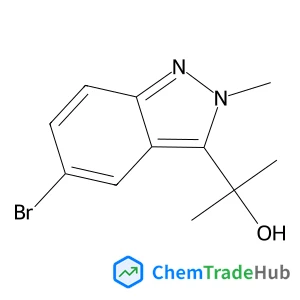
2-(5-Bromo-2-methyl-2H-indazol-3-yl)-2-propanol
CAS Number:
1823787-20-7
Molecular Formula:
C11H13BrN2O
Nguyen Thanh Si, Nguyen Phi Hung
Molecular structures and properties of the binary clusters containing twelve boron atoms mixed with n lithium atoms, B12Lin with n = 1–14, were investigated using density functional theory with the TPSSh functional and the 6-311+G(d) basis set. Energetic parameters including relative energies, average binding energies and second-order energies of the entire series were predicted using the coupled-cluster theory (U)CCSD(T) in conjunction with the cc-pVTZ basis set. Several lowest-lying isomers were determined for each size B12Lin whose energies differ from each other by <3 kcal mol−1, except for n = 1, 2 and 4 (≤5 kcal mol−1), and particularly n = 8 (∼13 kcal mol−1). Electronic structure and chemical bonding in some specific sizes such as B12Li4, B12Li8 and B12Li14 were analyzed in detail. We established the electron shells of some magic clusters such as the B12Li4 cone for which we proposed a mixed cone-disk electron shell model. Thanks to both the phenomenological shell and Clemenger–Nilsson models, B12Li8 which contains a specific set of shells of 44 valence electrons is a high stability species. The arrangement of Li atoms around a fullerene B12 framework shows that the mixed B12Li8 emerges as the most suitable of this cluster series to adsorb molecular hydrogen. Up to 32 H2 molecules can strongly be attached to the B12Li8 cluster which is thus predicted to be a realistic candidate for hydrogen storage material with gravimetric density reaching up to a theoritical limit of 26 wt%. Attachment of the fifth H2 molecule to each Li atom of B12Li8 results in weaker average bonds but can give rise to a total of 40 H2 molecules, corresponding to 30 wt% of hydrogen.
Henar Hernández, J. C. Losada, R. M. Benito
DOI: 10.1039/B902486G
Eugen Illenberger
DOI: 10.1039/B908192E
Dorota Koziej, Michael Hübner, Nicolae Barsan, Udo Weimar, Marcin Sikora, Jan-Dierk Grunwaldt
DOI: 10.1039/B906829E
Jingjing Zheng, Donald G. Truhlar
DOI: 10.1039/B927504E
Alexandra Nemeth, Vladimír Lukeš, Jaroslaw Sperling, Franz Milota, Tomáš Mančal
DOI: 10.1039/B902477H
Ling Liu, Jianbing Zhao, Patricia J. Culligan, Xi Chen
DOI: 10.1039/B905641F
DOI: 10.1039/B821452B
Gloria Preda, Gianfranco Pacchioni, Mario Chiesa, Elio Giamello
DOI: 10.1039/B906192D
When handling 2-Methyl-2-propanyl 5-amino-2-thiophenecarboxylate (CAS: 1498311-5...
5-Bromo-1,2-dichloro-3-fluorobenzene (CAS: 1000572-93-9) is a crystalline solid ...
(2R)-2-Amino-2-(4-bromophenyl)ethanol (CAS: 354153-64-3) should be stored in a c...
Methyl 4-(aminomethyl)tetrahydro-2H-pyran-4-carboxylate hydrochloride (CAS: 3627...
1,4-Dimethyl-1H-pyrazole-5-sulfonyl chloride is primarily used as an intermediat...
Dinaphtho[1,2-b:2',1'-d]furan is generally safe when handled with appropriate pe...
The market for 7-Methyl-7,9-dihydro-1H-purine-2,6,8(3H)-trione (CAS: 612-37-3) i...
2-(4-Chlorophenyl)malonaldehyde (CAS: 205676-17-1) is a colorless or light yello...
2-Methylchrysene (CAS: 3351-32-4) is typically synthesized via the reaction of c...
N-(6-aminopyrimidin-4-yl)acetamide (CAS: 89533-23-3) is generally considered saf...

Physical Chemistry Chemical Physics (PCCP) is an international journal co-owned by 19 physical chemistry and physics societies from around the world. This journal publishes original, cutting-edge research in physical chemistry, chemical physics and biophysical chemistry. To be suitable for publication in PCCP, articles must include significant innovation and/or insight into physical chemistry; this is the most important criterion that reviewers and Editors will judge against when evaluating submissions. The journal has a broad scope and welcomes contributions spanning experiment, theory, computation and data science. Topical coverage includes spectroscopy, dynamics, kinetics, statistical mechanics, thermodynamics, electrochemistry, catalysis, surface science, quantum mechanics, quantum computing and machine learning. Interdisciplinary research areas such as polymers and soft matter, materials, nanoscience, energy, surfaces/interfaces, and biophysical chemistry are welcomed if they demonstrate significant innovation and/or insight into physical chemistry. Joined experimental/theoretical studies are particularly appreciated when complementary and based on up-to-date approaches.
![2-[2-(2-Methoxyethoxy)ethoxy]-2-methylpropane structure](https://static.chemtradehub.com/structs/527/52788-79-1-71c1.webp "2-[2-(2-Methoxyethoxy)ethoxy]-2-methylpropane structure")
![N-[(1-Ethyl-2-pyrrolidinyl)methyl]-2-hydroxy-5-sulfamoylbenzamide structure](https://static.chemtradehub.com/structs/673/67381-52-6-877f.webp "N-[(1-Ethyl-2-pyrrolidinyl)methyl]-2-hydroxy-5-sulfamoylbenzamide structure")





