


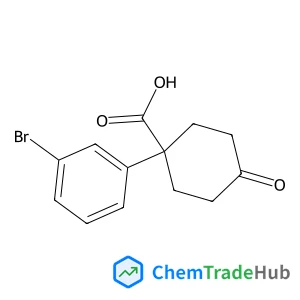
1-(3-Bromophenyl)-4-oxocyclohexanecarboxylic acid
CAS Number:
1385694-53-0
Molecular Formula:
C13H13BrO3
Xinxin Jiang, Quan Gao, Xuhui Xu, Ge Xu, Dongmei Li, Bin Cui, Fanyao Qu
Semiconductor photocatalysts, using sunlight to stimulate various photocatalytic reactions, are promising materials for solving the energy crisis and environmental problems. However, the low photocatalytic efficiency and high cost pose major challenges for their widespread application. Mimicking the natural photosynthesis system, we propose a direct Z-scheme photocatalyst based on a Janus van der Waals heterostructure (vdWH) comprising SnC and Janus SeSnS monolayers. From first-principles calculations, the intrinsic built-in electric field of Janus SeSnS and the charge transfer from the SnC to the SeSnS layer give rise to a type-II band alignment. Such a band alignment benefits the formation of spatially separated reductive and oxidative active sites and the reduction of the global bandgap of the Janus vdWH. The proposed material increases the solar-to-hydrogen conversion efficiency to 60.8%. Besides, we also find that the light absorption coefficient is stacking configuration controllable and strain-tunable, e.g., the tensile strain promotes photocatalytic efficiency. Moreover, because Sn, S, and Se are environmentally benign and inexpensive elements, SnC/SeSnS vdWH is a promising noble-metal-free direct Z-scheme photocatalyst.

Current Opinion in Solid State & Materials Science

Current Opinion in Colloid & Interface Science

Nature Medicine

Journal of Natural Medicines

Russian Journal of Applied Chemistry

Crystallography Reports

Russian Journal of Coordination Chemistry

Chemical Communications

Acta Materialia

Russian Chemical Bulletin
Govind Reddy
DOI: 10.1039/D1CP01185E
Giuseppe Mattioli, Lorenzo Avaldi, Paola Bolognesi, John D. Bozek, Mattea C. Castrovilli, Jacopo Chiarinelli, Alicja Domaracka, Suvasthika Indrajith, Sylvain Maclot, Aleksandar R. Milosavljević, Patrick Rousseau
DOI: 10.1039/D1CP02031E
Xue Peng, Chenlin Lu, Jian Pang, Zheng Liu, Diannan Lu
DOI: 10.1039/D1CP01519B
Wouter Monnens, Pin-Cheng Lin, Clio Deferm, Koen Binnemans, Jan Fransaer
DOI: 10.1039/D1CP01074C
Hajar Nili Ahmadabadi, Amir Ali Masoudi, Sahin Uyaver
DOI: 10.1039/D1CP03031K
Zhuang Wu, Lina Wang, Bo Lu, André K. Eckhardt, Peter R. Schreiner, Xiaoqing Zeng
DOI: 10.1039/D1CP02584H
Kimberly A. Carter-Fenk, Abigail C. Dommer, Michelle E. Fiamingo, Jeongin Kim, Rommie E. Amaro, Heather C. Allen
DOI: 10.1039/D1CP01407B
Scott G. Harroun, Yaoting Zhang, Huan-Tsung Chang
DOI: 10.1039/D1CP01498F
Jakob D. Asmussen, Rupert Michiels, Katrin Dulitz, Aaron Ngai, Ulrich Bangert, Marcel Binz, Lukas Bruder, Miltcho Danailov, Michele Di Fraia, Jussi Eloranta, Raimund Feifel, Luca Giannessi, Oksana Plekan, Kevin C. Prince, Richard J. Squibb, Daniel Uhl, Andreas Wituschek, Carlo Callegari, Frank Stienkemeier, Marcel Mudrich
DOI: 10.1039/D1CP01041G
Marco Pezzella, Sergei N. Yurchenko, Jonathan Tennyson
DOI: 10.1039/D1CP02162A
4-Benzyl-2,2-dimethylmorpholine is generally considered safe when handled under ...
(5,6-Dimethoxy-3-pyridinyl)boronic acid is a chemical compound with the molecula...
1,1,3,3-Tetramethyl-1,3-bis(2-methyl-2-propanyl)disiloxane is synthesized throug...
(2R,4S)-1-Boc-4-methylpyrrolidine-2-carboxylic acid is primarily used as a build...
When handling 2,3-Dichloroacrylonitrile, it is crucial to wear appropriate perso...
(S)-1-(o-Tolyl)ethanamine hydrochloride should be stored in a cool, dry place to...
Benzyl [1-(hydroxyamino)-1-imino-2-methyl-2-propanyl]carbamate (CAS: 518047-98-8...
2-Methyloxazole-5-carbaldehyde is used in the pharmaceutical industry for the sy...
The market for 2-Methyl-2-propanyl 4-[(1S)-1-hydroxyethyl]-1-piperidinecarboxyla...
1-Butyl-3-methylpyridinium bromide is generally considered safe for laboratory u...

Physical Chemistry Chemical Physics (PCCP) is an international journal co-owned by 19 physical chemistry and physics societies from around the world. This journal publishes original, cutting-edge research in physical chemistry, chemical physics and biophysical chemistry. To be suitable for publication in PCCP, articles must include significant innovation and/or insight into physical chemistry; this is the most important criterion that reviewers and Editors will judge against when evaluating submissions. The journal has a broad scope and welcomes contributions spanning experiment, theory, computation and data science. Topical coverage includes spectroscopy, dynamics, kinetics, statistical mechanics, thermodynamics, electrochemistry, catalysis, surface science, quantum mechanics, quantum computing and machine learning. Interdisciplinary research areas such as polymers and soft matter, materials, nanoscience, energy, surfaces/interfaces, and biophysical chemistry are welcomed if they demonstrate significant innovation and/or insight into physical chemistry. Joined experimental/theoretical studies are particularly appreciated when complementary and based on up-to-date approaches.
![2-Methyl-2-propanyl 4-[3-(aminomethyl)phenyl]-1-piperazinecarboxylate structure](https://static.chemtradehub.com/structs/889/889948-55-4-5c12.webp "2-Methyl-2-propanyl 4-[3-(aminomethyl)phenyl]-1-piperazinecarboxylate structure")
![Ethyl 5-[({[(2-methyl-2-propanyl)oxy]carbonyl}amino)methyl]-1,2-oxazole-3-carboxylate structure](https://static.chemtradehub.com/structs/253/253196-37-1-8450.webp "Ethyl 5-[({[(2-methyl-2-propanyl)oxy]carbonyl}amino)methyl]-1,2-oxazole-3-carboxylate structure")


