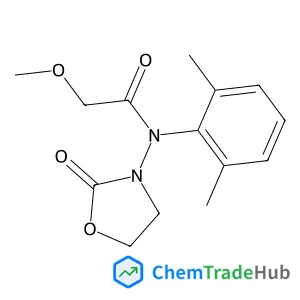
N-(2,6-Dimethylphenyl)-2-methoxy-N-(2-oxo-1,3-oxazolidin-3-yl)acetamide
CAS Number:
77732-09-3
Molecular Formula:
C14H18N2O4
Evgeniya A. Varaksina, Mikhail A. Kiskin, Konstantin A. Lyssenko, Lada N. Puntus, Gustavo S. Silva, Ricardo O. Freire, Ilya V. Taydakov
A series of europium and gadolinium complexes comprising a β-diketone moiety modified with a fluorinated side-group and thiophene ring have been designed and synthesized and a comparative study of their luminescence properties has been carried out. In this study, when the methyl side group was modified by sequential addition of fluorine substituents and then the perfluorinated carbon chain was extended up to n-C8F17 by adding CF2 fragments, it transpired that the non-radiative energy processes are significantly suppressed in structurally more rigid polyfluorinated β-diketonate compounds of the series as C–H oscillators are replaced with low-energy C–F oscillators. The impact of other electron-withdrawing and electron-donating substituents on the spectroscopic and photophysical properties of the complexes in the present study has also been observed. Despite the presence of low-lying ligand-to-metal charge transfer states, the fluorinated Eu3+ complexes proved to be bright luminophores capable of delivering ca. 50% quantum yield under UV radiation. The role of fluorination and carbon chain length was examined by using experimental spectroscopic methods and the results obtained were largely in good agreement with theoretical calculations (Judd–Ofelt theory analysis, and semiempirical quantum chemistry calculations) supporting our key experimental findings.
Carla Bazzicalupi, Andrea Bencini, Laura Bussotti, Emanuela Berni, Silvia Biagini, Enrico Faggi, Claudia Giorgi, Andrea Lapini, Agnese Marcelli, Barbara Valtancoli
DOI: 10.1039/B617453A
Hyeonseok Yoon, Sungrok Ko, Jyongsik Jang
DOI: 10.1039/B616660A
Guoxiong Hua, Yang Li, Alexandra M. Z. Slawin, J. Derek Woollins
DOI: 10.1039/B617418C
Martin Walko, Ben L. Feringa
DOI: 10.1039/B702264F
Ilya D. Gridnev, Cheng Fan, Paul G. Pringle
DOI: 10.1039/B617705K
Partha S. Mukherjee, Nazario Lopez, Atta M. Arif, Francisco Cervantes-Lee, Juan C. Noveron
DOI: 10.1039/B616502H
Ren-Jie Zhang, Ji-wei Cui, De-Ming Lu, Wan-Guo Hou
DOI: 10.1039/B701181D
Dong-Je Hong, Eunji Lee, Myongsoo Lee
DOI: 10.1039/B617404C
Bevan Elliott, Keqin Yang, Apparao M. Rao, Hadi D. Arman, William T. Pennington, Luis Echegoyen
DOI: 10.1039/B700320J
Tomohisa Yamashita, Shuji Kodama, Mikiya Ohto, Eriko Nakayama, Nobutaka Takayanagi, Tomoko Kemmei, Norio Teramae, Yukio Saito
DOI: 10.1039/B615369K
When handling 2-Chloro-1,2-bis(4-methylphenyl)ethanone (CAS: 71193-32-3), it is ...
4-Ethoxy-3-(5-methyl-4-oxo-7-propyl-1,4-dihydroimidazo[5,1-f][1,2,4]triazin-2-yl...
Methyl 3-Oxo-4-Androsten-17-Carboxylate (CAS: 2681-55-2) should be stored in a c...
(R)-3-Amino-4-(3-hexylphenylamino)-4-oxobutylphosphonic acid is primarily used i...
2-Methyl-2-propanyl 3-amino-3-carbamoyl-1-azetidinecarboxylate (CAS: 1254120-14-...
There are alternative reagents that can be used in synthesis instead of (E)-4-(t...
[2-(3-Chlorophenyl)-1,3-thiazol-4-yl]methanol (CAS: 121202-20-8) is a crystallin...
The market and research trends for Methyl (2S)-[(4S)-2,2-dimethyl-1,3-dioxolan-4...
The market for 1-Bromo-2-isocyanatoethane (CAS: 42865-19-0) is driven by its use...
4-Nitro-D-phenylalanine hydrochloride (CAS: 147065-06-3) is primarily used in re...

Physical Chemistry Chemical Physics (PCCP) is an international journal co-owned by 19 physical chemistry and physics societies from around the world. This journal publishes original, cutting-edge research in physical chemistry, chemical physics and biophysical chemistry. To be suitable for publication in PCCP, articles must include significant innovation and/or insight into physical chemistry; this is the most important criterion that reviewers and Editors will judge against when evaluating submissions. The journal has a broad scope and welcomes contributions spanning experiment, theory, computation and data science. Topical coverage includes spectroscopy, dynamics, kinetics, statistical mechanics, thermodynamics, electrochemistry, catalysis, surface science, quantum mechanics, quantum computing and machine learning. Interdisciplinary research areas such as polymers and soft matter, materials, nanoscience, energy, surfaces/interfaces, and biophysical chemistry are welcomed if they demonstrate significant innovation and/or insight into physical chemistry. Joined experimental/theoretical studies are particularly appreciated when complementary and based on up-to-date approaches.

![2-Hydroxy-4-[({[(4-methylphenyl)sulfonyl]oxy}acetyl)amino]benzoic acid structure](https://static.chemtradehub.com/structs/501/501919-59-1-579f.webp "2-Hydroxy-4-[({[(4-methylphenyl)sulfonyl]oxy}acetyl)amino]benzoic acid structure")