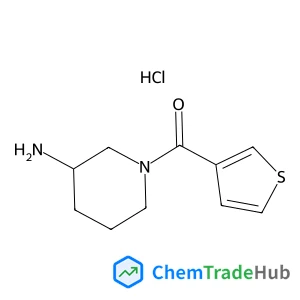
(3-Amino-piperidin-1-yl)-thiophen-3-yl-methanone hydrochloride
CAS Number:
1185316-70-4
Molecular Formula:
C10H15ClN2OS
Meng Lv, Xueli Wang, Danhong Wang, Xiuhua Li, Yangyi Liu, Haifeng Pan, Sanjun Zhang
When organic electron donor (D) and acceptor (A) chromophores are linked together, an electron transfer (ET) state can take place. When a short bridge such as one Sigma bond is used to link the donor and the acceptor, complete charge separation is difficult to access and one usually observes an intramolecular charge transfer (CT) state instead. Due to the inevitable coupling between the donor and the acceptor in compact organic chromophores, the most common decay pathway for the CT state is charge recombination, which may lead to a distinct longer wavelength fluorescence emission or non-radiative dissipation of the excited state energy. However, recent studies have shown that unique excited state dynamics can be observed when the CT state is involved during both forward and backward intersystem crossing (ISC) from singlet excited states to triplet excited states in organic chromophores. Analysis of the mechanism for ISC involving the CT state has received much attention over the last decade. In this perspective, we present a collection of molecular design rationales, spectroscopy and theoretical investigations that provide insights into the mechanism of the ISC involving the CT state in compact organic chromophores. We hope that this perspective will prove beneficial for researchers to design novel compact organic chromophores with a predictable ISC property for future biochemical and optoelectronic applications.
Steffen Wagner, Felix Leyssner, Christian Kördel, Sebastian Zarwell, Roland Schmidt, Karola Rück-Braun, Petra Tegeder
DOI: 10.1039/B823330F
Henar Hernández, J. C. Losada, R. M. Benito
DOI: 10.1039/B902486G
Amy L. Webber, Bénédicte Elena, John M. Griffin, Jonathan R. Yates, Tran N. Pham, Francesco Mauri, Chris J. Pickard, Ana M. Gil, Robin Stein, Anne Lesage, Lyndon Emsley, Steven P. Brown
DOI: 10.1039/C001290D
Matthieu Hureau, Alain Moissette, Séverine Marquis, Claude Brémard, Hervé Vezin
DOI: 10.1039/B904010B
DOI: 10.1039/C0CP90058C
Josh J. Newby, Ching-Ping Liu, Christian W. Müller, Timothy S. Zwier
DOI: 10.1039/B903827B
Francisco García-Blanco, José V. García-Ramos, Santiago Sánchez-Cortés
DOI: 10.1039/B903935J
Mingli Yang
DOI: 10.1039/B902627D
When handling 2-Methyl-2-propanyl 5-amino-2-thiophenecarboxylate (CAS: 1498311-5...
5-Bromo-1,2-dichloro-3-fluorobenzene (CAS: 1000572-93-9) is a crystalline solid ...
(2R)-2-Amino-2-(4-bromophenyl)ethanol (CAS: 354153-64-3) should be stored in a c...
Methyl 4-(aminomethyl)tetrahydro-2H-pyran-4-carboxylate hydrochloride (CAS: 3627...
1,4-Dimethyl-1H-pyrazole-5-sulfonyl chloride is primarily used as an intermediat...
Dinaphtho[1,2-b:2',1'-d]furan is generally safe when handled with appropriate pe...
The market for 7-Methyl-7,9-dihydro-1H-purine-2,6,8(3H)-trione (CAS: 612-37-3) i...
2-(4-Chlorophenyl)malonaldehyde (CAS: 205676-17-1) is a colorless or light yello...
2-Methylchrysene (CAS: 3351-32-4) is typically synthesized via the reaction of c...
N-(6-aminopyrimidin-4-yl)acetamide (CAS: 89533-23-3) is generally considered saf...

Physical Chemistry Chemical Physics (PCCP) is an international journal co-owned by 19 physical chemistry and physics societies from around the world. This journal publishes original, cutting-edge research in physical chemistry, chemical physics and biophysical chemistry. To be suitable for publication in PCCP, articles must include significant innovation and/or insight into physical chemistry; this is the most important criterion that reviewers and Editors will judge against when evaluating submissions. The journal has a broad scope and welcomes contributions spanning experiment, theory, computation and data science. Topical coverage includes spectroscopy, dynamics, kinetics, statistical mechanics, thermodynamics, electrochemistry, catalysis, surface science, quantum mechanics, quantum computing and machine learning. Interdisciplinary research areas such as polymers and soft matter, materials, nanoscience, energy, surfaces/interfaces, and biophysical chemistry are welcomed if they demonstrate significant innovation and/or insight into physical chemistry. Joined experimental/theoretical studies are particularly appreciated when complementary and based on up-to-date approaches.
![2,5-Dichloro-1H-pyrrolo[3,2-b]pyridine structure](https://static.chemtradehub.com/structs/100/1000342-87-9-f632.webp "2,5-Dichloro-1H-pyrrolo[3,2-b]pyridine structure")