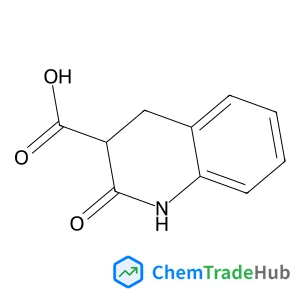
2-Oxo-1,2,3,4-tetrahydro-3-quinolinecarboxylic acid
CAS Number:
246867-17-4
Molecular Formula:
C10H9NO3
Giuseppe Lanza, Maria Assunta Chiacchio
A large number of clathrate-like cages have been proposed as the very first hydration shell of alkanes. The cages include canonical structures commonly found in clathrate hydrates and many others, not previously reported, derived from the carbon fullerene cavities. These structures have a rich and variegated form, which can adapt to the shape and conformation of the solute. They avoid “wasting” hydrogen bonds, while minimizing the volume cage and maximizing the solute–solvent van der Waals interactions. DFT/M06-2X and MP2 ab initio calculations give comparable structural and energetic results although the latter predicts slightly larger cages for a given solute. It is shown that the van der Waals interactions are substantial and the large exoenergetic values found for isobutane and cyclopentane provide an explanation for the surprising high melting points of related hydrates at room pressure. The encaging enthalpy for various hydrocarbons is similar to the enthalpy of solution measured at a temperature just above the melting point of aqueous hydrocarbon solutions, thus indicating that water molecules should not deviate too much from the configuration with O–H bonds tangentially oriented with respect to the solute surface. The computed trend differs from the enthalpy of solution measured at room temperature, thus the very first hydration shell departs, up to a certain degree, from the clathrate-like structures.
Minoru Umeda, Kazuhiro Nagai, Masahiko Shibamine, Mitsuhiro Inoue
DOI: 10.1039/B926115J
Takuji Ikeda, David A. Pacheco Tanaka, Margot A. Llosa Tanco, Yoshito Wakui, Koich Sato, Fujio Mizukami, Toshishige M. Suzuki
DOI: 10.1039/B909401F
Deborah J. Last, Juan J. Nájera, Carl J. Percival, Andrew B. Horn
DOI: 10.1039/B901815H
Jean-François Boily
DOI: 10.1039/B909925E
Inge L. C. Buurmans, Evgeny A. Pidko, Jennifer M. de Groot, Eli Stavitski, Rutger A. van Santen, Bert M. Weckhuysen
DOI: 10.1039/C002442B
When handling 2-Methyl-2-propanyl 5-amino-2-thiophenecarboxylate (CAS: 1498311-5...
5-Bromo-1,2-dichloro-3-fluorobenzene (CAS: 1000572-93-9) is a crystalline solid ...
(2R)-2-Amino-2-(4-bromophenyl)ethanol (CAS: 354153-64-3) should be stored in a c...
Methyl 4-(aminomethyl)tetrahydro-2H-pyran-4-carboxylate hydrochloride (CAS: 3627...
1,4-Dimethyl-1H-pyrazole-5-sulfonyl chloride is primarily used as an intermediat...
Dinaphtho[1,2-b:2',1'-d]furan is generally safe when handled with appropriate pe...
The market for 7-Methyl-7,9-dihydro-1H-purine-2,6,8(3H)-trione (CAS: 612-37-3) i...
2-(4-Chlorophenyl)malonaldehyde (CAS: 205676-17-1) is a colorless or light yello...
2-Methylchrysene (CAS: 3351-32-4) is typically synthesized via the reaction of c...
N-(6-aminopyrimidin-4-yl)acetamide (CAS: 89533-23-3) is generally considered saf...

Physical Chemistry Chemical Physics (PCCP) is an international journal co-owned by 19 physical chemistry and physics societies from around the world. This journal publishes original, cutting-edge research in physical chemistry, chemical physics and biophysical chemistry. To be suitable for publication in PCCP, articles must include significant innovation and/or insight into physical chemistry; this is the most important criterion that reviewers and Editors will judge against when evaluating submissions. The journal has a broad scope and welcomes contributions spanning experiment, theory, computation and data science. Topical coverage includes spectroscopy, dynamics, kinetics, statistical mechanics, thermodynamics, electrochemistry, catalysis, surface science, quantum mechanics, quantum computing and machine learning. Interdisciplinary research areas such as polymers and soft matter, materials, nanoscience, energy, surfaces/interfaces, and biophysical chemistry are welcomed if they demonstrate significant innovation and/or insight into physical chemistry. Joined experimental/theoretical studies are particularly appreciated when complementary and based on up-to-date approaches.
![3-(benzotriazol-1-yl)-N-[[2-[(3-bromophenyl)methoxy]phenyl]methylideneamino]propanamide structure](https://static.chemtradehub.com/structs/559/5595-78-8-0a32.webp "3-(benzotriazol-1-yl)-N-[[2-[(3-bromophenyl)methoxy]phenyl]methylideneamino]propanamide structure")