












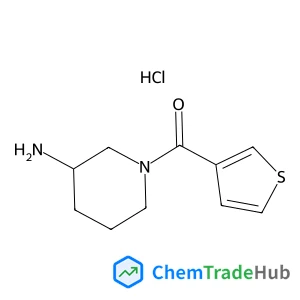
(3-Amino-piperidin-1-yl)-thiophen-3-yl-methanone hydrochloride
CAS Number:
1185316-70-4
Molecular Formula:
C10H15ClN2OS
Srijita Paul, Sandip Paul
Urea and choline-O-sulfate (COS) are both osmolytes, but have opposite effects on protein structure. Urea has been well-known for years to destabilize protein structure. Though COS has been revealed as an osmoprotective molecule against urea induced denaturation of proteins, the mechanism of this compensation is still unexplored. This study focuses on a theoretical investigation of the interdependent behavior of urea and COS in a mixture, to explore how urea becomes a weaker denaturing agent in the presence of COS. In this study, we have considered every possible interaction among the solute (urea and COS) and solvent (water) both at room temperature and high temperature, employing two different force field parameters i.e., CHARMM General Force Field parameters (CGenFF) and General AMBER Force Field (GAFF) parameters through classical molecular dynamics simulation studies. Different techniques have been used to analyze the average interactions between COS and urea as well as their solvation properties, which show that in the presence of COS, urea becomes a less effective denaturant than when alone. The water–water interaction shows that the mixed osmolyte solution of urea and COS strengthens the water hydrogen bonding network. The enhanced solvation of urea and COS in the urea–COS mixture and their mutual interactions, results in the exclusion of free urea as well as COS from the solution. This synergistic behavior of urea and COS could be the major reason behind COS counteracting urea’s denaturation of proteins.
Simon Mathieu, Georges Trinquier
DOI: 10.1039/B908152F
Simon R. Bare, Shelly D. Kelly, Bruce Ravel, Nan Greenlay, Lisa King, George E. Mickelson
DOI: 10.1039/B926621F
William M. Ames, Sarah C. Larsen
DOI: 10.1039/B905750A
Matthieu Hureau, Alain Moissette, Séverine Marquis, Claude Brémard, Hervé Vezin
DOI: 10.1039/B904010B
Zhen Yang, Xiaoning Yang, Zhijun Xu, Shuyan Liu
DOI: 10.1039/B821328C
Fereshteh Azari, Hojatollah Vali
DOI: 10.1039/B902881A
Selvarengan Paranthaman, François-Xavier Coudert, Alain H. Fuchs
DOI: 10.1039/B925074C
Steffen Wagner, Felix Leyssner, Christian Kördel, Sebastian Zarwell, Roland Schmidt, Karola Rück-Braun, Petra Tegeder
DOI: 10.1039/B823330F
When handling 2-Methyl-2-propanyl 5-amino-2-thiophenecarboxylate (CAS: 1498311-5...
5-Bromo-1,2-dichloro-3-fluorobenzene (CAS: 1000572-93-9) is a crystalline solid ...
(2R)-2-Amino-2-(4-bromophenyl)ethanol (CAS: 354153-64-3) should be stored in a c...
Methyl 4-(aminomethyl)tetrahydro-2H-pyran-4-carboxylate hydrochloride (CAS: 3627...
1,4-Dimethyl-1H-pyrazole-5-sulfonyl chloride is primarily used as an intermediat...
Dinaphtho[1,2-b:2',1'-d]furan is generally safe when handled with appropriate pe...
The market for 7-Methyl-7,9-dihydro-1H-purine-2,6,8(3H)-trione (CAS: 612-37-3) i...
2-(4-Chlorophenyl)malonaldehyde (CAS: 205676-17-1) is a colorless or light yello...
2-Methylchrysene (CAS: 3351-32-4) is typically synthesized via the reaction of c...
N-(6-aminopyrimidin-4-yl)acetamide (CAS: 89533-23-3) is generally considered saf...

Physical Chemistry Chemical Physics (PCCP) is an international journal co-owned by 19 physical chemistry and physics societies from around the world. This journal publishes original, cutting-edge research in physical chemistry, chemical physics and biophysical chemistry. To be suitable for publication in PCCP, articles must include significant innovation and/or insight into physical chemistry; this is the most important criterion that reviewers and Editors will judge against when evaluating submissions. The journal has a broad scope and welcomes contributions spanning experiment, theory, computation and data science. Topical coverage includes spectroscopy, dynamics, kinetics, statistical mechanics, thermodynamics, electrochemistry, catalysis, surface science, quantum mechanics, quantum computing and machine learning. Interdisciplinary research areas such as polymers and soft matter, materials, nanoscience, energy, surfaces/interfaces, and biophysical chemistry are welcomed if they demonstrate significant innovation and/or insight into physical chemistry. Joined experimental/theoretical studies are particularly appreciated when complementary and based on up-to-date approaches.
![4-Chloro-N-{[4-(dimethylamino)phenyl]carbamoyl}benzenesulfonamide structure](https://static.chemtradehub.com/structs/558/5581-42-0-7dcb.webp "4-Chloro-N-{[4-(dimethylamino)phenyl]carbamoyl}benzenesulfonamide structure")





