












Testing quantum speedups in exciton transport through a photosynthetic complex using quantum stochastic walks
Literature Information
Publication Date
2021-12-28
DOI
10.1039/D1CP02727A
Impact Factor
3.676
Authors
Naini Dudhe, Pratyush Kumar Sahoo, Colin Benjamin
View Original
Abstract
Photosynthesis is a highly efficient process, nearly 100 percent of the red photons falling on the surface of leaves reach the reaction center and get transformed into energy. Most theoretical studies on photosynthetic complexes focus mainly on the Fenna–Matthews–Olson complex obtained from green-sulfur bacteria. Quantum coherence was speculated to play a significant role in this very efficient transport process. However, recent reports indicate quantum coherence via exciton transport may not be as relevant as coherence originating via vibronic processes to photosynthesis. Regardless of the origin, there has been a debate on whether quantum coherence results in any speedup of the exciton transport process. To address this we model exciton transport in FMO using a quantum stochastic walk (QSW) with only incoherence, pure dephasing and with both dephasing and incoherence. We find that the QSW model with pure dephasing leads to a substantial speedup in exciton transport as compared to a QSW model which includes both dephasing and incoherence and one which includes only incoherence, both of which experience slowdowns.
Related Literature
Mono-selective β-C–H arylation of N-methylated amino acids and peptides promoted by the 2-(methylthio)aniline directing group
Thorsten Kinsinger, Uli Kazmaier
2019-05-14
Paper
DOI: 10.1039/C9OB00966C
The role of conserved arginine in the GH70 family: a computational study of the structural features and their implications on the catalytic mechanism of GTF-SI from Streptoccocus mutans
Leslie Sánchez, Fernanda Mendoza, Joel B. Alderete, Verónica A. Jiménez, Gonzalo A. Jaña
2019-06-05
Paper
DOI: 10.1039/C9OB01055F
Fluorination-triggered tandem cyclization of styrene-type carboxylic acids to access 3-aryl isocoumarin derivatives under microwave irradiation
Jinwei Yuan, Fanlin Zeng, Wenpeng Mai, Liangru Yang, Yongmei Xiao, Pu Mao, Donghui Wei
2019-04-24
Paper
DOI: 10.1039/C9OB00509A
Syntheses and in vitro biological evaluation of S1PR1 ligands and PET studies of four F-18 labeled radiotracers in the brain of nonhuman primates
Zonghua Luo, Junbin Han, Hui Liu, Adam J. Rosenberg, Delphine L. Chen, Robert J. Gropler, Zhude Tu
2018-11-15
Paper
DOI: 10.1039/C8OB02609B
Conversion of aldimines to secondary amines using iron-catalysed hydrosilylation
Anu Saini, Cecilia R. Smith, Francis S. Wekesa, Amanda K. Helms, Michael Findlater
2018-11-29
Communication
DOI: 10.1039/C8OB01262H
Bypassing the stereoselectivity issue: transformations of Kinugasa adducts from chiral alkynes and non-chiral acyclic nitrones
Rafał Kutaszewicz, Barbara Grzeszczyk, Marcin Górecki, Olga Staszewska-Krajewska, Bartłomiej Furman, Marek Chmielewski
2019-05-31
Paper
DOI: 10.1039/C9OB00940J
Importance of the main chain of lysine for histone lysine methyltransferase catalysis
Abbas H. K. Al Temimi, Ruben S. Teeuwen, Vu Tran, Arthur J. Altunc, Danny C. Lenstra, Wansheng Ren, Ping Qian, Hong Guo
2019-05-20
Communication
DOI: 10.1039/C9OB01038F
Domino reaction of a gold catalyzed 5-endo-dig cyclization and a [3,3]-sigmatropic rearrangement towards polysubstituted pyrazoles
Arno Verlee, Thomas Heugebaert, Tom van der Meer, Pavel Kerchev, Frank Van Breusegem, Christian V. Stevens
2018-11-28
Communication
DOI: 10.1039/C8OB02807A
Catalytic carbene/alkyne metathesis (CAM): a versatile strategy for alkyne bifunctionalization
Cheng Zhang, Yu Qian
2018-10-26
Review Article
DOI: 10.1039/C8OB02420K
A designed protein binding-pocket to control excited-state intramolecular proton transfer fluorescence
Bryan J. Lampkin, Cecilia Monteiro, Evan T. Powers, Paige M. Bouc, Jeffery W. Kelly, Brett VanVeller
2018-11-28
Paper
DOI: 10.1039/C8OB02673D
You might also like
Compound Q&A
What is 3-Fluoro-2-methylbenzylamine (CAS: 771573-36-5)?
3-Fluoro-2-methylbenzylamine is an organic compound with the CAS number 771573-3...
771573-36-53-Fluoro-2-methylben...
Compound Q&A
Is Tert-butyl 2-(oxetan-3-ylidene)acetate (CAS: 1207175-03-8) safe?
Tert-butyl 2-(oxetan-3-ylidene)acetate is considered safe for its intended uses ...
1207175-03-8Tert-butyl 2-(oxetan...
Compound Q&A
What precautions should be taken when handling 4-Acetyl-2-fluorobenzonitrile (CAS: 214760-18-6)?
Proper personal protective equipment (PPE) such as gloves, goggles, and a lab co...
214760-18-64-Acetyl-2-fluoroben...
Compound Q&A
How is 2-Ethyl-4-methyl-1,3-thiazole (CAS: 15679-12-6) typically synthesized?
2-Ethyl-4-methyl-1,3-thiazole is commonly synthesized via the reaction of thiour...
15679-12-62-Ethyl-4-methyl-1,3...
Compound Q&A
How should 5',5''-([2,2'-Bithiophene]-5,5'-diyl)bis(([1,1':3',1''-terphenyl]-4,4''-dicarboxylic acid)) (CAS: 1227780-71-3) be stored?
This compound should be stored in a cool, dry place away from direct sunlight an...
1227780-71-35',5''''-([2,2'-Bith...
Compound Q&A
What regulatory guidelines apply to L-Lysine Acetate Salt (CAS: 52315-92-1)?
L-Lysine Acetate Salt (CAS: 52315-92-1) is subject to various regulatory guideli...
52315-92-1L-LYSINE ACETATE SAL...
Compound Q&A
Is 6-Fluoro-3-hydroxy-2-pyrazinecarboxamide (CAS: 259793-96-9) safe?
6-Fluoro-3-hydroxy-2-pyrazinecarboxamide (CAS: 259793-96-9) is generally conside...
259793-96-96-Fluoro-3-hydroxy-2...
Compound Q&A
What are the physical and chemical properties of 1,1'-Sulfonylbis(1H-imidazole) (CAS: 7189-69-7)?
1,1'-Sulfonylbis(1H-imidazole) is a crystalline solid with a molecular weight of...
7189-69-71,1'-Sulfonylbis(1H-...
Compound Q&A
What industries use 4-methyl-7-nitro-1H-indole-3-carbonitrile (CAS: 289483-82-5)?
4-Methyl-7-nitro-1H-indole-3-carbonitrile (CAS: 289483-82-5) is primarily used i...
289483-82-54-methyl-7-nitro-1H-...
Compound Q&A
How should waste containing 5-Bromo-3-indolyl-beta-galactoside (CAS: 97753-82-7) be handled?
Waste containing 5-Bromo-3-indolyl-beta-galactoside (CAS: 97753-82-7) should be ...
97753-82-75-Bromo-3-indolyl-be...
Source Journal
Physical Chemistry Chemical Physics

CiteScore:
5.5
Self-citation Rate:
10.3%
Articles per Year:
3036
Physical Chemistry Chemical Physics (PCCP) is an international journal co-owned by 19 physical chemistry and physics societies from around the world. This journal publishes original, cutting-edge research in physical chemistry, chemical physics and biophysical chemistry. To be suitable for publication in PCCP, articles must include significant innovation and/or insight into physical chemistry; this is the most important criterion that reviewers and Editors will judge against when evaluating submissions. The journal has a broad scope and welcomes contributions spanning experiment, theory, computation and data science. Topical coverage includes spectroscopy, dynamics, kinetics, statistical mechanics, thermodynamics, electrochemistry, catalysis, surface science, quantum mechanics, quantum computing and machine learning. Interdisciplinary research areas such as polymers and soft matter, materials, nanoscience, energy, surfaces/interfaces, and biophysical chemistry are welcomed if they demonstrate significant innovation and/or insight into physical chemistry. Joined experimental/theoretical studies are particularly appreciated when complementary and based on up-to-date approaches.
Recommended Compounds
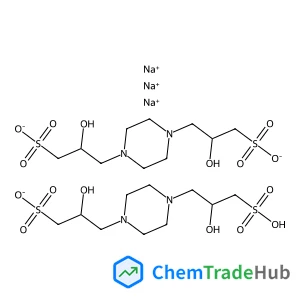
3,3'-(Piperazine-1,4-diyl)bis(2-hydroxypropane-1-sulfonic acid) Sodium Salt
CAS Number:
108321-08-0
Molecular Formula:
C20H41N4Na3O16S4
Recommended Suppliers





Disclaimer
This page provides academic journal information for reference and research purposes only. We are not affiliated with any journal publishers and do not handle publication submissions. For publication-related inquiries, please contact the respective journal publishers directly.
If you notice any inaccuracies in the information displayed, please contact us at support@chemtradehub.com. We will promptly review and address your concerns.