












Breakdown of the Stokes–Einstein relation in supercooled water: the jump-diffusion perspective
Literature Information
Publication Date
2021-09-06
DOI
10.1039/D1CP02202D
Impact Factor
3.676
Authors
Vikas Dubey, Shivam Dueby, Snehasis Daschakraborty
View Original
Abstract
Although water is the most ubiquitous liquid it shows many thermodynamic and dynamic anomalies. Some of the anomalies further intensify in the supercooled regime. While many experimental and theoretical studies have focused on the thermodynamic anomalies of supercooled water, fewer studies explored the dynamical anomalies very extensively. This is due to the intricacy of the experimental measurement of the dynamical properties of supercooled water. Violation of the Stokes–Einstein relation (SER), an important relation connecting the diffusion of particles with the viscosity of the medium, is one of the major dynamical anomalies. In absence of experimentally measured viscosity, researchers used to check the validity of SER indirectly using average translational relaxation time or α-relaxation time. Very recently, the viscosity of supercooled water was accurately measured at a wide range of temperatures and pressures. This allowed direct verification of the SER at different temperature-pressure thermodynamic state points. An increasing breakdown of the SER was observed with decreasing temperature. Increasing pressure reduces the extent of breakdown. Although some well-known theories explained the above breakdown, a detailed molecular mechanism was still elusive. Recently, a translational jump-diffusion (TJD) approach has been able to quantitatively explain the breakdown of the SER in pure supercooled water and an aqueous solution of methanol. The objective of this article is to present a detailed and state-of-the-art analysis of the past and present works on the breakdown of SER in supercooled water with a specific focus on the new TJD approach for explaining the breakdown of the SER.
Related Literature
Recent advances in cobalt-catalysed C–H functionalizations
Alessio Baccalini, Stefania Vergura, Pravas Dolui, Giuseppe Zanoni, Debabrata Maiti
2019-11-07
Review Article
DOI: 10.1039/C9OB01994D
Synthetic approaches towards avibactam and other diazabicyclooctane β-lactamase inhibitors
Laure Peilleron, Kevin Cariou
2020-01-13
Review Article
DOI: 10.1039/C9OB02605C
Phenylboronic acid-catalyzed tandem construction of S–S and C–S bonds: a new method for the synthesis of benzyl disulfanylsulfone derivatives from S-benzyl thiosulfonates
Raju Jannapu Reddy, Md. Waheed, Gamidi Rama Krishna
2020-04-03
Communication
DOI: 10.1039/D0OB00442A
Highly selective staining and quantification of intracellular lipid droplets with a compact push–pull fluorophore based on benzothiadiazole
S. Israel Suarez, Caroline C. Warner, Heather Brown-Harding, Andrea M. Thooft, Brett VanVeller, John C. Lukesh, III
2019-12-12
Paper
DOI: 10.1039/C9OB02486G
Rhodium(iii)-catalyzed ortho-C–H amidation of 2-arylindazoles with a dioxazolone as an amidating reagent
Payel Ghosh, Sadhanendu Samanta, Alakananda Hajra
2020-01-27
Communication
DOI: 10.1039/C9OB02756D
Mechanism and stereoselectivity of benzylic C–H hydroxylation by Ru–porphyrin: a computational study
Xiahe Chen, Qunmin Wang, Haimin Shen, Guijie Li, Yun-Fang Yang, Yuan-Bin She
2019-12-09
Paper
DOI: 10.1039/C9OB02415H
Visible light induced 3-position-selective addition of arylpropiolic acids with ethers via C(sp3)–H functionalization
Zi-juan Wan, Xiao-feng Yuan, Jun Luo
2020-04-07
Communication
DOI: 10.1039/D0OB00480D
Synthesis of monofluorooxazoles with quaternary C–F centers through photoredox-catalyzed radical addition of methylene-2-oxazolines
Chuan-Hua Qu, Jin-Hong Chen, Zhi-Gang Xu, Cheng-He Zhou, Zhong-Zhu Chen
2020-03-06
Communication
DOI: 10.1039/D0OB00267D
The visible-light-triggered regioselective alkylation of quinoxalin-2(1H)-ones via decarboxylation coupling
Hongdou Zhang, Jun Xu, Min Zhou, Jianming Zhao, Pengfei Zhang, Wanmei Li
2019-11-14
Paper
DOI: 10.1039/C9OB02203A
A Selectfluor-promoted oxidative reaction of disulfides and amines: access to sulfinamides
Jiang Liu, Romana Pajkert, Gerd-Volker Röschenthaler, Jianlin Han
2020-05-06
Paper
DOI: 10.1039/D0OB00720J
You might also like
Compound Q&A
What regulatory guidelines apply to 6-Bromo-2-methylimidazo[1,2-a]pyrimidine (CAS: 1111638-05-1)?
6-Bromo-2-methylimidazo[1,2-a]pyrimidine (CAS: 1111638-05-1) falls under various...
1111638-05-16-Bromo-2-methylimid...
Compound Q&A
Are there alternatives to 1-Pyrrolidineethanol, β-methyl-α-phenyl-, (αS,βR) (CAS: 123620-80-4) in synthesis?
While there are no direct alternatives, similar compounds like 1-Pyrrolidineetha...
123620-80-41-Pyrrolidineethanol...
Compound Q&A
Is 4-Methyl-2,6-bis(2-methyl-2-propanyl)phenyl methylcarbamate (CAS: 1918-11-2) safe?
4-Methyl-2,6-bis(2-methyl-2-propanyl)phenyl methylcarbamate (CAS: 1918-11-2) is ...
1918-11-24-Methyl-2,6-bis(2-m...
Compound Q&A
How should 2-(3-Bromo-4-fluorophenyl)-1,3-dioxolane (CAS: 77771-04-1) be stored?
2-(3-Bromo-4-fluorophenyl)-1,3-dioxolane (CAS: 77771-04-1) should be stored in a...
77771-04-12-(3-Bromo-4-fluorop...
Compound Q&A
What are the physical and chemical properties of 4,5,6,7-Tetrahydro-1H-indazole hydrochloride (CAS: 18161-11-0)?
4,5,6,7-Tetrahydro-1H-indazole hydrochloride is a white crystalline solid with a...
18161-11-04,5,6,7-Tetrahydro-1...
Compound Q&A
What is (2R)-1-Methoxy-3-phenyl-2-propanamine (CAS: 59919-07-2)?
(2R)-1-Methoxy-3-phenyl-2-propanamine is a chiral organic compound with the CAS ...
59919-07-2(2R)-1-Methoxy-3-phe...
Compound Q&A
What industries use Ethyl 1-(1-phenylethyl)-1H-imidazole-5-carboxylate (CAS: 56649-47-9)?
Ethyl 1-(1-phenylethyl)-1H-imidazole-5-carboxylate is used in various industries...
56649-47-9Ethyl 1-(1-phenyleth...
Compound Q&A
What regulatory guidelines apply to 4-[(1E,3S)-1-(4-Hydroxyphenyl)-1,4-pentadien-3-yl]phenol (CAS: 17676-24-3)?
4-[(1E,3S)-1-(4-Hydroxyphenyl)-1,4-pentadien-3-yl]phenol (CAS: 17676-24-3) falls...
17676-24-34-[(1E,3S)-1-(4-Hydr...
Compound Q&A
What industries use (S)-3-Amino-5-phenylpentanoic acid hydrochloride (CAS: 331846-97-0)?
(S)-3-Amino-5-phenylpentanoic acid hydrochloride is primarily used in the pharma...
331846-97-0(S)-3-Amino-5-phenyl...
Compound Q&A
How is 7-methoxy-1-benzothiophene-2-carboxylic acid (CAS: 88791-07-5) typically synthesized?
7-Methoxy-1-benzothiophene-2-carboxylic acid is typically synthesized by reactin...
88791-07-57-methoxy-1-benzothi...
Source Journal
Physical Chemistry Chemical Physics

CiteScore:
5.5
Self-citation Rate:
10.3%
Articles per Year:
3036
Physical Chemistry Chemical Physics (PCCP) is an international journal co-owned by 19 physical chemistry and physics societies from around the world. This journal publishes original, cutting-edge research in physical chemistry, chemical physics and biophysical chemistry. To be suitable for publication in PCCP, articles must include significant innovation and/or insight into physical chemistry; this is the most important criterion that reviewers and Editors will judge against when evaluating submissions. The journal has a broad scope and welcomes contributions spanning experiment, theory, computation and data science. Topical coverage includes spectroscopy, dynamics, kinetics, statistical mechanics, thermodynamics, electrochemistry, catalysis, surface science, quantum mechanics, quantum computing and machine learning. Interdisciplinary research areas such as polymers and soft matter, materials, nanoscience, energy, surfaces/interfaces, and biophysical chemistry are welcomed if they demonstrate significant innovation and/or insight into physical chemistry. Joined experimental/theoretical studies are particularly appreciated when complementary and based on up-to-date approaches.
Recommended Compounds
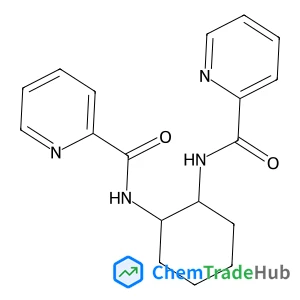
N,N'-(1R,2R)-1,2-Cyclohexanediyldi(2-pyridinecarboxamide)
CAS Number:
218290-24-5
Molecular Formula:
C18H20N4O2
![9H-Fluoren-9-ylmethyl {15-[(2,5-dioxo-1-pyrrolidinyl)oxy]-15-oxo-3,6,9,12-tetraoxapentadec-1-yl}carbamate structure](https://static.chemtradehub.com/structs/131/1314378-14-7-4316.webp "9H-Fluoren-9-ylmethyl {15-[(2,5-dioxo-1-pyrrolidinyl)oxy]-15-oxo-3,6,9,12-tetraoxapentadec-1-yl}carbamate structure")
9H-Fluoren-9-ylmethyl {15-[(2,5-dioxo-1-pyrrolidinyl)oxy]-15-oxo-3,6,9,12-tetraoxapentadec-1-yl}carbamate
CAS Number:
1314378-14-7
Molecular Formula:
C30H36N2O10
![Benzeneacetic acid, 2-[(2,6-dichlorophenyl)amino]-, compd. with 1-pyrrolidineethanol (1:1) structure](https://static.chemtradehub.com/structs/119/119623-66-4-5301.webp "Benzeneacetic acid, 2-[(2,6-dichlorophenyl)amino]-, compd. with 1-pyrrolidineethanol (1:1) structure")
Benzeneacetic acid, 2-[(2,6-dichlorophenyl)amino]-, compd. with 1-pyrrolidineethanol (1:1)
CAS Number:
119623-66-4
Molecular Formula:
C20H24Cl2N2O3
Recommended Suppliers





Disclaimer
This page provides academic journal information for reference and research purposes only. We are not affiliated with any journal publishers and do not handle publication submissions. For publication-related inquiries, please contact the respective journal publishers directly.
If you notice any inaccuracies in the information displayed, please contact us at support@chemtradehub.com. We will promptly review and address your concerns.