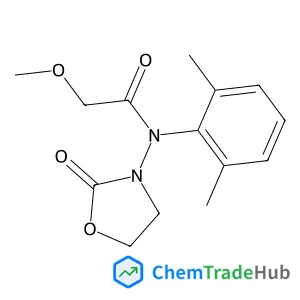
N-(2,6-Dimethylphenyl)-2-methoxy-N-(2-oxo-1,3-oxazolidin-3-yl)acetamide
CAS Number:
77732-09-3
Molecular Formula:
C14H18N2O4
Fangying Li, Chendi Zhan, Xuewei Dong, Guanghong Wei
The aggregation of amyloid-β protein (Aβ) into fibrillary deposits is implicated in Alzheimer's disease (AD), and inhibiting Aβ aggregation and clearing Aβ fibrils are considered as promising strategies to treat AD. It has been reported that resveratrol (RSV) and epigallocatechin-3-gallate (EGCG), two of the most extensively studied natural polyphenols, are able to inhibit Aβ fibrillization and remodel the preformed fibrillary aggregates into amorphous, non-toxic species. However, the mechanisms by which RSV inhibits Aβ42 aggregation and disrupts Aβ42 protofibril, as well as the inhibitory/disruptive mechanistic similarities and differences between RSV and EGCG, remain mostly elusive. Herein, we performed extensive all-atom molecular dynamics (MD) simulations on Aβ42 dimers (the early aggregation state of Aβ42) and protofibrils (the intermediate of Aβ42 fibril formation and elongation) in the absence/presence of RSV or EGCG molecules. Our simulations show that both RSV and EGCG can bind with Aβ42 monomers and inhibit the dimerization of Aβ42. The binding of RSV with Aβ42 peptide is mostly via π–π stacking interactions, while the binding of EGCG with Aβ42 is mainly through hydrophobic, π–π stacking, and hydrogen-bonding interactions. Moreover, both RSV and EGCG disrupt the β-sheet structure and K28–A42 salt bridges, leading to a disruption of Aβ42 protofibril structure. RSV mainly binds with residues whose side-chains point inwards from the surface of the protofibril, while EGCG mostly binds with residues whose side-chains point outwards from the surface of the protofibril. Furthermore, RSV interacts with Aβ42 protofibrils mostly via π–π stacking interactions, while EGCG interacts with Aβ42 protofibrils mainly via hydrogen-bonding and hydrophobic interactions. For comparison, we also explore the effects of RSV/EGCG molecules on the aggregation inhibition and protofibril disruption of the Iowa mutant (D23N) Aβ. Our findings may pave the way for the design of more effective drug candidates as well as the utilization of cocktail therapy using RSV and EGCG for the treatment of AD.
Lu Zhang, Shen Dong, Lei Zhu
DOI: 10.1039/B618413H
Jian-Ming Xu, Fu Zhang, Bo-Kai Liu, Qi Wu, Xian-Fu Lin
DOI: 10.1039/B700327G
Toru Amaya, Koichi Mori, Hsyueh-Liang Wu, Satoshi Ishida, Jun-ichi Nakamura, Kazuhiko Murata, Toshikazu Hirao
DOI: 10.1039/B701322A
Jiguang Zhang, Yuan Gao, Tobias Hanrath, Brian A. Korgel, Jillian M. Buriak
DOI: 10.1039/B616883C
Oliver Kaufhold, Andreas Stasch, Peter G. Edwards, F. Ekkehardt Hahn
DOI: 10.1039/B617033A
Bevan Elliott, Keqin Yang, Apparao M. Rao, Hadi D. Arman, William T. Pennington, Luis Echegoyen
DOI: 10.1039/B700320J
Heather A. Spinney, Ilia Korobkov, Darrin S. Richeson
DOI: 10.1039/B617434E
Kristopher A. Kilian, Katharina Gaus, Justin King-Lacroix, Michael Gal, J. Justin Gooding
DOI: 10.1039/B702762A
Andreas Hennig, Garima Ghale, Werner M. Nau
DOI: 10.1039/B618703J
When handling 2-Chloro-1,2-bis(4-methylphenyl)ethanone (CAS: 71193-32-3), it is ...
4-Ethoxy-3-(5-methyl-4-oxo-7-propyl-1,4-dihydroimidazo[5,1-f][1,2,4]triazin-2-yl...
Methyl 3-Oxo-4-Androsten-17-Carboxylate (CAS: 2681-55-2) should be stored in a c...
(R)-3-Amino-4-(3-hexylphenylamino)-4-oxobutylphosphonic acid is primarily used i...
2-Methyl-2-propanyl 3-amino-3-carbamoyl-1-azetidinecarboxylate (CAS: 1254120-14-...
There are alternative reagents that can be used in synthesis instead of (E)-4-(t...
[2-(3-Chlorophenyl)-1,3-thiazol-4-yl]methanol (CAS: 121202-20-8) is a crystallin...
The market and research trends for Methyl (2S)-[(4S)-2,2-dimethyl-1,3-dioxolan-4...
The market for 1-Bromo-2-isocyanatoethane (CAS: 42865-19-0) is driven by its use...
4-Nitro-D-phenylalanine hydrochloride (CAS: 147065-06-3) is primarily used in re...

Physical Chemistry Chemical Physics (PCCP) is an international journal co-owned by 19 physical chemistry and physics societies from around the world. This journal publishes original, cutting-edge research in physical chemistry, chemical physics and biophysical chemistry. To be suitable for publication in PCCP, articles must include significant innovation and/or insight into physical chemistry; this is the most important criterion that reviewers and Editors will judge against when evaluating submissions. The journal has a broad scope and welcomes contributions spanning experiment, theory, computation and data science. Topical coverage includes spectroscopy, dynamics, kinetics, statistical mechanics, thermodynamics, electrochemistry, catalysis, surface science, quantum mechanics, quantum computing and machine learning. Interdisciplinary research areas such as polymers and soft matter, materials, nanoscience, energy, surfaces/interfaces, and biophysical chemistry are welcomed if they demonstrate significant innovation and/or insight into physical chemistry. Joined experimental/theoretical studies are particularly appreciated when complementary and based on up-to-date approaches.
![2-Hydroxy-4-[({[(4-methylphenyl)sulfonyl]oxy}acetyl)amino]benzoic acid structure](https://static.chemtradehub.com/structs/501/501919-59-1-579f.webp "2-Hydroxy-4-[({[(4-methylphenyl)sulfonyl]oxy}acetyl)amino]benzoic acid structure")