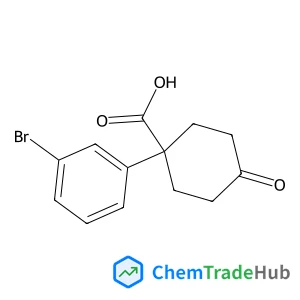
1-(3-Bromophenyl)-4-oxocyclohexanecarboxylic acid
CAS Number:
1385694-53-0
Molecular Formula:
C13H13BrO3
Jiansheng Shen, Bin Wang, Zhansheng Lu, Dongwei Ma
The electrocatalytic hydrogen evolution reaction (HER) for water splitting is crucial for the sustainable production of clean hydrogen fuel, while the high cost of Pt catalysts impedes its commercialization. Herein, we have performed a systematic theoretical study on the electrocatalytic HER over single-atom catalysts (SACs) based on low-cost TiN. Specifically, the TiN(100) surface with a Ti or N vacancy has been considered as the support. 20 transition-metal (TM) atoms and 3 nonmetallic atoms are embedded into the Ti or N vacancy, accordingly denoted as M@Tiv or M@Nv. All the single atoms can be stabilized by the surface vacancies, controlled by the adjustable chemical potential. Interestingly, for TM-embedded TiN(100), the hydrogen binding is much stronger over M@Nv than M@Tiv, which can be attributed to the more localized d states of the TM atoms anchored by the N vacancies, indicating a strong coordination effect. Among 43 catalysts, 10 (Ni, Zn, Nb, Mo, Rh@Tiv, and Au, Pd, W, Mo, B@Nv) were predicted to have high HER catalytic activity with near-zero hydrogen adsorption free energy. For the further gaseous hydrogen evolution, Zn@Tiv can adopt both Tafel (with an energy barrier of 0.68 eV) and Heyrovsky mechanisms, while the others may prefer the Heyrovsky mechanism. This work provides a promising strategy to realize cost-efficient electrocatalysts for the HER, and highlights the important role of the local coordination environment for SACs.
Hajar Nili Ahmadabadi, Amir Ali Masoudi, Sahin Uyaver
DOI: 10.1039/D1CP03031K
S. Y. Wu, R. L. Qian, C. L. Ma, Y. Shan, Y. J. Wu, X. Y. Wu, J. L. Zhang, X. B. Zhu, H. T. Ji, C. Y. Qu, F. Hou, L. Z. Liu
DOI: 10.1039/D1CP03155D
Ramesh Kumar, Jitendra Kumar, Priya Srivastava, Gaurav Manik
DOI: 10.1039/D1CP03621A
Renato Pereira Orenha, Letícia Bermudes Peixoto, Giovanni Finoto Caramori, Maurício Jeomar Piotrowski, Krys Elly de Araújo Batista, Julia Contreras-Garcia, Nelson Henrique Morgon, Fernando Mendizabal, Renato Luis Tame Parreira
DOI: 10.1039/D1CP02514G
Krishna Gopal Chattaraj, Sandip Paul
DOI: 10.1039/D1CP01504D
Sheikh I. Hossain, Suvash C. Saha
DOI: 10.1039/D1CP03250J
Xueru Cai, Guoqing Sun, Yaxin Xu, Jinlong Ma, Dongwei Xu
DOI: 10.1039/D1CP02759J
Ignacio Borge-Durán, Denial Aias, Ilya Grinberg
DOI: 10.1039/D1CP02935E
Yujuan Huang, Longlong Zhang, Yuying Hao
DOI: 10.1039/D1CP03686F
Le-Yi Zhao, Dan-Ao Han, Lei Wang, Hai-Yu Wang, Bing-Rong Gao, Hong-Bo Sun
DOI: 10.1039/D1CP02455H
4-Benzyl-2,2-dimethylmorpholine is generally considered safe when handled under ...
(5,6-Dimethoxy-3-pyridinyl)boronic acid is a chemical compound with the molecula...
1,1,3,3-Tetramethyl-1,3-bis(2-methyl-2-propanyl)disiloxane is synthesized throug...
(2R,4S)-1-Boc-4-methylpyrrolidine-2-carboxylic acid is primarily used as a build...
When handling 2,3-Dichloroacrylonitrile, it is crucial to wear appropriate perso...
(S)-1-(o-Tolyl)ethanamine hydrochloride should be stored in a cool, dry place to...
Benzyl [1-(hydroxyamino)-1-imino-2-methyl-2-propanyl]carbamate (CAS: 518047-98-8...
2-Methyloxazole-5-carbaldehyde is used in the pharmaceutical industry for the sy...
The market for 2-Methyl-2-propanyl 4-[(1S)-1-hydroxyethyl]-1-piperidinecarboxyla...
1-Butyl-3-methylpyridinium bromide is generally considered safe for laboratory u...

Physical Chemistry Chemical Physics (PCCP) is an international journal co-owned by 19 physical chemistry and physics societies from around the world. This journal publishes original, cutting-edge research in physical chemistry, chemical physics and biophysical chemistry. To be suitable for publication in PCCP, articles must include significant innovation and/or insight into physical chemistry; this is the most important criterion that reviewers and Editors will judge against when evaluating submissions. The journal has a broad scope and welcomes contributions spanning experiment, theory, computation and data science. Topical coverage includes spectroscopy, dynamics, kinetics, statistical mechanics, thermodynamics, electrochemistry, catalysis, surface science, quantum mechanics, quantum computing and machine learning. Interdisciplinary research areas such as polymers and soft matter, materials, nanoscience, energy, surfaces/interfaces, and biophysical chemistry are welcomed if they demonstrate significant innovation and/or insight into physical chemistry. Joined experimental/theoretical studies are particularly appreciated when complementary and based on up-to-date approaches.