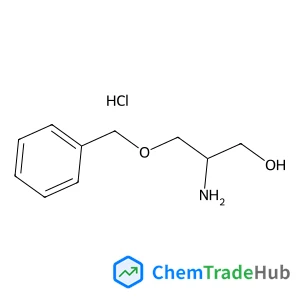
(R)-2-amino-3-(benzyloxy)propan-1-ol hydrochloride
CAS Number:
58577-95-0
Molecular Formula:
C10H16ClNO2
V. Mihalache, C. Negrila, I. Mercioniu, N. Iacob, V. Kuncser
Zn–Fe–O nanoparticle systems (Z3F, Z20F and Z60F) were produced by changing the Zn:Fe ratio (0.97 : 0.03, 0.8 : 0.2 and 0.4 : 0.6 in at%, respectively) in Zn(II)–Fe(III)–carboxylate precursors. According to X-ray diffraction, Z60F is nearly single-phase ZnFe2O4 (5.9 nm crystallite size), Z20F is a ZnO/ZnFe2O4 nanocomposite consisting of 48.8% ZnFe2O4 (4.7 nm crystallite size), and Z3F is apparently pure ZnO (9.5 nm). We found evidence for a ZnFe2O4 spinel of high inversion degree (80–100%) and with superparamagnetic (SPM) behaviour at room temperature in all three samples by a remarkable correlation between HRTEM, FTIR, XPS, Mössbauer and magnetization analyses. Iron modifies the decomposition process of the precursor and enhances its viscosity, which appears to favour the separation of Zn- and Fe-rich phases. As a consequence, two-phase systems of individual nanocrystals/nanoparticles (ZnO and ZnFe2O4) are formed. The large anisotropy constant, 106–107 erg cm−3, of the ZnFe2O4 nanoparticles and the concentration dependence of their magnetic energy barrier are explained in terms of interparticle interactions interlinked with finite size effects and high inversion degree; these factors also control the other parameters of importance for applications, including the blocking temperature (13–111 K), saturation magnetization (1.08–17.7 emu g−1 at 300 K, 4.6–44.8 emu g−1 at 5 K) and coercivity (85.4–491 Oe at 5 K). Magnetic dynamic results, particularly modelled by the Néel-Brown and Vogel–Fulcher laws, yield fitting parameters which validate the presence of concentration-dependent dipole-like interactions between ZnFe2O4 nanoparticles. A fraction of iron was found in the Fe2+ state, presumably substituting for Zn2+ in zinc oxide; however, the samples behave like ZnFe2O4 SPM nanoclusters/nanoparticles dispersed in a nonmagnetic ZnO particle assembly, rather than Zn(Fe)O dilute magnetic semiconductors. The relevance of the properties of the investigated material for specific applications is highlighted throughout the manuscript.
Andrew D. Newman, D. Robert Brown, Prem Siril, Adam F. Lee, Karen Wilson
DOI: 10.1039/B603979K
Robert Vácha, Pavel Jungwirth, Jing Chen, Kalliat Valsaraj
DOI: 10.1039/B610253K
C. Steinbach, M. Fárník, I. Ettischer, J. Siebers, U. Buck
DOI: 10.1039/B604715G
Alejandra Ricci, Cecilia Bonazzola, Ernesto J. Calvo
DOI: 10.1039/B609497J
J. Tomkinson, M. T. F. Telling
DOI: 10.1039/B608590C
Jianbo Liu, Brady W. Uselman, Brian Van Devener, Scott L. Anderson
DOI: 10.1039/B610814H
Giuseppina Raffaini, Fabio Ganazzoli
DOI: 10.1039/B604540E
Sean Maksimuk, Xiaowei Teng, Hong Yang
DOI: 10.1039/B611186F
Bas Hofs, Ilja K. Voets, Arie de Keizer, Martien A. Cohen Stuart
DOI: 10.1039/B605695D
Ethyl 4-chlorothieno[2,3-b]pyridine-5-carboxylate (CAS: 59713-58-5) can be synth...
5-Methyl-1H-indole-3-carbaldehyde (CAS: 52562-50-2) is subject to various regula...
(1,3-Dimethyl-2,4-dioxo-1,2,3,4-tetrahydro-5-pyrimidinyl)boronic acid is a white...
Waste containing Sulfocostunolide A (CAS: 1016983-51-9) should be handled with c...
When handling Murraxocin (CAS: 88478-44-8), ensure proper personal protective eq...
Formvar (CAS: 63148-64-1) is an alkyd resin characterized by a high molecular we...
(S)-4-benzyl-2-((benzyloxy)methyl)morpholine is generally safe when handled with...
Methyl 1-(5-bromo-2-pyrimidinyl)cyclopropanecarboxylate (CAS: 1447607-69-3) is p...
2-Methyl-1-phenyl-1-propanamine hydrochloride (CAS: 24290-47-9) is generally con...
3-(4-Bromophenyl)-2-methylpropanoic acid is synthesized through a multi-step pro...

Physical Chemistry Chemical Physics (PCCP) is an international journal co-owned by 19 physical chemistry and physics societies from around the world. This journal publishes original, cutting-edge research in physical chemistry, chemical physics and biophysical chemistry. To be suitable for publication in PCCP, articles must include significant innovation and/or insight into physical chemistry; this is the most important criterion that reviewers and Editors will judge against when evaluating submissions. The journal has a broad scope and welcomes contributions spanning experiment, theory, computation and data science. Topical coverage includes spectroscopy, dynamics, kinetics, statistical mechanics, thermodynamics, electrochemistry, catalysis, surface science, quantum mechanics, quantum computing and machine learning. Interdisciplinary research areas such as polymers and soft matter, materials, nanoscience, energy, surfaces/interfaces, and biophysical chemistry are welcomed if they demonstrate significant innovation and/or insight into physical chemistry. Joined experimental/theoretical studies are particularly appreciated when complementary and based on up-to-date approaches.