












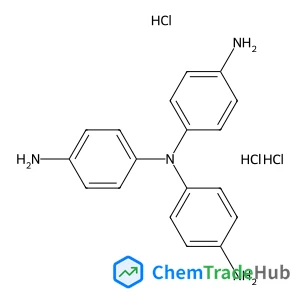
N1,N1-Bis(4-aminophenyl)benzene-1,4-diamine trihydrochloride
CAS Number:
114254-48-7
Molecular Formula:
C18H21Cl3N4
Sabyasachi Pramanik, Mihir Manna, Biswajit Hudait, Shilaj Roy, Satyapriya Bhandari
Herein, we report a complexation reaction between Zn2+ ions present on the surface of an orange-red-emitting environmentally sustainable Mn2+-doped ZnS QD and a non-emitting copper quinolate (CuQ2) complex, which leads to the formation of a greenish blue-emitting surface zinc quinolate (ZnQ2) complex. The synchronous contribution of the surface ZnQ2 complex and Mn2+-doped ZnS QD is directed towards the generation of photostable bright white light (at λex – 355 nm) with chromaticity coordinates of (0.34, 0.42), color rendering index (CRI) of 71 and color-correlated temperature (CCT) of 5046 K. The ZnQ2 complexed Mn2+-doped ZnS QD is herein called as quantum dot complex (QDC). The excitation- and time-dependent tunability in emission, chromaticity, CRI and CCT of QDC revealed their futuristic applications in light-emitting devices with an anticipated color output. The current work also shows the catalytic behavior of Mn2+-doped ZnS QDs towards facilitating the formation of surface ZnQ2 from CuQ2, which is not feasible with regard to the reactivity of CuQ2 under normal conditions according to the Irving–William series. The rate of the reaction was observed to be first order with respect to CuQ2 at 20 °C, and the complexation constant for the formation of ZnQ2 was estimated to be 8.3 × 10⁵ M−1. This is important for understanding the surface chemistry of metal chalcogenide QDs towards complexation reactions.
DOI: 10.1039/D3CP03393G
Li Shen, Xiaobo Gao, Zhanqing Chang, Changhao Zhang, Yue Li, Jitao Lu, Qingguo Meng, Qian Wu
DOI: 10.1039/D3CP05199D
Jinfan Wu, Tao Wang, Fen Xu, Lixian Sun, Yuan Gao, Hehui Wang, Guorong Zhang, Zhong Cao, Julan Zeng
DOI: 10.1039/D3SE01162C
Meixin Cheng
DOI: 10.1039/D3CP04975B
Novrita Idayanti
DOI: 10.1039/D4SE90004A
Umair Shamraiz, Abdul Majeed, Bareera Raza, Noor ul Ain, Amin Badshah
DOI: 10.1039/D3SE00942D
Jiali Nie, Ying Li, Dongyue Gao, Yi Fang, Jing Lin, Chengchun Tang, Zhonglu Guo
DOI: 10.1039/D3CP04718K
Jaemin Park, Dukjoon Kim, Jung Kyu Kim
DOI: 10.1039/D3SE01371E
Abhishek Kalpattu, Tristan Dilbeck, Kenneth Hanson
DOI: 10.1039/D3CP90241B
Xiao-Juan Wang, Yan Long, Chuan-Wan Wei, Shu-Qin Gao
DOI: 10.1039/D3CP05403A
Waste containing N-Methoxy-N-methyl-1,3-thiazole-5-carboxamide (CAS: 898825-89-3...
N-(4-Biphenylyl)dibenzo[b,d]furan-4-amine should be stored in a tightly sealed c...
The market for 3-Acetamido-5-amino-2,4,6-triiodobenzoic acid (CAS: 1713-07-1) is...
Benzyl 2-O-acetyl-3,4,6-tri-O-benzyl-beta-D-galactopyranoside (CAS: 61820-03-9) ...
2-Ethylpiperazine dihydrochloride (CAS: 438050-52-3) is regulated under the Glob...
1,1'-[1,3-Phenylenebis(methylene)]bis(3-methyl-1H-pyrrole-2,5-dione) (CAS: 11946...
Several alternatives can be used in the synthesis of 5-Fluoro-2-(1-pyrrolidinyl)...
Proper personal protective equipment (PPE) must be worn when handling this compo...
When handling 6-Bromoimidazo[1,2-a]pyridin-8-amine, it is important to wear appr...
Alternatives to (2S,4R)-4-(4-Nitrobenzyl)pyrrolidine-2-carboxylic acid hydrochlo...

Physical Chemistry Chemical Physics (PCCP) is an international journal co-owned by 19 physical chemistry and physics societies from around the world. This journal publishes original, cutting-edge research in physical chemistry, chemical physics and biophysical chemistry. To be suitable for publication in PCCP, articles must include significant innovation and/or insight into physical chemistry; this is the most important criterion that reviewers and Editors will judge against when evaluating submissions. The journal has a broad scope and welcomes contributions spanning experiment, theory, computation and data science. Topical coverage includes spectroscopy, dynamics, kinetics, statistical mechanics, thermodynamics, electrochemistry, catalysis, surface science, quantum mechanics, quantum computing and machine learning. Interdisciplinary research areas such as polymers and soft matter, materials, nanoscience, energy, surfaces/interfaces, and biophysical chemistry are welcomed if they demonstrate significant innovation and/or insight into physical chemistry. Joined experimental/theoretical studies are particularly appreciated when complementary and based on up-to-date approaches.
![[(5-Methyl-1,3,4-thiadiazol-2-yl)sulfanyl]acetic acid structure](https://static.chemtradehub.com/structs/509/50918-26-8-4ce8.webp "[(5-Methyl-1,3,4-thiadiazol-2-yl)sulfanyl]acetic acid structure")





