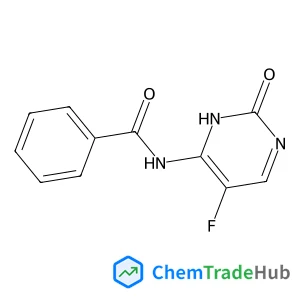
N-(5-Fluoro-2-oxo-2,3-dihydro-4-pyrimidinyl)benzamide
CAS Number:
10357-07-0
Molecular Formula:
C11H8FN3O2
Kathrin Ebner, Lingmei Ni, Viktoriia A. Saveleva, Benjamin P. Le Monnier, Adam H. Clark, Frank Krumeich, Maarten Nachtegaal, Jeremy S. Luterbacher, Ulrike I. Kramm, Juan Herranz
Pt-group metal (PGM)-free catalysts of the Me–N–C type based on abundant and inexpensive elements have gained importance in the field of oxygen reduction reaction (ORR) electrocatalysis due to their promising ORR-activities. Their insufficient stability, however, has fueled the interest in obtaining an in-depth understanding of their composition, which requires highly sensitive techniques compatible with their low metal contents (typically <5 wt%). In the particular context of iron-based materials, 57Fe-Mössbauer spectroscopy is often used to provide such compositional information, but requires (partially) 57Fe-enriched precursors. As a consequence, the extrapolation of conclusions drawn from Mössbauer measurements on 57Fe-enriched catalysts to equivalent materials with the standard isotope distribution relies on the assumption that the metal precursor's isotopic profile does not affect the catalysts’ composition and ORR-activity. To verify this hypothesis, in this study we prepared two series of Fe-based catalysts using distinctively different synthesis approaches and various relative contents of 57Fe-enriched precursors, and observed that the extent of the latter parameter significantly affected the catalysts’ ORR-activity. This effect was successfully correlated with the Fe-speciation of the catalysts inferred from the characterization of these samples with Mössbauer and X-ray absorption spectroscopies. Ultimately, these results highlight the crucial importance of verifying the consistency of the catalysts’ activity and composition upon comparing standard and 57Fe-enriched samples.
Miwako Teranishi, Shin-ichi Naya, Hiroaki Tada
DOI: 10.1039/D3SE01513K
Alasdair D. Keith, Elizabeth B. Sawyer, Desmond C. Y. Choy, Yuhang Xie, George S. Biggs, Oskar James Klein, Paul D. Brear, David J. Wales, Paul D. Barker
DOI: 10.1039/D3CP03897A
Fakhrul H. Bhuiyan, Ashlie Martini
DOI: 10.1039/D3CP05320B
Sergei Prokvolit, Erqian Mao, Thomas G. Gray
DOI: 10.1039/D3CP05385G
Liying Pan, Xuxin Kang
DOI: 10.1039/D3CP04660E
Raquel Yanes-Rodríguez, Rita Prosmiti
DOI: 10.1039/D3CP05410A
Licheng Liu, Deepak Pant
DOI: 10.1039/D3SE00876B
Yongliang Zhang, Xilong Zhang, Mingjie Li, Yunfei Liu, Zhen Hu
DOI: 10.1039/D3SE00989K
Chengyong Zhong, Shuo Li
DOI: 10.1039/D3CP05005J
Waste containing N-Methoxy-N-methyl-1,3-thiazole-5-carboxamide (CAS: 898825-89-3...
N-(4-Biphenylyl)dibenzo[b,d]furan-4-amine should be stored in a tightly sealed c...
The market for 3-Acetamido-5-amino-2,4,6-triiodobenzoic acid (CAS: 1713-07-1) is...
Benzyl 2-O-acetyl-3,4,6-tri-O-benzyl-beta-D-galactopyranoside (CAS: 61820-03-9) ...
2-Ethylpiperazine dihydrochloride (CAS: 438050-52-3) is regulated under the Glob...
1,1'-[1,3-Phenylenebis(methylene)]bis(3-methyl-1H-pyrrole-2,5-dione) (CAS: 11946...
Several alternatives can be used in the synthesis of 5-Fluoro-2-(1-pyrrolidinyl)...
Proper personal protective equipment (PPE) must be worn when handling this compo...
When handling 6-Bromoimidazo[1,2-a]pyridin-8-amine, it is important to wear appr...
Alternatives to (2S,4R)-4-(4-Nitrobenzyl)pyrrolidine-2-carboxylic acid hydrochlo...

Physical Chemistry Chemical Physics (PCCP) is an international journal co-owned by 19 physical chemistry and physics societies from around the world. This journal publishes original, cutting-edge research in physical chemistry, chemical physics and biophysical chemistry. To be suitable for publication in PCCP, articles must include significant innovation and/or insight into physical chemistry; this is the most important criterion that reviewers and Editors will judge against when evaluating submissions. The journal has a broad scope and welcomes contributions spanning experiment, theory, computation and data science. Topical coverage includes spectroscopy, dynamics, kinetics, statistical mechanics, thermodynamics, electrochemistry, catalysis, surface science, quantum mechanics, quantum computing and machine learning. Interdisciplinary research areas such as polymers and soft matter, materials, nanoscience, energy, surfaces/interfaces, and biophysical chemistry are welcomed if they demonstrate significant innovation and/or insight into physical chemistry. Joined experimental/theoretical studies are particularly appreciated when complementary and based on up-to-date approaches.