












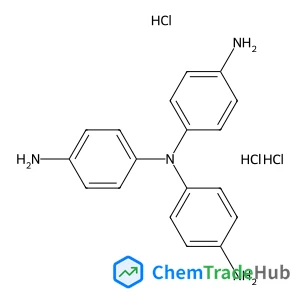
N1,N1-Bis(4-aminophenyl)benzene-1,4-diamine trihydrochloride
CAS Number:
114254-48-7
Molecular Formula:
C18H21Cl3N4
Tobias F. Pascher, Milan Ončák, Christian van der Linde, Martin K. Beyer
The investigation of copper nitrate cluster anions Cu(II)n(NO3)2n+1−, n ≤ 4, in the gas phase using ultraviolet/visible/near-infrared (UV/vis/NIR) spectroscopy provides detailed insight into the electronic structure of the copper salt and its intriguing photochemistry. In the experimentally studied region up to 5.5 eV, the spectra of copper(II) nitrate exhibit a 3d–3d band in the vis/NIR and well-separated bands in the UV. The latter bands originate from Ligand-to-Metal Charge Transfer (LMCT) as well as n–π* transitions in the nitrate ligands. The clusters predominantly decompose by loss of neutral copper nitrate in the electronic ground state after internal conversion or via the photochemical loss of a neutral NO3 ligand after a LMCT. These two decomposition channels are in direct competition on the ground state potential energy surface for the smallest copper nitrate cluster, Cu(II)(NO3)3−. Here, copper nitrate evaporation is thermochemically less favorable. Population of π* orbitals in the nitrate ligands may lead to N–O bond photolysis. This is observed in the UV region with a small quantum efficiency, with photochemical loss of either nitrogen dioxide or an oxygen atom.
Riku Okamoto, Akira Kimura, Yuhi Nakayasu, Akira Yamakata, Ryota Tomizawa, Taizo Masuda, Koichiro Nakatani
DOI: 10.1039/D3SE01408H
Kang Zhao, Dao Wang, Sajjad Ur Rehman
DOI: 10.1039/D3CP04883G
Li-Ting Cui, Wen-Feng Lin, Shi-Gang Sun
DOI: 10.1039/D3SE01275A
Shengzhuo Chen, Juntian Niu, Xianrong Zheng, Haiyu Liu, Yan Jin, Jingyu Ran
DOI: 10.1039/D3CP05435G
Chengyong Zhong, Shuo Li
DOI: 10.1039/D3CP05005J
Meixin Cheng
DOI: 10.1039/D3CP04975B
D. C. Malaspina, J. P. Larentzos, J. K. Brennan, A. D. Mackie, J. Bonet Avalos
DOI: 10.1039/D3CP03791F
Qifeng Mu, Jian Hu
DOI: 10.1039/D3CP04160C
Miaomiao Zhang, Cunyuan Pei, Qiqi Xiang, Lintao Liu, Zhongxu Dai, Huijuan Ma, Shibing Ni
DOI: 10.1039/D3CP04952C
Alessandro Grottesi
DOI: 10.1039/D3CP05530B
Waste containing N-Methoxy-N-methyl-1,3-thiazole-5-carboxamide (CAS: 898825-89-3...
N-(4-Biphenylyl)dibenzo[b,d]furan-4-amine should be stored in a tightly sealed c...
The market for 3-Acetamido-5-amino-2,4,6-triiodobenzoic acid (CAS: 1713-07-1) is...
Benzyl 2-O-acetyl-3,4,6-tri-O-benzyl-beta-D-galactopyranoside (CAS: 61820-03-9) ...
2-Ethylpiperazine dihydrochloride (CAS: 438050-52-3) is regulated under the Glob...
1,1'-[1,3-Phenylenebis(methylene)]bis(3-methyl-1H-pyrrole-2,5-dione) (CAS: 11946...
Several alternatives can be used in the synthesis of 5-Fluoro-2-(1-pyrrolidinyl)...
Proper personal protective equipment (PPE) must be worn when handling this compo...
When handling 6-Bromoimidazo[1,2-a]pyridin-8-amine, it is important to wear appr...
Alternatives to (2S,4R)-4-(4-Nitrobenzyl)pyrrolidine-2-carboxylic acid hydrochlo...

Physical Chemistry Chemical Physics (PCCP) is an international journal co-owned by 19 physical chemistry and physics societies from around the world. This journal publishes original, cutting-edge research in physical chemistry, chemical physics and biophysical chemistry. To be suitable for publication in PCCP, articles must include significant innovation and/or insight into physical chemistry; this is the most important criterion that reviewers and Editors will judge against when evaluating submissions. The journal has a broad scope and welcomes contributions spanning experiment, theory, computation and data science. Topical coverage includes spectroscopy, dynamics, kinetics, statistical mechanics, thermodynamics, electrochemistry, catalysis, surface science, quantum mechanics, quantum computing and machine learning. Interdisciplinary research areas such as polymers and soft matter, materials, nanoscience, energy, surfaces/interfaces, and biophysical chemistry are welcomed if they demonstrate significant innovation and/or insight into physical chemistry. Joined experimental/theoretical studies are particularly appreciated when complementary and based on up-to-date approaches.
![4-[(2-{2-[2-(2-Aminoethoxy)ethoxy]ethoxy}ethyl)amino]-2-(2,6-dioxo-3-piperidinyl)-1H-isoindole-1,3(2H)-dione structure](https://static.chemtradehub.com/structs/209/2093416-31-8-3162.webp "4-[(2-{2-[2-(2-Aminoethoxy)ethoxy]ethoxy}ethyl)amino]-2-(2,6-dioxo-3-piperidinyl)-1H-isoindole-1,3(2H)-dione structure")
![4-Chloro-2-{[(2-chlorophenoxy)acetyl]amino}benzoic acid structure](https://static.chemtradehub.com/structs/351/351424-20-9-9467.webp "4-Chloro-2-{[(2-chlorophenoxy)acetyl]amino}benzoic acid structure")






