












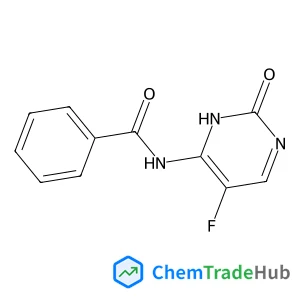
N-(5-Fluoro-2-oxo-2,3-dihydro-4-pyrimidinyl)benzamide
CAS Number:
10357-07-0
Molecular Formula:
C11H8FN3O2
Rasheed Bilal, Minsi Xin, Zhong Lv, Yong Tan, Zhihai Yao
The Raman spectra of dimethylsulfoxide (DMSO)/benzene binary mixtures were studied by decreasing the temperature from 333 K to 263 K with the aim to reveal the molecular interaction properties during phase transition. The intensity of the Raman band for benzene at 992 cm−1 showed an increasing trend in the liquid and solid phases, while it exhibited a highly decreasing trend during the liquid–solid phase transition. The potential energy was calculated to study the effect of intermolecular interaction distance between DMSO and benzene on Raman intensity. The observations indicated that the blueshift of the low-frequency bands of DMSO was significantly different from the redshift of its high-frequency bands. The hydrogen bond generated between DMSO and benzene was well formed in the binary systems. This interaction inducing an enhanced hydrogen bond between the binary systems and attenuated C–H bonds led to opposite Raman shift variations with decreasing temperature. The Raman bands of DMSO at 1425 cm−1, 2899 cm−1, and 2992 cm−1 each split into two peaks after phase transition. The splitting of the Raman bands of DMSO at 1417 cm−1, 2895 cm−1, and 2982 cm−1 cropped up as the temperature dropped to the transformation point of 288 K. This is attributed to the phase transition-induced latent def.(C7) atomic vibrations corresponding to the individual methyl groups of DMSO. The implications of these analyses are expected to be helpful to understand the effect of phase transition on the Raman properties of binary solutions.
C. Díaz, R. A. Olsen, D. J. Auerbach, G. J. Kroes
DOI: 10.1039/C001956A
DOI: 10.1039/B923959F
Sason Shaik
DOI: 10.1039/C001372M
Xumei Wang, Shuping Xu, Weiqing Xu
DOI: 10.1039/C0CP00929F
Tangui Le Bahers, Frédéric Labat, Thierry Pauporté, Ilaria Ciofini
DOI: 10.1039/C004358C
Maciej Kołaski, Anupriya Kumar, N. Jiten Singh, Kwang S. Kim
DOI: 10.1039/C003008B
Atsushi Itadani, Takashi Yumura, Takahiro Ohkubo, Hisayoshi Kobayashi, Yasushige Kuroda
DOI: 10.1039/C000967A
Oscar Donoso-Tauda, Pablo Jaque, Juan C. Santos
DOI: 10.1039/C0CP00928H
Ce Hao, Zhilong Xiu, Jieshan Qiu
DOI: 10.1039/B927049C
Waste containing N-Methoxy-N-methyl-1,3-thiazole-5-carboxamide (CAS: 898825-89-3...
N-(4-Biphenylyl)dibenzo[b,d]furan-4-amine should be stored in a tightly sealed c...
The market for 3-Acetamido-5-amino-2,4,6-triiodobenzoic acid (CAS: 1713-07-1) is...
Benzyl 2-O-acetyl-3,4,6-tri-O-benzyl-beta-D-galactopyranoside (CAS: 61820-03-9) ...
2-Ethylpiperazine dihydrochloride (CAS: 438050-52-3) is regulated under the Glob...
1,1'-[1,3-Phenylenebis(methylene)]bis(3-methyl-1H-pyrrole-2,5-dione) (CAS: 11946...
Several alternatives can be used in the synthesis of 5-Fluoro-2-(1-pyrrolidinyl)...
Proper personal protective equipment (PPE) must be worn when handling this compo...
When handling 6-Bromoimidazo[1,2-a]pyridin-8-amine, it is important to wear appr...
Alternatives to (2S,4R)-4-(4-Nitrobenzyl)pyrrolidine-2-carboxylic acid hydrochlo...

Physical Chemistry Chemical Physics (PCCP) is an international journal co-owned by 19 physical chemistry and physics societies from around the world. This journal publishes original, cutting-edge research in physical chemistry, chemical physics and biophysical chemistry. To be suitable for publication in PCCP, articles must include significant innovation and/or insight into physical chemistry; this is the most important criterion that reviewers and Editors will judge against when evaluating submissions. The journal has a broad scope and welcomes contributions spanning experiment, theory, computation and data science. Topical coverage includes spectroscopy, dynamics, kinetics, statistical mechanics, thermodynamics, electrochemistry, catalysis, surface science, quantum mechanics, quantum computing and machine learning. Interdisciplinary research areas such as polymers and soft matter, materials, nanoscience, energy, surfaces/interfaces, and biophysical chemistry are welcomed if they demonstrate significant innovation and/or insight into physical chemistry. Joined experimental/theoretical studies are particularly appreciated when complementary and based on up-to-date approaches.
![2-(7,7-Difluorobicyclo[4.1.0]hept-1-yl)ethanamine structure](https://static.chemtradehub.com/structs/209/2098065-08-6-ff24.webp "2-(7,7-Difluorobicyclo[4.1.0]hept-1-yl)ethanamine structure")
![2-Methyl-2-propanyl {3-[4-(4,4,5,5-tetramethyl-1,3,2-dioxaborolan-2-yl)phenyl]-3-oxetanyl}carbamate structure](https://static.chemtradehub.com/structs/127/1279090-25-3-1b84.webp "2-Methyl-2-propanyl {3-[4-(4,4,5,5-tetramethyl-1,3,2-dioxaborolan-2-yl)phenyl]-3-oxetanyl}carbamate structure")




