












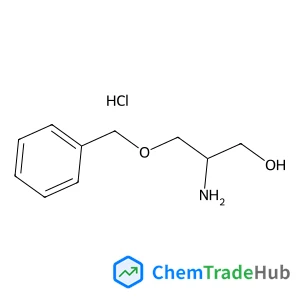
(R)-2-amino-3-(benzyloxy)propan-1-ol hydrochloride
CAS Number:
58577-95-0
Molecular Formula:
C10H16ClNO2
Ritwik Maity, Alo Dutta, Saswata Halder, Santiranjan Shannigrahi, Kalyan Mandal, T. P. Sinha
In this work we have synthesized Mn doped GdFeO3 nano-particles using a green and facile sol gel method and studied their photocatalytic, optical, vibrational and electrical properties. The Rietveld refinement of the XRD profiles suggests that all the materials have an orthorhombic Pbnm crystal structure. The transmission electron microscope (TEM) images show the decrease of the average particle size from 140 to 80 nm with the Mn concentration. The high crystallinity of the synthesized particles is confirmed from the HR-TEM images. Raman spectrum is employed to investigate the phonon modes of the materials. The optical band gap of the materials is obtained from the UV-vis reflectance spectroscopy (DRS) using Tauc relation which indicates the reduction of the band gap from 2.18 to 1.72 eV with Mn-doping. The photocatalytic activity of the materials is studied by the photocatalytic degradation of rhodamine B (Rh-B) in aqueous solution under visible light illumination. The substitution of Mn at the Fe site introduces an extra electronic state between the conduction band and the valence band which reduces the electronic band gap and enhances the Rh-B degradation efficiency. A 30% Mn doping at the Fe site (GFMO3) provides an optimum space charge width which assists to attain the maximum rate of degradation of the Rh-B dye. The doping of Mn3+ reduces the photogenerated electron and hole recombination rate and hence more charge carriers take part in the redox reaction which facilitates the photo-catalytic efficiency in GFMO3. The degradation rate enhances by a factor of 2.5 for GFMO3 as compared to pure GdFeO3. The highest photocurrent density of 1.31 μA cm−2 of GFMO3 with respect to other materials promotes the separation and transfer of the photo generated charge carriers. The possible photocatalytic mechanism of the Mn doped GdFeO3 is also critically discussed. Alternating current impedance spectroscopy is used to study the electrical properties of the synthesized materials. The increase in the conductivity with the Mn concentration is explained on the basis of the band gap reduction and this is consistent with the Smit and Wijn theory. Magnetic measurement is performed to measure the magnetization strength which is useful to separate the photocatalyst by simply using a magnet. The temperature dependent magnetization measurement suggests the anti-ferromagnetic (AFM) behaviour of the studied materials with the decrease of Néel temperature (TN) with Mn concentration. The XPS study reveals the presence of multiple oxidation states of Fe(2+/3+) and Mn(4+/3+) in these materials which facilitates the conductivity as well as the oxidation/reduction efficiency at the surface of the catalyst. The band gap reduction and its effect on the enhancement of the photocatalytic degradation efficiency with Mn doping are also discussed from the density of states calculations. Thus, this study describes a promising approach for the organic pollutant degradation by designing an efficient and stable perovskite photocatalyst.
DOI: 10.1039/B603499C
M. Abu-samha, K. J. Børve, L. J. Sæthre, G. Öhrwall, H. Bergersen, T. Rander, O. Björneholm, M. Tchaplyguine
DOI: 10.1039/B516905D
Robert Vácha, Pavel Jungwirth, Jing Chen, Kalliat Valsaraj
DOI: 10.1039/B610253K
Marat O. Gallyamov, Ahmed Mourran, Bernd Tartsch, Rostislav A. Vinokur, Lev N. Nikitin, Kjeld Schaumburg, Martin Möller
DOI: 10.1039/B602959K
Jairton Dupont, Paulo A. Z. Suarez
DOI: 10.1039/B602046A
Cunshun Huang, Sridhar A. Lahankar, Myung Hwa Kim, Bailin Zhang, Arthur G. Suits
DOI: 10.1039/B612324D
Ethyl 4-chlorothieno[2,3-b]pyridine-5-carboxylate (CAS: 59713-58-5) can be synth...
5-Methyl-1H-indole-3-carbaldehyde (CAS: 52562-50-2) is subject to various regula...
(1,3-Dimethyl-2,4-dioxo-1,2,3,4-tetrahydro-5-pyrimidinyl)boronic acid is a white...
Waste containing Sulfocostunolide A (CAS: 1016983-51-9) should be handled with c...
When handling Murraxocin (CAS: 88478-44-8), ensure proper personal protective eq...
Formvar (CAS: 63148-64-1) is an alkyd resin characterized by a high molecular we...
(S)-4-benzyl-2-((benzyloxy)methyl)morpholine is generally safe when handled with...
Methyl 1-(5-bromo-2-pyrimidinyl)cyclopropanecarboxylate (CAS: 1447607-69-3) is p...
2-Methyl-1-phenyl-1-propanamine hydrochloride (CAS: 24290-47-9) is generally con...
3-(4-Bromophenyl)-2-methylpropanoic acid is synthesized through a multi-step pro...

Physical Chemistry Chemical Physics (PCCP) is an international journal co-owned by 19 physical chemistry and physics societies from around the world. This journal publishes original, cutting-edge research in physical chemistry, chemical physics and biophysical chemistry. To be suitable for publication in PCCP, articles must include significant innovation and/or insight into physical chemistry; this is the most important criterion that reviewers and Editors will judge against when evaluating submissions. The journal has a broad scope and welcomes contributions spanning experiment, theory, computation and data science. Topical coverage includes spectroscopy, dynamics, kinetics, statistical mechanics, thermodynamics, electrochemistry, catalysis, surface science, quantum mechanics, quantum computing and machine learning. Interdisciplinary research areas such as polymers and soft matter, materials, nanoscience, energy, surfaces/interfaces, and biophysical chemistry are welcomed if they demonstrate significant innovation and/or insight into physical chemistry. Joined experimental/theoretical studies are particularly appreciated when complementary and based on up-to-date approaches.
![2-Methyl-2-propanyl 1,6-diazaspiro[3.4]octane-6-carboxylate structure](https://static.chemtradehub.com/structs/115/1158749-79-1-81ee.webp "2-Methyl-2-propanyl 1,6-diazaspiro[3.4]octane-6-carboxylate structure")
![Imidazo[1,5-a]pyrazine structure](https://static.chemtradehub.com/structs/274/274-49-7-d749.webp "Imidazo[1,5-a]pyrazine structure")




