











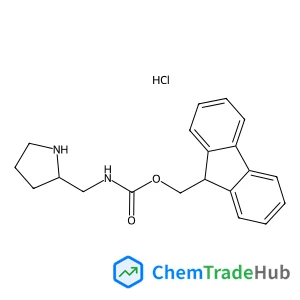
(S)-(9H-Fluoren-9-yl)methyl (pyrrolidin-2-ylmethyl)carbamate hydrochloride
CAS Number:
1217813-15-4
Molecular Formula:
C20H23ClN2O2
James D. Blakemore, Bruce S. Brunschwig, Harry B. Gray, Petter Persson
The attachment of the 2,2′-bipyridine (bpy) moieties to the surface of planar silicon(111) (photo)electrodes was investigated using ab initio simulations performed on a new cluster model for methyl-terminated silicon. Density functional theory (B3LYP) with implicit solvation techniques indicated that adventitious chlorine atoms, when present in the organic linker backbone, led to instability at very negative potentials of the surface-modified electrode. In prior experimental work, chlorine atoms were present as a trace surface impurity due to required surface processing chemistry, and thus could plausibly result in the observed surface instability of the linker. Free energy calculations for the Cl-atom release process with model silyl-linker constructs revealed a modest barrier (14.9 kcal mol−1) that decreased as the electrode potential became more negative. A small library of new bpy-derived structures has additionally been explored computationally to identify strategies that could minimize chlorine-induced linker instability. Structures with fluorine substituents are predicted to be more stable than their chlorine analogues, whereas fully non-halogenated structures are predicted to exhibit the highest stability. The behavior of a hydrogen-evolving molecular catalyst Cp*Rh(bpy) (Cp* = pentamethylcyclopentadienyl) immobilized on a silicon(111) cluster was explored theoretically to evaluate differences between the homogeneous and surface-attached behavior of this species in a tautomerization reaction observed under reductive conditions for catalytic H2 evolution. The calculated free energy difference between the tautomers is small, hence the results suggest that use of reductively stable linkers can enable robust attachment of catalysts while maintaining chemical behavior on the electrode similar to that exhibited in homogeneous solution.
Xiao-Yu Liu, Yong Qin
DOI: 10.1039/D3NP00020F
DOI: 10.1039/D3NJ05137D
Shuming Zeng, Qian Shen, Lina Guo, Yinchang Zhao, Hao Huang, Yusong Tu
DOI: 10.1039/D3TA04338J
Jean-Alexandre Bureau, Magdalena Escobar Oliva, Yueming Dong, Codruta Ignea
DOI: 10.1039/D3NP00005B
Iván Sánchez-García, Richard J. M. Egberink, Willem Verboom, Hitos Galán
DOI: 10.1039/D3NJ04265K
Armando di Biase, Carlo Castellano, Giorgia Confalonieri, Patrizia Fumagalli, Simone Tumiati, Davide Ceresoli
DOI: 10.1039/D3TA04847K
Lucas H. G. Kalinke, Mariany S. Silva, Ana K. Valdo, Felipe T. Martins, Nicolás Moliner, Miguel Julve, Francesc Lloret, Joan Cano, Danielle Cangussu
DOI: 10.1039/D3NJ04701F
Wenming Ding, Shengbo Yuan, Yang Yang, Xiaoman Li, Min Luo
DOI: 10.1039/D3TA04947G
Donya Mohammadi Amidi, Kamran Akhbari
DOI: 10.1039/D3NJ05198F
Manviri Rani, Jyoti Yadav, Uma Shanker
DOI: 10.1039/D3NJ04966C
Waste containing N-Methoxy-N-methyl-1,3-thiazole-5-carboxamide (CAS: 898825-89-3...
N-(4-Biphenylyl)dibenzo[b,d]furan-4-amine should be stored in a tightly sealed c...
The market for 3-Acetamido-5-amino-2,4,6-triiodobenzoic acid (CAS: 1713-07-1) is...
Benzyl 2-O-acetyl-3,4,6-tri-O-benzyl-beta-D-galactopyranoside (CAS: 61820-03-9) ...
2-Ethylpiperazine dihydrochloride (CAS: 438050-52-3) is regulated under the Glob...
1,1'-[1,3-Phenylenebis(methylene)]bis(3-methyl-1H-pyrrole-2,5-dione) (CAS: 11946...
Several alternatives can be used in the synthesis of 5-Fluoro-2-(1-pyrrolidinyl)...
Proper personal protective equipment (PPE) must be worn when handling this compo...
When handling 6-Bromoimidazo[1,2-a]pyridin-8-amine, it is important to wear appr...
Alternatives to (2S,4R)-4-(4-Nitrobenzyl)pyrrolidine-2-carboxylic acid hydrochlo...

Physical Chemistry Chemical Physics (PCCP) is an international journal co-owned by 19 physical chemistry and physics societies from around the world. This journal publishes original, cutting-edge research in physical chemistry, chemical physics and biophysical chemistry. To be suitable for publication in PCCP, articles must include significant innovation and/or insight into physical chemistry; this is the most important criterion that reviewers and Editors will judge against when evaluating submissions. The journal has a broad scope and welcomes contributions spanning experiment, theory, computation and data science. Topical coverage includes spectroscopy, dynamics, kinetics, statistical mechanics, thermodynamics, electrochemistry, catalysis, surface science, quantum mechanics, quantum computing and machine learning. Interdisciplinary research areas such as polymers and soft matter, materials, nanoscience, energy, surfaces/interfaces, and biophysical chemistry are welcomed if they demonstrate significant innovation and/or insight into physical chemistry. Joined experimental/theoretical studies are particularly appreciated when complementary and based on up-to-date approaches.


![tert-Butyl 6-chloro-4-oxospiro[chroman-2,4'-piperidine]-1'-carboxylate structure](https://static.chemtradehub.com/structs/101/1011482-37-3-88a5.webp "tert-Butyl 6-chloro-4-oxospiro[chroman-2,4'-piperidine]-1'-carboxylate structure")
![2-(7,7-Difluorobicyclo[4.1.0]hept-1-yl)ethanamine structure](https://static.chemtradehub.com/structs/209/2098065-08-6-ff24.webp "2-(7,7-Difluorobicyclo[4.1.0]hept-1-yl)ethanamine structure")






