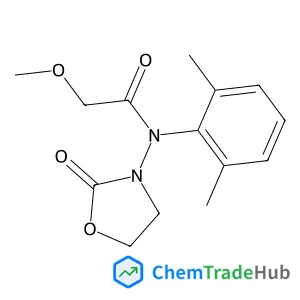
N-(2,6-Dimethylphenyl)-2-methoxy-N-(2-oxo-1,3-oxazolidin-3-yl)acetamide
CAS Number:
77732-09-3
Molecular Formula:
C14H18N2O4
Xinyue Jing
Ab initio calculations have been performed to investigate the competition and conversion between the pnicogen bonds and hydrogen bonds in complexes containing prototype organophosphorus compounds RPO2 (R = CH3 and CH3O). The competition between the pnicogen bonds and hydrogen bonds is controlled by the magnitude of Vs,min and Vs,max in the prototype organophosphorus compounds. Monomeric methyl metaphosphate (CH3OPO2), with more positive π-holes, is more likely to form pnicogen bonds with different electron donors, such as NH3, H2O, HNC and HCCH. Methoxyphosphinidene oxide (trans- and cis-CH3OPO) is inclined to form hydrogen bonds with H2O, HNC and HCCH. Most of the pnicogen bonds have covalent or partially covalent character, while most of the hydrogen bonds exhibit the noncovalent characteristics of weak interactions. The mechanisms of three typical conversions between the pnicogen bond and the hydrogen bond have been investigated and the breakage and formation of the bonds along the reaction pathways have been analyzed using topological analysis of electron density. For the three studied conversion processes, the transformation between the hydrogen-bonded complex and pnicogen-bonded complex is achieved readily through several T-shape structure transition states.
Su Chen, Chunhui Hu, Li Chen, Nanping Xu
DOI: 10.1039/B700994A
Dong-Je Hong, Eunji Lee, Myongsoo Lee
DOI: 10.1039/B617404C
Andreas Hennig, Garima Ghale, Werner M. Nau
DOI: 10.1039/B618703J
Fernando Pina, A. Jorge Parola, César A. T. Laia, Carlos A. M. Afonso
DOI: 10.1039/B618169D
Oliver Kaufhold, Andreas Stasch, Peter G. Edwards, F. Ekkehardt Hahn
DOI: 10.1039/B617033A
A. Chesnaud, C. Bogicevic, F. Karolak, C. Estournès, G. Dezanneau
DOI: 10.1039/B615524C
Sarah J. Dunstone, Joanna H. Clark, Michael A. Hayward
DOI: 10.1039/B703877A
Sébastien Gauthier, Euro Solari, Barnali Dutta, Rosario Scopelliti, Kay Severin
DOI: 10.1039/B618712A
When handling 2-Chloro-1,2-bis(4-methylphenyl)ethanone (CAS: 71193-32-3), it is ...
4-Ethoxy-3-(5-methyl-4-oxo-7-propyl-1,4-dihydroimidazo[5,1-f][1,2,4]triazin-2-yl...
Methyl 3-Oxo-4-Androsten-17-Carboxylate (CAS: 2681-55-2) should be stored in a c...
(R)-3-Amino-4-(3-hexylphenylamino)-4-oxobutylphosphonic acid is primarily used i...
2-Methyl-2-propanyl 3-amino-3-carbamoyl-1-azetidinecarboxylate (CAS: 1254120-14-...
There are alternative reagents that can be used in synthesis instead of (E)-4-(t...
[2-(3-Chlorophenyl)-1,3-thiazol-4-yl]methanol (CAS: 121202-20-8) is a crystallin...
The market and research trends for Methyl (2S)-[(4S)-2,2-dimethyl-1,3-dioxolan-4...
The market for 1-Bromo-2-isocyanatoethane (CAS: 42865-19-0) is driven by its use...
4-Nitro-D-phenylalanine hydrochloride (CAS: 147065-06-3) is primarily used in re...

Physical Chemistry Chemical Physics (PCCP) is an international journal co-owned by 19 physical chemistry and physics societies from around the world. This journal publishes original, cutting-edge research in physical chemistry, chemical physics and biophysical chemistry. To be suitable for publication in PCCP, articles must include significant innovation and/or insight into physical chemistry; this is the most important criterion that reviewers and Editors will judge against when evaluating submissions. The journal has a broad scope and welcomes contributions spanning experiment, theory, computation and data science. Topical coverage includes spectroscopy, dynamics, kinetics, statistical mechanics, thermodynamics, electrochemistry, catalysis, surface science, quantum mechanics, quantum computing and machine learning. Interdisciplinary research areas such as polymers and soft matter, materials, nanoscience, energy, surfaces/interfaces, and biophysical chemistry are welcomed if they demonstrate significant innovation and/or insight into physical chemistry. Joined experimental/theoretical studies are particularly appreciated when complementary and based on up-to-date approaches.