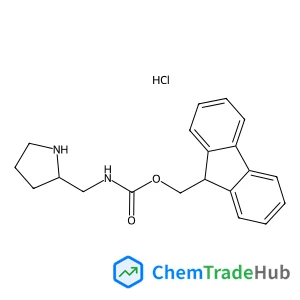
(S)-(9H-Fluoren-9-yl)methyl (pyrrolidin-2-ylmethyl)carbamate hydrochloride
CAS Number:
1217813-15-4
Molecular Formula:
C20H23ClN2O2
Katerina Bogomolov, Ekaterina Grishina
Nickel–zinc (Ni–Zn) batteries are rechargeable (secondary) aqueous batteries with high theoretical power density and a considerably low cost in addition to being safe and rather sustainable. Currently, the cycle life of these batteries is still insufficient to keep up with other common industrially available battery chemistries. This insufficiency is a result of dendrite formation, parasitic hydrogen evolution, corrosion, passivation, and dynamic character of morphology evolution. The application of electrolyte additives is a simple and cost-effective method to address these challenges and promote alternative beneficial layer-like morphologies. This work reports on the positive effects of additive combination, inspired by embracing and optimizing additives, originating from copper (Cu) electroplating in the very large system integrated (VLSI) microelectronic field. Here, we report on the vast impact of bis(sodium-sulfo-propyl) disulfide (SPS) and other sulfur-based derivatives, such as sodium 3-(dimethylcarbamothioylsulfanyl) propane-1-sulfonate (DPS) and 3-S-isothiuronium propyl sulfonate (UPS) on Zn deposition and growth morphology and hydrogen evolution and corrosion processes. Integrating the optimized additive-modified electrolyte into a full-cell assembly reveals that the unique combination of additives can reduce protrusion growth with a minimal polarization loss, resulting in an extended cycle life of the advanced Ni–Zn battery of up to 2000 cycles in a deep discharge regime.
Chiara Liliana Boldrini, Andrea Francesca Quivelli, Filippo Maria Perna, Paolo Biagini, Vito Capriati, Alessandro Abbotto, Norberto Manfredi
DOI: 10.1039/D3SE00949A
Yang Zhang, Wenxing Jiang, Zhenying Chen, Yingying Liu, Chengwei Deng, Xiaodong Zhuang, Junliang Zhang, Changchun Ke
DOI: 10.1039/D3SE01401K
Bratislav P. Marinković, Jaime Rosado, Francisco Blanco, Gustavo García, Jelena B. Maljković
DOI: 10.1039/D3CP05052A
Zhichao Liu, Tianle Zhou, Gui Jin, Jiangbin Su, Bin Tang
DOI: 10.1039/D3CP05095E
Japheth Joseph Yeow Wan Foong, Herlina Arianita Dewi, Ayan A. Zhumekenov, Benny Febriansyah, Annalisa Bruno, Teddy Salim, Hesham R. Abuzeid, Teck Ming Koh
DOI: 10.1039/D3SE01369C
Shouqiang Wu, An Yong Li
DOI: 10.1039/D3CP05101C
Margarita Bužančić Milosavljević
DOI: 10.1039/D3CP05291E
Kumar Ayush, Pooja Sahu, Sk. Musharaf Ali, Tarak K. Patra
DOI: 10.1039/D3CP05136F
Waste containing N-Methoxy-N-methyl-1,3-thiazole-5-carboxamide (CAS: 898825-89-3...
N-(4-Biphenylyl)dibenzo[b,d]furan-4-amine should be stored in a tightly sealed c...
The market for 3-Acetamido-5-amino-2,4,6-triiodobenzoic acid (CAS: 1713-07-1) is...
Benzyl 2-O-acetyl-3,4,6-tri-O-benzyl-beta-D-galactopyranoside (CAS: 61820-03-9) ...
2-Ethylpiperazine dihydrochloride (CAS: 438050-52-3) is regulated under the Glob...
1,1'-[1,3-Phenylenebis(methylene)]bis(3-methyl-1H-pyrrole-2,5-dione) (CAS: 11946...
Several alternatives can be used in the synthesis of 5-Fluoro-2-(1-pyrrolidinyl)...
Proper personal protective equipment (PPE) must be worn when handling this compo...
When handling 6-Bromoimidazo[1,2-a]pyridin-8-amine, it is important to wear appr...
Alternatives to (2S,4R)-4-(4-Nitrobenzyl)pyrrolidine-2-carboxylic acid hydrochlo...

Journal of Materials Chemistry A, B & C cover high quality studies across all fields of materials chemistry. The journals focus on those theoretical or experimental studies that report new understanding, applications, properties and synthesis of materials. The journals have a strong history of publishing quality reports of interest to interdisciplinary communities and providing an efficient and rigorous service through peer review and publication. The journals are led by an international team of Editors-in-Chief and Associate Editors who are all active researchers in their fields. Journal of Materials Chemistry A, B & C are separated by the intended application of the material studied. Broadly, applications in energy and sustainability are of interest to Journal of Materials Chemistry A, applications in biology and medicine are of interest to Journal of Materials Chemistry B, and applications in optical, magnetic and electronic devices are of interest to Journal of Materials Chemistry C. More than one Journal of Materials Chemistry journal may be suitable for certain fields and researchers are encouraged to submit their paper to the journal that they feel best fits for their particular article. Example topic areas within the scope of Journal of Materials Chemistry A are listed below. This list is neither exhaustive nor exclusive. Artificial photosynthesis Batteries Carbon dioxide conversion Catalysis Fuel cells Gas capture/separation/storage Green/sustainable materials Hydrogen generation Hydrogen storage Photocatalysis Photovoltaics Self-cleaning materials Self-healing materials Sensors Supercapacitors Thermoelectrics Water splitting Water treatment

![4-Chloro-2-{[(2-chlorophenoxy)acetyl]amino}benzoic acid structure](https://static.chemtradehub.com/structs/351/351424-20-9-9467.webp "4-Chloro-2-{[(2-chlorophenoxy)acetyl]amino}benzoic acid structure")