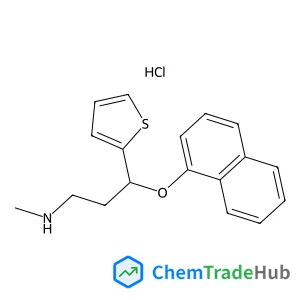
N-Methyl-3-(1-naphthyloxy)-3-(2-thienyl)-1-propanamine hydrochloride (1:1)
CAS Number:
1188266-11-6
Molecular Formula:
C18H20ClNOS
Danillo Valverde, Adalberto Vasconcelos Sanches de Araújo, Sylvio Canuto, Leticia González, Antonio Carlos Borin
The population and depopulation mechanisms leading to the lowest-lying triplet states of 2-Se-Thymine were studied at the MS-CASPT2/cc-pVDZ level of theory. Several critical points on different potential energy hypersurfaces were optimized, including minima, conical intersections, and singlet–triplet crossings. The accessibility of all relevant regions on the potential energy hypersurfaces was investigated by means of minimum energy paths and linear interpolation in internal coordinates techniques. Our analysis indicates that, after the population of the bright S2 state in the Franck–Condon region, the first photochemical event is a barrierless evolution towards one of its two minima. After that, three viable photophysical deactivation paths can take place. In one of them, the population in the S2 state is transferred to the T2 state via intersystem crossing and subsequently to the T1 state by internal conversion. Alternatively, the S1 state could be accessed by internal conversion through two distinct conical intersections with S2 state followed by singlet–triplet crossing with the T2 state. The absence of a second minimum on the T1 state and a small energy barrier on pathway along the potential energy surface towards the ground state from the lowest triplet state are attributed as potential reasons to explain why the lifetime of the triplet state of 2-Se-Thymine might be reduced in comparison with its thio-analogue.
Zhen Liu, Frank Endres
DOI: 10.1039/C5CP01472G
Nancy Faßheber, Nathalie Lamoureux, Gernot Friedrichs
DOI: 10.1039/C5CP01414J
Mihai Lomora, Fabian Itel, Ionel Adrian Dinu, Cornelia G. Palivan
DOI: 10.1039/C4CP05879H
Mohammad R. Momeni, Lisa Shulman, Eric Rivard, Alex Brown
DOI: 10.1039/C5CP01993A
Jascindra Ravi, Angelo Bella, Ana J. V. Correia, Baptiste Lamarre, Maxim G. Ryadnov
DOI: 10.1039/C5CP01185J
Anup Ghosh, Chayan K. De, Tanmay Chatterjee, Prasun K. Mandal
DOI: 10.1039/C5CP02036K
J. Tomko, J. J. Naddeo, R. Jimenez, Y. Tan, M. Steiner, J. M. Fitz-Gerald, D. M. Bubb, S. M. O'Malley
DOI: 10.1039/C5CP01965F
Yoshio Ono, Toshihide Baba
DOI: 10.1039/C5CP01839K
Yan Qian, Shaohua Lu, Erjun Kan, Ruifeng Lu, Kaiming Deng, Hui Wang, Yanming Ma
DOI: 10.1039/C5CP01601K
Waste containing 6-Chloro-5-(2'-hydroxy-3'-methoxy-4-biphenylyl)-3-(3-methoxyphe...
(3alpha,5alpha)-3-Hydroxypregnane-11,20-dione is primarily used in the pharmaceu...
The market for 4-Amino-6-chloro-2-pyridinecarboxylic acid (CAS: 546141-56-4) is ...
Alternatives to (2-Benzoylethyl)trimethylammonium chloride (CAS: 24472-88-6) in ...
N-[4-Nitro-3-(trifluoromethyl)phenyl]acetamide (CAS: 393-12-4) is generally safe...
Alternative reagents such as other phosphates or similar functional groups can b...
There are alternatives to N,N'-Bis(3-aminopropyl)-1,3-propanediamine (CAS: 4605-...
When handling Aluminium trihexadecanoate, it is important to use appropriate per...
(1,1-Dioxido-3-oxo-1,2-benzothiazol-2(3H)-yl)acetic acid is a chemical compound ...
Several alternatives to 5,5-dimethyloxolan-2-one (CAS: 3123-97-5) can be used in...

Physical Chemistry Chemical Physics (PCCP) is an international journal co-owned by 19 physical chemistry and physics societies from around the world. This journal publishes original, cutting-edge research in physical chemistry, chemical physics and biophysical chemistry. To be suitable for publication in PCCP, articles must include significant innovation and/or insight into physical chemistry; this is the most important criterion that reviewers and Editors will judge against when evaluating submissions. The journal has a broad scope and welcomes contributions spanning experiment, theory, computation and data science. Topical coverage includes spectroscopy, dynamics, kinetics, statistical mechanics, thermodynamics, electrochemistry, catalysis, surface science, quantum mechanics, quantum computing and machine learning. Interdisciplinary research areas such as polymers and soft matter, materials, nanoscience, energy, surfaces/interfaces, and biophysical chemistry are welcomed if they demonstrate significant innovation and/or insight into physical chemistry. Joined experimental/theoretical studies are particularly appreciated when complementary and based on up-to-date approaches.

![5'-Fluoro-[2,3'-biindolinylidene]-2',3-dione structure](https://static.chemtradehub.com/structs/251/251903-00-1-9cb1.webp "5'-Fluoro-[2,3'-biindolinylidene]-2',3-dione structure")