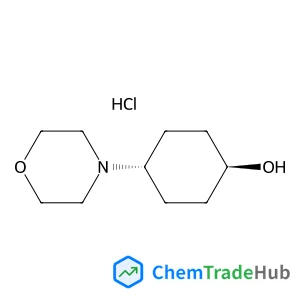
trans-4-(4-Morpholinyl)cyclohexanol hydrochloride (1:1)
CAS Number:
1588441-09-1
Molecular Formula:
C10H20ClNO2
Xin Zhang, Xiaowei Feng, Leon Lee Zhou, Bin Liu, Zhengbo Chen, Xia Zuo
Peroxides in edible oils, whose amounts are measured using the peroxide value, are closely related to human health. Long-term consumption of edible oils with high peroxide values can lead to a variety of human diseases, which highlights the significance of examining oil types and their corresponding peroxide values. For identifying a wide range of edible oils, we established a colorimetric sensor array based on the halogen ion exchange between CsPbBr3 and two iodides (octadecylammonium iodide (ODAI) and ZnI2). Different kinds of edible oils contain distinct peroxidic substances that have the distinct ability to oxidize iodides. After specific types of edible oils react with excess iodides (ODAI and ZnI2), different amounts of residual iodides are left for further halogen exchange with CsPbBr3, resulting in various colorimetric responses, measured in RGB (red/green/blue) values, under fluorescent light. Based on RGB pattern analysis as fingerprints using two anion exchangers (ODAI and ZnI2), our proposed colorimetric sensor array was proved by linear discriminant analysis (LDA) to have an ability to accurately distinguish edible oils at a minimal volumetric concentration of 6.67% in seven real samples.
Zheng Deng, Haojie Yu, Li Wang, Jiyang Liu, Kenneth J. Shea
DOI: 10.1039/C9TA03403J
Liu Deng, Ling Liu, Chengzhou Zhu, Dan Li, Shaojun Dong
DOI: 10.1039/C3CC38776C
Minghui Bi, Guanghua Li, Jia Hua, Xiaomin Liu, Yawei Hu, Zhan Shi, Shouhua Feng
DOI: 10.1039/B709852A
Keiichi Katoh, Brian K. Breedlove, Masahiro Yamashita
DOI: 10.1039/C5SC04669F
Mingchao Wang, Renhao Dong, Xinliang Feng
DOI: 10.1039/D2CS90005J
Keying Xu, Jing Li, Qingyi Han, Dingding Zhang, Libing Zhang, Zhen Zhang, Xiaoquan Lu
DOI: 10.1039/D1AN02289J
Madeleine Peschke, Clara Brieke
DOI: 10.1039/C7CC09409D
Rachid Amine, Xuanxuan Bi, Yan Qin, Matthew Li, Said Al-Hallaj, Fengwei Huo, Jun Lu, Khalil Amine
DOI: 10.1039/C9TA03763B
Xin Zhang, Xiaowei Feng, Leon Lee Zhou, Bin Liu, Zhengbo Chen, Xia Zuo
DOI: 10.1039/D1AN02109E
Ethyl 4-chlorothieno[2,3-b]pyridine-5-carboxylate (CAS: 59713-58-5) can be synth...
5-Methyl-1H-indole-3-carbaldehyde (CAS: 52562-50-2) is subject to various regula...
(1,3-Dimethyl-2,4-dioxo-1,2,3,4-tetrahydro-5-pyrimidinyl)boronic acid is a white...
Waste containing Sulfocostunolide A (CAS: 1016983-51-9) should be handled with c...
When handling Murraxocin (CAS: 88478-44-8), ensure proper personal protective eq...
Formvar (CAS: 63148-64-1) is an alkyd resin characterized by a high molecular we...
(S)-4-benzyl-2-((benzyloxy)methyl)morpholine is generally safe when handled with...
Methyl 1-(5-bromo-2-pyrimidinyl)cyclopropanecarboxylate (CAS: 1447607-69-3) is p...
2-Methyl-1-phenyl-1-propanamine hydrochloride (CAS: 24290-47-9) is generally con...
3-(4-Bromophenyl)-2-methylpropanoic acid is synthesized through a multi-step pro...

Analyst publishes analytical and bioanalytical research that reports premier fundamental discoveries and inventions, and the applications of those discoveries, unconfined by traditional discipline barriers.
![4-{1-[4-(4,4,5,5-Tetramethyl-1,3,2-dioxaborolan-2-yl)phenyl]cyclopropyl}morpholine structure](https://static.chemtradehub.com/structs/120/1206594-08-2-7afb.webp "4-{1-[4-(4,4,5,5-Tetramethyl-1,3,2-dioxaborolan-2-yl)phenyl]cyclopropyl}morpholine structure")