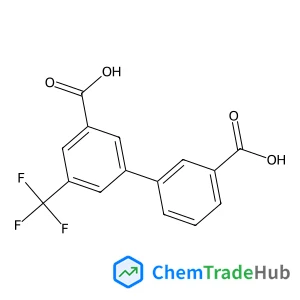
3-(3-Carboxyphenyl)-5-(trifluoromethyl)benzoic acid
CAS Number:
1261930-96-4
Molecular Formula:
C15H9F3O4
Shi Li, Cheng Zhang, Jie Pan, Anthony B. Murphy
Currently, about 90% of methane (CH4) is used in various combustion processes, releasing carbon dioxide into the atmosphere. In order to optimize the use of fossil-fuel energy and reduce greenhouse gas emissions, finding effective ways to convert CH4 into fuels and chemicals has become a research focus in academic circles and industry. Activating the strong C(sp3)–H bond (434 kJ mol−1) in CH4 under mild conditions is one of the most rigorous challenges. The use of a plasma for dissociating CH4 to CH3 free radicals has advantages over conventional pyrolysis approaches. This work aims to increase the CH3 production rate at low temperature by use of a nanosecond repetitively pulsed dielectric barrier discharge plasma with optimization of several parameters, including pulse rise time, pulse width and pulse repetition frequency. The maximum CH4 conversion reaches 31.9% when the pulse repetition frequency is increased to 9 kHz, while the dominant C2 hydrocarbon is always C2H6 (from CH3 coupling reaction). A chemical kinetic model confirms that H and CH3 are the critical radicals produced from electron-impact CH4 dissociation, with their peak densities of the order of 1015 cm−3 and 1014 cm−3, respectively. The results indicate that the improved plasma technology can continuously produce abundant H and CH3 radicals, which would enhance the surface reactions on the catalyst in the plasma-catalytic CH4 conversion process.

Current Opinion in Solid State & Materials Science

Journal of Saudi Chemical Society

Crystallography Reports

Russian Journal of Organic Chemistry

Journal of Peptide Science

Organic Process Research & Development

Russian Journal of Bioorganic Chemistry

Russian Journal of Coordination Chemistry

Journal of Natural Medicines

Russian Journal of General Chemistry
Peter Carlqvist
DOI: 10.1039/B613434C
Xiao-Bin Jiang, Piet W. N. M. van Leeuwen, Joost N. H. Reek
DOI: 10.1039/B700156H
Barbara A. Breeze, Muralidharan Shanmugam, Floriana Tuna, Richard E. P. Winpenny
DOI: 10.1039/B711650K
Mark A. Fox, Carlo Nervi, Antonella Crivello, Paul J. Low
DOI: 10.1039/B700110J
Travis L. Benanti, Pranorm Saejueng, D. Venkataraman
DOI: 10.1039/B610565C
Ruth Pritchard, Colin A. Kilner, Malcolm A. Halcrow
DOI: 10.1039/B613402E
Wayne A. Chomitz, John Arnold
DOI: 10.1039/B709763H
Yoshiaki Kitamura, Satoko Sako, Takahiro Udzu, Azusa Tsutsui, Tomohiro Maegawa, Yasunari Monguchi, Hironao Sajiki
DOI: 10.1039/B712207A
Zin Seok Yoon, Su Bum Noh, Dong-Gyu Cho, Jonathan L. Sessler, Dongho Kim
DOI: 10.1039/B618674B
4-Amino-3-bromophenol (CAS: 74440-80-5) falls under the classification of a haza...
(17beta)-3-Oxoestr-4-en-17-yl acetate should be stored in a cool, dry place away...
2-[(2,2-Diethoxyethyl)disulfanyl]-1,1-diethoxyethane (CAS: 76505-71-0) is a colo...
The market and research for 1-(β-D-ribofuranosyl)-1H-imidazo[4,5-c]pyridin-4-ami...
Waste containing Conjugated Estrogen (CAS: 12126-59-9) should be collected and d...
The market for Bis(2,2,2-trifluoroethyl) (methoxycarbonylmethyl)phosphonate (CAS...
There are several alternatives to 3,4'-Di-O-methylellagic acid (CAS: 57499-59-9)...
2-Chloro-N,N-dimethylpyridin-4-amine (CAS: 59047-70-0) is regulated under the Gl...
Cerium(3+);oxygen(2-);vanadium(5+) (CAS: 13597-19-8) is a complex inorganic comp...
7-Chloro-1-iodoisoquinoline (CAS: 1203579-27-4) is generally considered safe whe...