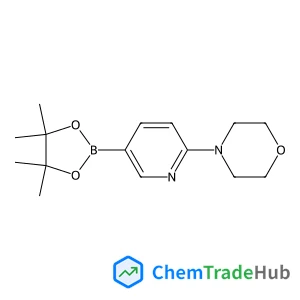
4-(5-(4,4,5,5-tetramethyl-1,3,2-dioxaborolan-2-yl)pyridin-2-yl)morpholine
CAS Number:
485799-04-0
Molecular Formula:
C15H23BN2O3
Xiaoyu Bai, Bowei Yang, Hansen Chen, Jiangang Shen, Dan Yang
In order to understand the production and functions of HOCl in biological systems, a sensitive and selective detection method is urgently needed, especially for HOCl visualization in living cells and tissues. Herein we report a highly sensitive and selective rhodol-based fluorescent probe HKOCl-4 for HOCl detection. HKOCl-4r and HKOCl-4m, which were designed for better cellular uptake and mitochondria-targeting, respectively, have been successfully applied in detecting endogenous HOCl in macrophages. Furthermore, HOCl production in ischemic rat brain tissues has been visualized with HKOCl-4r in a middle cerebral artery occlusion (MCAO) model. These probes would serve as powerful imaging tools for delving into the roles of HOCl in health and disease.

Topics in Catalysis

Polycyclic Aromatic Compounds

Critical Reviews in Solid State and Materials Sciences

Bioorganic & Medicinal Chemistry

Journal of the Indian Institute of Science

Acta Metallurgica Sinica-English Letters

Atomization and Sprays

Colloid Journal

Herald of the Russian Academy of Sciences

Main Group Chemistry
Chunxue Liu, Susu Zhang, Wei Jiang
DOI: 10.1039/C9AN00589G
Lili Chen, Xiangguang Li, Tongda Zou, Tiantian Wang, Xiping Cui, Yingshan Chen, Chunguo Zhang, Suqing Zhao
DOI: 10.1039/C9AN00193J
Yuqing Hou, Wen Zhang, Shengtao Li, Zhen Wang, Huiqing Zhong, Zhiming Liu, Zhouyi Guo
DOI: 10.1039/C8AN00405F
Juliana Coatrini Soares, Valquiria da Cruz Rodrigues, Iram Taj Awan, Matias Eliseo Melendez, Maria Helena Oliveira Piazzetta, Angelo Luiz Gobbi, José Humberto T. G. Fregnani, André Lopes Carvalho, Osvaldo N. Oliveira, Jr
DOI: 10.1039/C8AN00430G
Ramshad Kalluruttimmal, Divya Thekke Thattariyil, Archana Panthalattu Parambil, Ashis Kumar Sen, Lakshmi Chakkumkumarath, Muraleedharan Kannoth Manheri
DOI: 10.1039/C9AN00522F
Elisabetta Giorgini, Simona Sabbatini, Romina Rocchetti, Valentina Notarstefano, Corrado Rubini, Carla Conti, Giulia Orilisi, Elisa Mitri, Diana E. Bedolla, Lisa Vaccari
DOI: 10.1039/C8AN00602D
Niall J. Finnerty, Fiachra B. Bolger
DOI: 10.1039/C8AN00631H
Qing Hong, Limin Yang, Lei Ge, Zhenhui Liu, Feng Li
DOI: 10.1039/C8AN00888D
(1R,3S)-1,3-Cyclopentanediol finds applications in various industries. In the ph...
When handling N'-[4-(Dimethylamino)phenyl]-N,N-dimethyl-1,4-benzenediamine, it i...
There are several alternatives to 5-(2,4-Difluorophenyl)-2-methoxypyrimidine in ...
1-(3-Methoxyphenoxy)propan-2-ol (CAS: 382141-68-6) must comply with the Globally...
Tetrodotoxin Citrate is extremely dangerous and should be handled with extreme c...
2-Methyl-2-propanyl [(1R,3S)-3-hydroxycyclopentyl]carbamate (CAS: 225641-84-9) i...
Waste containing 4-(2-Hydroxyhexafluoroisopropyl)Benzoic Acid (CAS: 16261-80-6) ...
2-Methyl-2-proanyl {(2S)-1-[(benzyloxy)amino]-3-hydroxy-3-methyl-1-oxo-2-butanyl...
Benzeneethanamine, α-ethyl-, hydrochloride (1:1) is an organic compound with the...
In the synthesis of compounds similar to 3-{(E)-[4-(Dimethylamino)phenyl]diazeny...

Organic Chemistry Frontiers publishes high-quality research from across organic chemistry. Emphases are placed on studies that make significant contributions to the field of organic chemistry by reporting either new or significantly improved protocols or methodologies. Topics include, but are not limited to the following: Organic synthesis Development of synthetic methodologies Catalysis Natural products Functional organic materials Supramolecular and macromolecular chemistry Physical and computational organic chemistry